
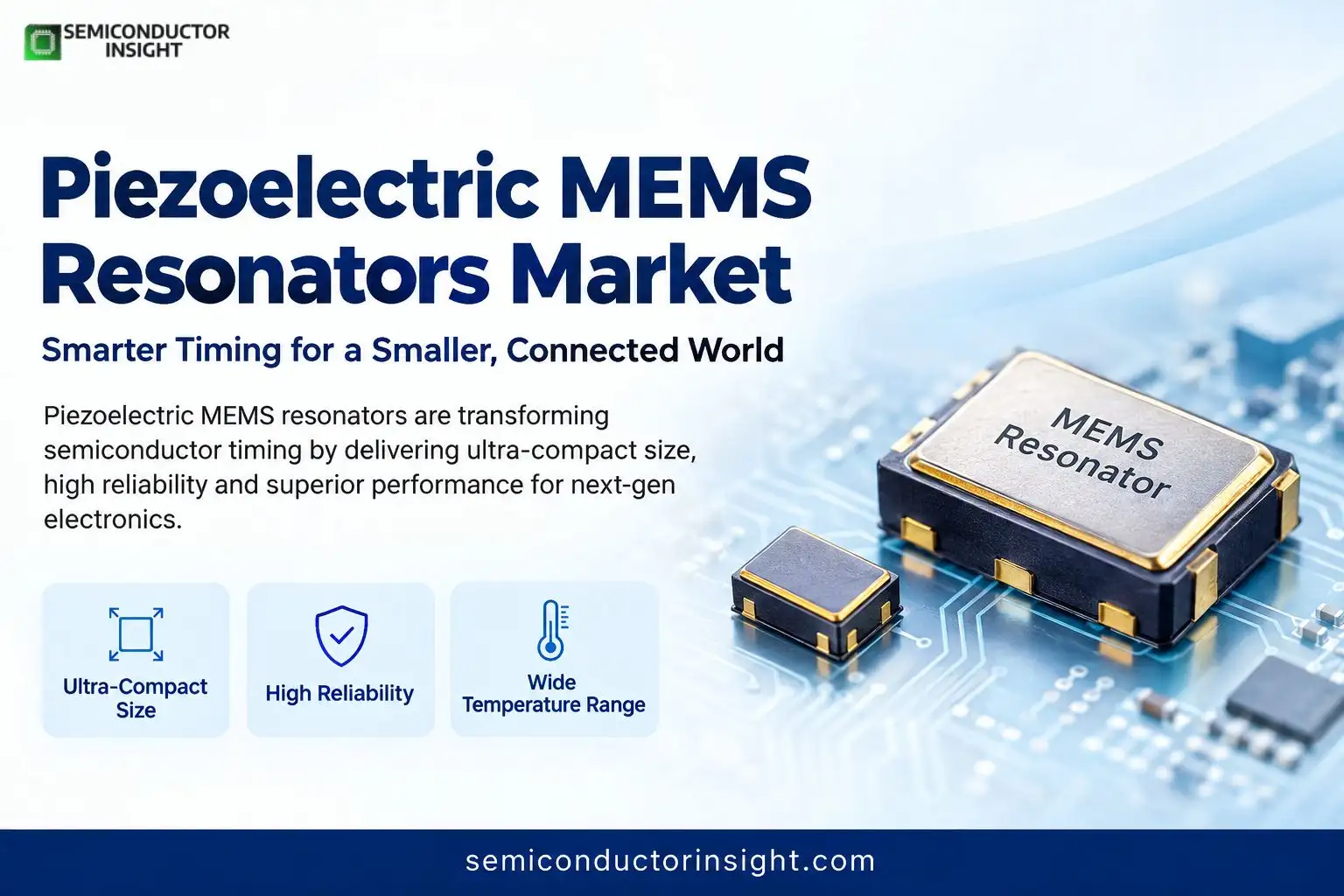
How Are Piezoelectric MEMS Resonators Changing Precision Timing in 2026? A Semiconductor Design Breakdown
The timing component is one of the smallest parts on a semiconductor board, yet a frequency error measured in parts per million can affect wireless communication, sensor synchronization, power management and data transfer.
That is why piezoelectric MEMS resonators are attracting renewed attention. Instead of relying solely on conventional quartz, manufacturers are using silicon microstructures and piezoelectric films to create miniature frequency references that can be integrated into increasingly space-constrained electronics.
The Resonator Is Moving Closer to the Silicon
MEMS resonators work through mechanical resonance at microscopic scale. In piezoelectric designs, an electrical signal excites mechanical motion and the resulting resonance becomes the frequency reference. Kyocera explains that its silicon MEMS development combines silicon structures with aluminum-nitride thin-film technology, allowing the resonator to achieve an electrical equivalent circuit comparable with quartz while addressing silicon’s inherent non-piezoelectric nature.
This is important for semiconductor designers because the component is no longer simply a passive timing accessory. It can become part of a much smaller timing architecture surrounding an MCU, SoC, wireless chipset or sensor.
A New Size Equation Is Emerging
Ø SiTime’s current Titan MEMS resonators illustrate how aggressively packaging is changing. Its 32 MHz SiT11100 and 76.8 MHz SiT11101 use a 0.46 × 0.46 mm 0505 chip-scale package.
Ø The company states that the package occupies 7× less PCB area than a 1210 quartz resonator for the 32 MHz device, while the 76.8 MHz version uses 4× less area than a 1008 quartz component.
Ø Quartz reference → Silicon MEMS structure → Piezoelectric actuation → Wafer-level packaging → Chip-scale timing
Ø That progression matters in wearables, implantable electronics, wireless modules and edge devices where every fraction of a square millimeter can influence the board architecture.
Frequency Is Expanding Beyond Conventional Clock Choices
The opportunity is not limited to one frequency range. SiTime’s latest Titan family includes 32, 38.4, 40, 48 and 76.8 MHz variants, targeting BLE, Bluetooth, UWB, Wi-Fi and MCU applications.
At the other end of the spectrum, its SiT1533 family operates at 32.768 kHz, with a maximum supply current of only 1.4 µA and operating temperatures extending from -40°C to +85°C.
This creates two very different application paths: ultra-low-power timing for battery-operated electronics and higher-frequency references for connected semiconductor systems.
What Are the Price Differences Between SiTime, Kyocera and Microchip Low-Power MEMS Resonators for Precision Timing Applications?
Public distributor pricing provides a useful snapshot, although these products are not exact like-for-like parts, and Kyocera does not publicly publish a comparable current MEMS-resonator unit price in the sources reviewed.
A SiTime SiT1533 32.768 kHz MEMS oscillator is listed by DigiKey India at approximately ₹153.76 for one unit, falling to about ₹95.52 at 2,500 units for one listed configuration. Microchip’s DSC1001 family, meanwhile, is listed by DigiKey at approximately ₹59.24 at 1 unit and ₹55.71 at 1,000 units for a 64 MHz configuration.
Microchip’s own historical announcement for its DSC6000 MEMS oscillators cited starting pricing of $0.81 in 10,000-unit quantities, demonstrating how high-volume pricing can differ substantially from distributor single-unit pricing.
For Kyocera, the comparison needs more caution: the company confirms silicon MEMS resonator development and sample deliveries, but a public comparable unit-price schedule was not identified. Its FY2026 reporting still lists silicon MEMS resonators and oscillators among products being developed for increasingly compact and reliable communications equipment.
– Pricing takeaway: SiTime’s publicly listed low-power parts currently sit around the ₹100-₹180/unit range in the cited distributor examples, while Microchip examples can fall below ₹60/unit at distributor quantities for particular configurations. Kyocera pricing is quotation-based in the public information reviewed, so assigning an unsupported figure would be misleading.
Curious about the report? Dive into our newest updated version at no cost: https://semiconductorinsight.com/report/piezoelectric-mems-resonators-market/
Why Shock and Temperature Are Becoming Design Variables?
Timing components increasingly have to survive conditions that older clock architectures were not optimized for. SiTime reports MEMS timing products capable of operating through temperatures up to 125°C and cites shock resistance as high as 50,000 g for certain MEMS oscillators.
Its Titan family specifies operation from -40°C to +125°C, while the company reports up to 50× better shock and vibration performance than quartz for the platform.
For automotive sensors, industrial controllers and portable electronics, that resilience can be as important as frequency accuracy itself.
The 2026 Design Question Is No Longer Quartz or MEMS Alone
The more relevant question is increasingly which timing architecture fits the system. Kyocera has been developing silicon MEMS resonators through its Finnish technology operation, while Microchip continues expanding ultra-low-power MEMS oscillator families and SiTime is pushing resonators toward chip-scale packaging.
The result is a timing landscape where power consumption, frequency, package footprint, temperature behavior, shock tolerance and production economics are evaluated together. For semiconductor designers building smaller wireless, automotive, medical and IoT systems, piezoelectric MEMS resonators are therefore becoming less of a quartz replacement experiment and more of a serious architectural option.

Comments (0)