

How Airlines Are Accelerating Decarbonization through Sustainable Aviation Fuel Market?
The aviation sector contributes nearly 2.5% of global CO₂ emissions, but its share is rising as air travel demand rebounds strongly. In 2024, global passenger traffic crossed 4.5 billion travellers, nearing pre-pandemic highs. With limited alternatives to liquid fuels for long-haul flights, the industry is rapidly turning toward Sustainable Aviation Fuel as a practical decarbonization pathway.
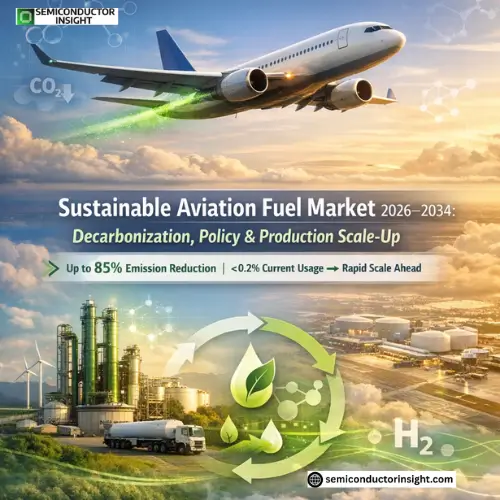
Depending on the feedstock and production process, SAF can lower lifecycle emissions by as much as 70%-85%, in contrast to traditional jet fuel. Given that a single long-haul aircraft can generate more than 150-200 tonnes of CO2, this reduction is noteworthy. The urgency to cut these emissions is pushing airlines, governments, and fuel producers into accelerated adoption cycles.
A Brief Look at Our Detailed Analysis Related Report:
https://semiconductorinsight.com/report/aircraft-ignition-system-market/
Production Scale Is Expanding But Still Below Demand
- Despite rising interest, SAF production volumes remain a fraction of total aviation fuel demand. In 2023, global SAF production reached approximately 600 million liters, compared to over 300 billion liters of total jet fuel consumption. This means SAF accounted for less than 0.2% of global aviation fuel usage.
- However, scaling efforts are intensifying. By 2025, announced projects aim to push production beyond 2 billion liters annually, with long-term targets exceeding 30 billion liters by 2030. Countries like the United States are targeting 11 billion liters of SAF production per year by 2030 under clean energy initiatives.
- Feedstock diversity is also improving. Used cooking oil, agricultural waste, municipal solid waste, and even algae are being explored. For instance, waste-based SAF pathways currently contribute nearly 60% of total SAF output, highlighting the industry’s focus on circular economy models.
Airline Commitments Are Turning Into Real Fuel Contracts
Major airlines are no longer just pledging sustainability they are signing large-scale SAF procurement agreements. In past years, global airline SAF commitments exceeded 20 billion liters in forward purchase agreements, reflecting strong future demand visibility.
For example, leading carriers have integrated SAF into daily operations at major hubs, blending it at ratios of 10%-50% with conventional jet fuel. Some pilot programs have even demonstrated 100% SAF-powered flights, proving technical feasibility without engine modifications.
Airports are also adapting infrastructure. Over 40 major international airports now have SAF blending and supply systems in place, enabling smoother integration into existing fuel logistics.
Government Mandates Are Accelerating Adoption Rates
- Policy frameworks are playing a decisive role in shaping Sustainable Aviation Fuel Market. The European Union has introduced mandates requiring 2% SAF blending by 2025, increasing to 6% by 2030 and targeting 70% by 2050.
- Similarly, the United States has implemented tax credits offering up to $1.75 per gallon for SAF producers, directly improving cost competitiveness. These incentives are crucial because SAF currently costs 2 to 4 times more than conventional jet fuel.
- Asia-Pacific is also emerging as a key region, with countries like Japan and Singapore aiming for 10% SAF usage by 2030. Such mandates are creating predictable demand, encouraging long-term investments in production capacity.
Technology Innovation Is Redefining Fuel Pathways
The SAF ecosystem is witnessing rapid technological evolution. While Hydroprocessed Esters and Fatty Acids (HEFA) dominate current production, accounting for nearly 80% of SAF output, newer technologies are gaining traction.
Power-to-liquid (PtL) fuels, produced using renewable electricity and captured CO₂, are emerging as a scalable long-term solution. These synthetic fuels have the potential to achieve near-zero lifecycle emissions, especially when powered by solar or wind energy.
Additionally, Alcohol-to-Jet (ATJ) pathways are expanding, converting ethanol into aviation fuel. With global ethanol production exceeding 110 billion liters annually, this pathway offers significant scaling potential.
Supply Chain Transformation Is Becoming Critical
Scaling SAF is not just about production it requires a complete supply chain transformation. Feedstock collection, refining, blending, and distribution all need optimization.
Currently, feedstock availability limits production scalability. For instance, global used cooking oil supply is estimated at 25-30 million tonnes annually, which can only support a fraction of aviation demand. This constraint is pushing innovation toward non-traditional feedstocks like forestry residues and carbon capture.
Logistics is another challenge. SAF must be integrated into existing airport fuel systems without disrupting operations. This has led to investments in dedicated pipelines, storage tanks, and blending facilities across key aviation hubs.
Corporate Travel Demand Is Influencing Market Growth
Corporate sustainability goals are indirectly boosting SAF demand. Large multinational companies are entering agreements with airlines to offset travel emissions using SAF.
In 2024 alone, over 300 corporations globally participated in SAF programs, contributing to emission reductions of approximately 1 million tonnes of CO₂. This trend is transforming SAF from a niche fuel into a strategic sustainability tool for businesses.
Such collaborations are also helping airlines justify higher SAF costs, as corporate clients are willing to pay a premium for lower-carbon travel solutions.
The Market Is Transitioning From Niche to Necessity. See How?
What started as an experimental alternative is now becoming a central pillar of aviation strategy. With air travel projected to grow by 3%-4% annually, emissions pressure will only intensify.
Sustainable Aviation Fuel Market is evolving from limited pilot projects to a structured, policy-driven, and investment-backed ecosystem. As production scales, costs decline, and infrastructure matures, SAF is expected to play a defining role in reshaping the aviation industry’s environmental footprint.
The transition is complex, but the direction is clear aviation’s future is increasingly tied to cleaner, scalable, and commercially viable fuel alternatives.

Comments (0)