
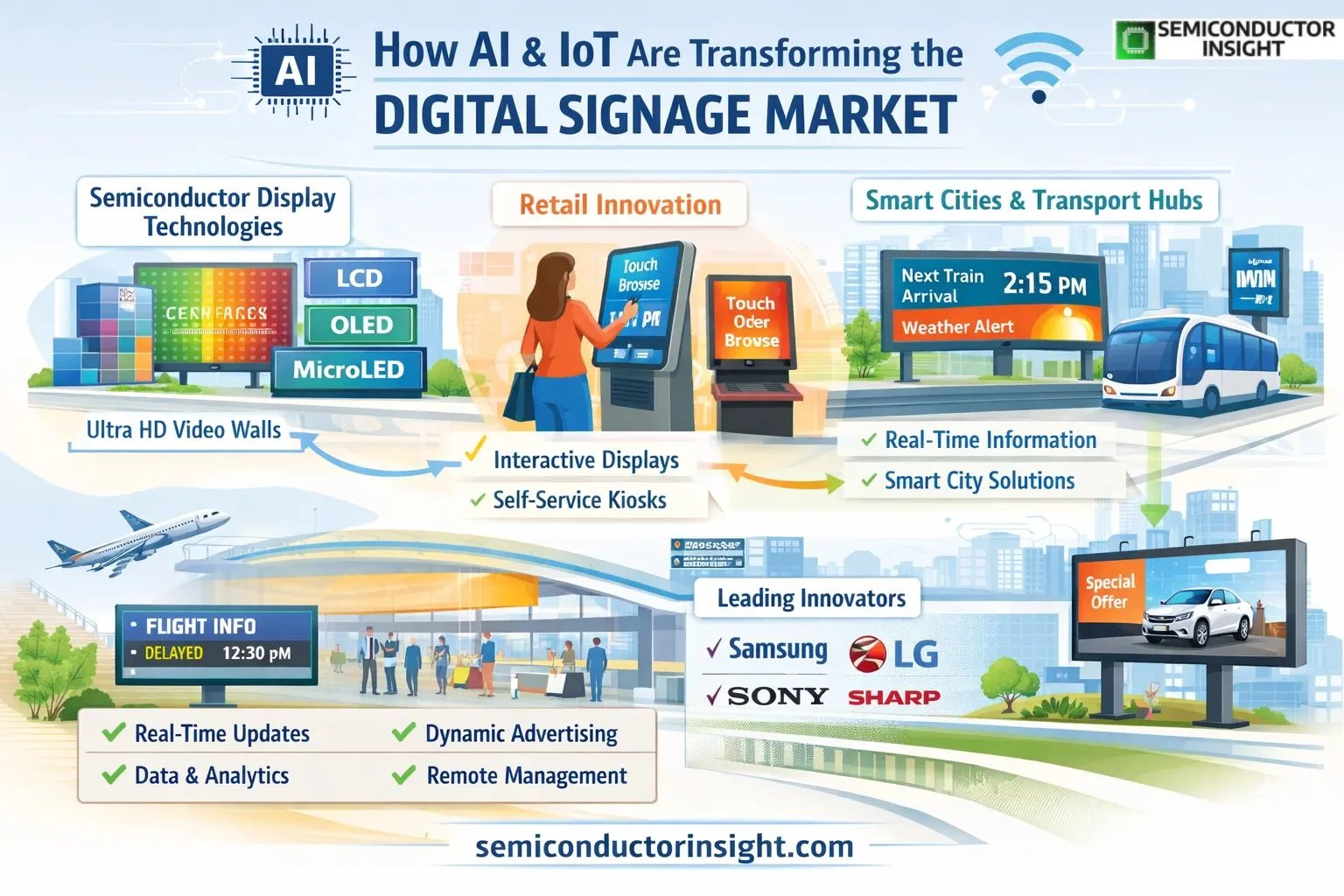
How AI and IoT Are Transforming Digital Signage Market?
The way organizations communicate with customers and the public has changed dramatically in recent years. Static posters and printed boards are gradually being replaced by dynamic display systems capable of delivering real-time information and targeted content. These systems form the foundation of Digital Signage Market, which integrates semiconductor display technology, connectivity platforms, and content management software.
Digital signage screens are now commonly installed in retail stores, airports, railway stations, corporate offices, hospitals, and educational institutions. The growth of urban infrastructure and smart city projects has significantly expanded the use of these display systems. In public transportation hubs alone, thousands of screens are installed to guide passengers, provide service updates, and display advertisements.
For example, many international airports operate large digital display networks consisting of more than 2,000 connected screens that deliver flight updates, safety instructions, and commercial promotions simultaneously.
Please Take a Look at Our Updated Report before Continuing: https://semiconductorinsight.com/report/digital-signage-market/
Semiconductor Display Technologies Powering Modern Screens
At the core of digital signage systems are semiconductor-driven display panels such as LCD, OLED, and MicroLED technologies. These displays rely on complex driver integrated circuits and semiconductor backplanes that control brightness, color accuracy, and refresh rates.
Large LED video walls used in stadiums and shopping centres contain thousands of small semiconductor-controlled pixels. Some high-resolution video walls contain more than 8 million individual pixels, allowing them to display ultra-high-definition visual content.
Recent developments in MicroLED displays are also reshaping the digital signage ecosystem. These displays use microscopic light-emitting diodes that provide higher brightness levels and longer lifespans compared with traditional display technologies. In certain commercial installations, microLED displays can operate for more than 100,000 hours before brightness degradation becomes noticeable.
These technological improvements are allowing digital signage systems to operate continuously in demanding environments such as outdoor transportation hubs and stadiums.
Retail Transformation through Interactive Displays
-
Retail businesses have become one of the most active adopters of digital signage technology. Interactive screens installed inside stores allow customers to explore products, view promotional videos, and access personalized offers.
-
Recent retail surveys indicate that nearly 70% of shoppers notice digital displays inside stores and approximately 40% report that these screens influence purchasing decisions. As a result, retailers are increasingly integrating signage with data analytics and inventory systems.
-
A well-known example is the use of interactive displays in flagship fashion stores where customers can browse product catalogs, check available sizes, and even request assistance from staff through touch-enabled kiosks.
-
Fast-food restaurants are also deploying self-service ordering kiosks powered by touchscreen display systems, enabling customers to customize orders while reducing waiting time at counters.
Smart Cities and Public Information Networks
Urban infrastructure development is another major factor expanding the use of digital signage. Smart city programs often include intelligent display networks that provide real-time public information.
City governments in several countries have deployed digital information boards that display traffic updates, weather alerts, and emergency notifications. In some metropolitan transit networks, more than 10,000 digital screens are used across metro stations and bus terminals to keep commuters informed.
Outdoor signage systems also rely on high-brightness displays capable of operating under direct sunlight. Advanced LED signage panels can reach brightness levels exceeding 5,000 nits, ensuring visibility even in outdoor environments.
These networks play a critical role in public communication, helping authorities quickly share important information during large events or emergency situations.
Major Technology Companies Driving Innovation
-
Samsung Electronics has introduced large-scale modular LED display walls used in airports, stadiums, and luxury retail stores. Their display systems are capable of creating screens measuring over 100 inches without visible bezels.
-
LG Electronics has developed transparent OLED signage panels that can be installed on glass surfaces in shopping malls and museums, allowing digital content to appear while maintaining visibility behind the screen.
-
Sony has introduced crystal LED display systems that use millions of microLED modules to deliver extremely high contrast ratios and cinema-level image quality.
-
Another major player is Sharp Corporation, which provides professional large-format displays widely used in corporate conference rooms and control centers.
-
These companies are continuously improving display efficiency, resolution, and energy consumption through advanced semiconductor engineering.
Practical Advantages of Modern Display Networks
Digital signage offers multiple operational benefits compared with traditional printed advertising and static boards.
-
Real-time content updates across thousands of screens
-
Dynamic advertising campaigns that change throughout the day
-
Integration with sensors and data analytics platforms
-
Higher engagement compared with static visual communication
-
Reduced printing and distribution requirements
Further, as connectivity technologies continue to evolve, digital signage systems are becoming part of broader smart infrastructure networks. Cloud-based management platforms now allow operators to control thousands of screens remotely, updating content instantly across multiple locations.
In the future, integration with AI-powered analytics could enable displays to adapt content based on audience demographics, traffic patterns, and real-time environmental conditions.
These developments illustrate how intelligent visual communication platforms are becoming an essential component of modern infrastructure, supporting the continued expansion of Digital Signage Market across industries.

Comments (0)