

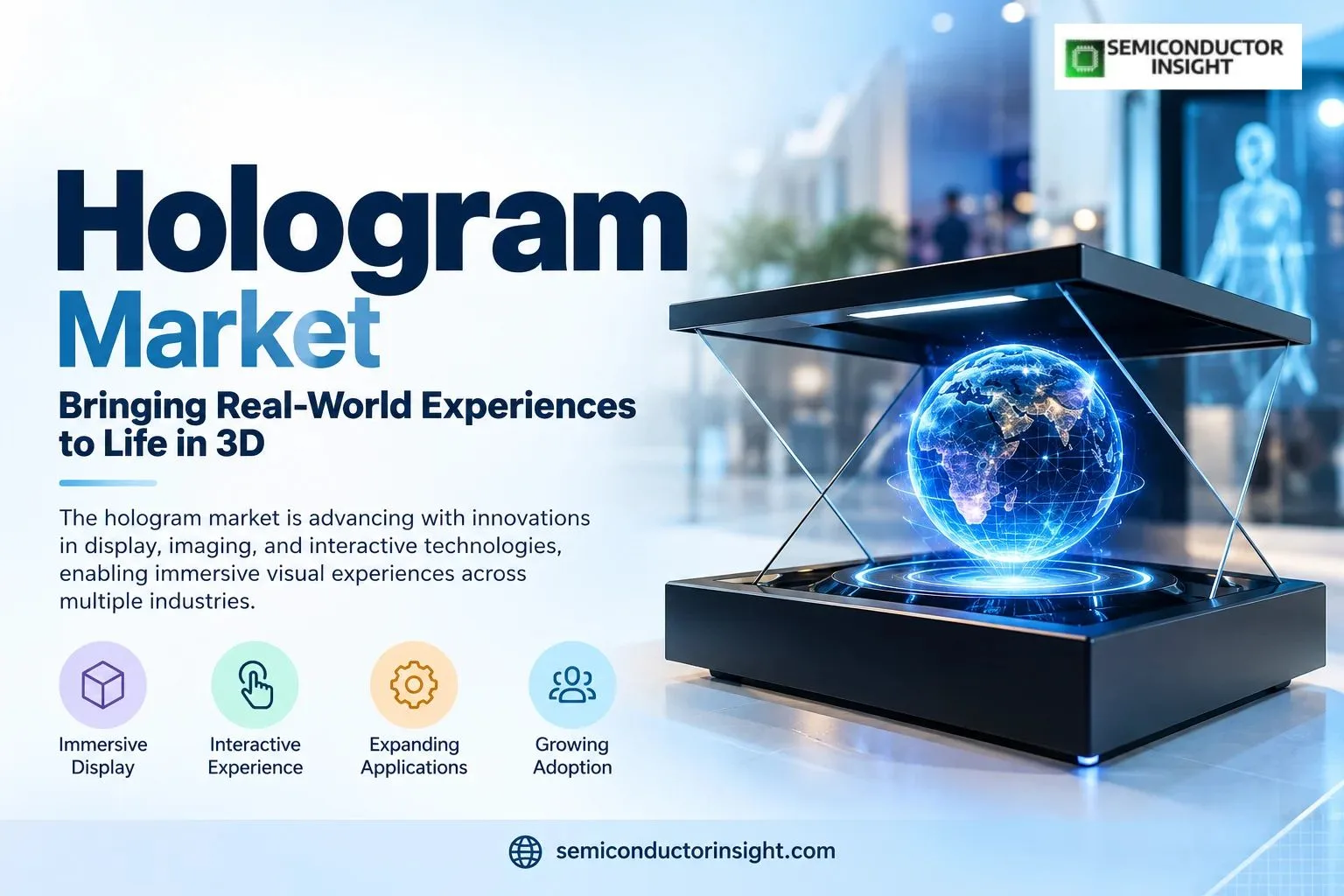
Hologram Market Updates on the Road to Automotive Holographic Display Manufacturing by 2029
Holographic technology is moving beyond visual demonstrations into practical applications involving automotive displays, industrial visualisation and advanced optical systems. Unlike conventional screens, holographic displays can manipulate light to create depth, direct images into specific viewing areas or present information through transparent surfaces.
The hologram market therefore encompasses several distinct technologies, including holographic optical elements (HOEs), computer-generated holography and holographic windshield displays. Each has different manufacturing requirements and commercial applications.
October 2026 Brings a New Development in Automotive Holography
- On October 8, 2026, ZEISS announced its acquisition of Ceres Holographics, a Scotland-based company specialising in holographic technology.
- The transaction is intended to accelerate the industrialisation of holography for automotive, aerospace and consumer applications. The companies did not disclose the purchase price.
- The announcement matters because automotive holography requires more than a convincing optical demonstration.
- Manufacturers must reproduce precise optical structures consistently, integrate them with glass and projection systems, and maintain performance under demanding operating conditions.
- Combining holographic design expertise with manufacturing capabilities could help address these requirements.
Why the Windshield Is Becoming a New Display Surface?
Traditional head-up displays project driving information into a driver’s field of view using optical systems and a windshield or dedicated combiner. Holographic windshield displays take a different approach by incorporating holographic optical elements into the glass assembly, allowing selected information to appear on a transparent surface.
- In January 2025, Hyundai Mobis demonstrated its holographic windshield display in a Kia EV9 at CES. The concept places information such as navigation and driving data near the lower portion of the windshield without requiring a conventional dashboard-mounted display for that content. Hyundai Mobis initially targeted commercialisation from 2027.
The subsequent supply-chain developments have made the industrialisation pathway more concrete.
Four Companies Are Building the Supply Chain for Holographic Glass
In February 2026, Hyundai Mobis, ZEISS, tesa and Saint-Gobain Sekurit formed the QuadAlliance to accelerate holographic windshield display production. Their responsibilities span system integration, holographic optics, film technologies and automotive glass. The alliance identified 2029 as its target for mass production.
This structure illustrates how the hologram market differs from a conventional display business. Commercial deployment depends on several specialised suppliers working together. Optical mastering must align with film replication, windshield lamination, projection hardware and vehicle interface systems.
For component manufacturers, the opportunity extends beyond selling a finished holographic display. It includes supplying optical films, precision replication equipment, specialised coatings and integrated projection components.
Take a Quick Glance at Our In-Depth Analysis Report: https://semiconductorinsight.com/report/hologram-market/
What Engineers Must Solve Before Holograms Reach More Vehicles
- Automotive applications impose requirements that are less important in controlled exhibition environments.
- Displays must remain legible under changing daylight, avoid distracting the driver and accommodate different viewing positions.
- Windshield curvature, temperature changes, vibration and long-term material stability also influence system performance.
- Manufacturers must further establish how much information can be displayed without obscuring the real-world view.
- Navigation arrows, lane guidance and hazard indicators may be useful, but excessive visual content could undermine the safety benefits.
- These considerations make optical efficiency, manufacturing repeatability and human-machine interface design central to commercial adoption.
Does Tesla Use Silicon Carbide?
Silicon carbide (SiC) is relevant to the semiconductor industry, but it serves a different purpose from holographic optics. SiC power semiconductors are used in power-conversion systems, including electric-vehicle inverters, where they can improve efficiency under suitable operating conditions.
Tesla has used SiC power electronics in its vehicle drive units. During its March 2023 Investor Day, the company also discussed redesigning its next-generation drive unit to use 75% less silicon carbide without compromising vehicle performance or efficiency. This was a reduction target for its next-generation design, not a statement that Tesla would eliminate SiC entirely.
The distinction is important for semiconductor readers. Silicon carbide supports electrical power conversion, whereas holographic optical elements control light. They belong to different technology categories, even though both contribute to advanced automotive systems.
From Prototype Displays to Repeatable Industrial Production
The hologram market’s commercial progress will depend on whether manufacturers can move from impressive demonstrations to components that meet automotive cost, reliability and volume requirements. The 2026 ZEISS acquisition and QuadAlliance initiative provide concrete examples of the industry building that capability.
For semiconductor and optical component suppliers, holographic displays create potential demand for precision optical structures, projection components, specialised films and integrated electronics. The next milestone is not simply a more realistic hologram. It is a system that can be manufactured consistently, integrated safely and justified by its practical value to vehicle manufacturers.

Comments (0)