

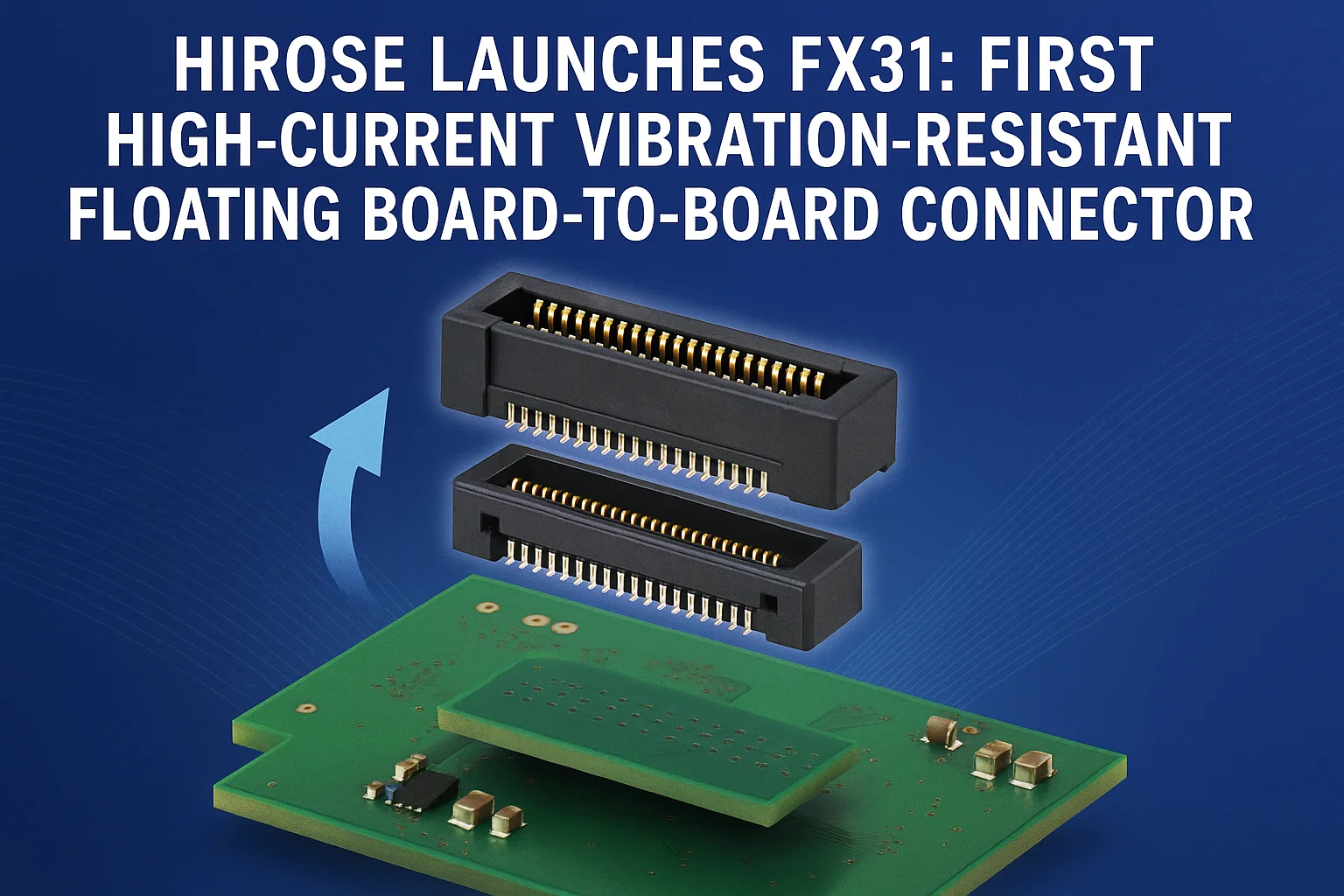
Hirose Launches FX31: First High-Current Vibration-Resistant Floating Board-to-Board Connector
Board-to-board connectors are ordinary looking components that quietly solve some of the hardest design problems in modern consumer electronics: squeezing power and data through ever-thinner stacks, surviving shock and vibration inside pocketable devices, and preserving signal integrity as data rates climb into the tens of gigabits per second. Over the past 18 months the industry has accelerated on several fronts miniaturization, higher current density, tolerance compensation (floating/self-align features), and the race to meet next-generation high-speed interface requirements.
Access Your Free Sample Report- Consumer Electronics Board to Board Connector Market
Why Board-To-Board Connectors Matter Now
Consumer electronics are simultaneously getting thinner, more feature-dense, and more power-hungry. Manufacturers need compact ways to:
- Move higher currents between stacked PCBs (battery to power management; power distribution for compact form factors)
- Maintain reliable mechanical and electrical connections despite assembly tolerances and user handling
- Preserve signal integrity for high-speed serial links (USB, PCIe-internal, camera interfaces, display interfaces)
- Reduce BOM complexity by combining power and signal in fewer mechanical interfaces
In short: when every millimeter and every milliwatt counts, a clever connector can be the difference between a viable product and a prototype that never ships.
Recent Product and Technology Highlights
Hirose FX31: high current + vibration resistance
Hirose’s FX31 family represents a clear industry push to merge high current capability with tolerance compensation. Historically, connectors that carried tens of amps were large and heavy; FX31 shows that clever mechanical design (floating structures, compliant contacts) can move significant current while compensating for misalignment in stacked assemblies. For consumer devices, the immediate benefits are twofold: more compact power distribution paths and improved reliability in portable devices where shock and drop concerns are real.
Why this is significant: It enables OEMs to rethink internal power routing replacing bulk bus-bars or large cables with compact, mated board-to-board solutions that also handle vibration and misalignment. That reduces assembly complexity and often lowers weight.
JAE WP11 / WP12: Tiny form, higher current
The JAE WP11/WP12 launches target ultra-compact electronics (think flagship phones, wearables, AR glasses) with 0.4 mm pitch and stacking heights under a millimeter, but with current capability markedly higher than previous small-pitch connectors. Increased retention forces and improved mechanical robustness mean these components survive manufacturing stresses and everyday use.
Why this is significant: As manufacturers cram more power-hungry sensors and processors into thin packages, being able to carry 10–15 A in compact stacks without sacrificing durability is a game changer.
High-speed & high-density entrants: Nicomatic, Adam Tech, and others
High-density connectors capable of 12.5–28 Gb/s (or more) are now common in specialized board-to-board families. These designs emphasize controlled impedance, ground-plane management, and minimal insertion loss all essential for high-speed serial lanes in consumer devices (e.g., camera interfaces, internal PCIe lanes for modules, or high-res display links).
Why this is significant: Consumer devices are not immune to the data throughput demands of AI-enabled imaging, video codecs, and low-latency streaming. High-speed board-to-board connectors let designers place modular high-bandwidth subsystems (camera stacks, coprocessor modules) while keeping manufacturability intact.
Floating / tolerance-compensating designs (Phoenix Contact, Hirose styles)
Floating connectors reduce the need for super-tight mechanical tolerances across stacked boards and assemblies. They help during automated assembly and in-field stresses (thermal cycling, flexing, shock).
Why this is significant: Yield in consumer electronics is king. A connector that absorbs misalignment reduces rework and destructive testing, lowering manufacturing cost and improving device reliability.
Supply chain and distribution innovations (Molex mini-reel program, distributor cooperation)
Manufacturers and distributors are adapting by offering smaller reel sizes and faster fulfillment models. For fast-moving consumer markets where design iterations are rapid and volumes can scale quickly, flexible distribution helps shorten design cycles and prototype iteration timelines.
Why this is significant: Smaller initial order quantities reduce risk for startups and smaller OEMs; quicker turnaround speeds time-to-market for device updates and seasonal products. For larger OEMs, it enables more agile replacement of parts in localized facilities.
Deeper technical context: what’s changing under the hood
1. Miniaturization without sacrificing current
The physics of current density and thermal management places constraints on how small a conductor and contact can be while still carrying useful power. Recent connector designs mitigate this by:
- Using multiple parallel contacts for power to share current load
- Employing advanced contact metallurgy and plating to reduce contact resistance
- Designing larger current paths within the mechanical envelope (stacked copper, embedded power rails)
These approaches allow sub-millimeter stacking heights to pass tens of amps without thermal runaway crucial for battery feeds and high-power modules in phones and wearables.
2. Signal integrity at rising data rates
At 10–28 Gb/s and beyond, even short interconnects behave like transmission lines. Key engineering strategies in modern board-to-board connectors include:
- Controlled impedance pathways and matched traces through the connector
- Integrated ground shielding and differential pair guard traces to limit crosstalk
- Low-loss contact materials and precise mechanical tolerances to control insertion loss
- Use of PAM-4 and other modulation strategies in the system to trade off symbol rate and SNR
For consumer applications such as multi-camera stacks and internal AI accelerators, these strategies make the difference between a reliable link and intermittent errors.
3. Tolerance compensation and mechanical resilience
Floating contacts, dual-axis compliance, and self-aligning features allow connectors to tolerate misalignment in X, Y, and Z. This reduces mechanical stress during mating and unmating and improves long-term reliability in devices exposed to temperature swings and vibration.
4. Hybrid power + signal approaches
Rather than separate connectors for power and data, the industry is moving towards hybrid connectors that carry both. This reduces part count, saves PCB area, and simplifies assembly but makes thermal and signal crosstalk management more challenging. Recent product families are explicitly designed for hybrid operation: segregated power lanes and shielded signal lanes within the same connector body are increasingly common.
Download Sample Report PDF- Consumer Electronics Board to Board Connector Market
Applications in consumer electronics: where these developments land
Smartphones and flagship devices
- Battery to power-management routing: Compact, high-current board-to-board connectors allow battery packs and power distribution units to be stacked in creative ways, enabling thinner chassis without sacrificing run time.
- Camera stacks: Modular camera subsystems often use mezzanine connectors for the image sensor stack, actuator control, and optical stabilizers. High-density, high-speed connectors make multi-sensor arrays practical.
- Foldables and wearables: Mechanical resilience and tolerance compensation reduce stress during folding cycles or on the wrist.
AR/VR and wearables
- In very small and light devices, designers rely on sub-mm stacking and high retention to keep boards aligned under motion. High-current micro connectors also power local haptics and sensors.
Laptops, tablets, and docking modules
- High-bandwidth internal links (internal PCIe, DisplayPort) rely on high-speed board-to-board connectors to enable modular upgrades think swappable expansion modules or compact daughtercards for AI accelerators.
Audio and IoT devices
- Compact connectors allow designers to separate RF, audio, and power domains on different boards improving EMC performance while simplifying assembly.
Market dynamics and projections why the market will more than double to ~US$2.18B by 2032
The market growth to US$2,177 million by 2032 at a 14.3% CAGR is underpinned by several linked forces:
- Rising unit volumes of connected devices: Smartphones, tablets, wearables, AR/VR devices, and a new wave of smart home products continue to expand device counts globally. Each device typically uses multiple board-to-board interfaces.
- Higher component value per device: As connectors take on more complex mechanical and electrical roles (hybrid power+data, tolerance compensation), their per-unit price and engineering value increase.
- Data rate driven upgrades: As internal interfaces migrate to higher data rates to support richer features (multi-camera, on-device AI), connectors must be redesigned and replaced with higher-value, high-speed alternatives.
- Automotive spillover into consumer electronics: Learnings from automotive (robustness, vibration resilience, high current) influence consumer designs especially for e-bike controllers, portable power banks, and ruggedized phones.
- Supply chain sophistication and distribution flexibility: Better access to smaller quantities and local fulfillment reduces barriers for new entrants and faster refresh cycles driving more connector SKUs to market and increasing market size.
- Modular design trends: Device modularity (replaceable camera modules, detachable AI modules) increases connector counts and drives demand for higher-specification board-to-board interconnects.
Headwinds & Challenges
No sector cruises upward without friction. Here are the principal challenges that could temper growth or complicate adoption:
1. Signal integrity limits at extremely high rates
Past ~50–100 Gb/s per lane, copper interconnects become extremely difficult to manage due to loss and crosstalk. While some connectors are designed for 25–28 Gb/s today, pushing into the multi-hundreds of gigabits may require alternative approaches (short optical links, on-package interposers, or advanced materials) that are not plug-and-play.
2. Thermal management of high-current micro connectors
Packing tens of amps into tiny contacts necessitates careful thermal design; without adequate PCB copper and heat dissipation strategies, connectors can become thermal bottlenecks.
3. Cost and complexity
Higher performance connectors mean more complex tooling, tighter manufacturing tolerances, and potentially higher cost. OEMs balancing cost targets for mass consumer price points will need to evaluate where the added performance justifies the price.
4. Component fragmentation
A proliferation of connector types and pitches increases BOM complexity and supply chain management. Standardization across the industry is limited outside some niches, so design teams may face long-term sourcing risks.
5. Replacement and repair difficulty
Very small, tightly stacked connectors can make repairability and serviceability harder, which is an issue for brands with service-center models or regulatory pressures toward repairability.
Strategic Recommendations For OEMs and Suppliers
Based on the recent technical and market developments, here are targeted recommendations.
For OEMs / product designers
- Adopt hybrid connectors selectively: Use hybrid power+signal connectors where board area and assembly complexity benefit most but validate thermal and EMI impacts early in prototyping.
- Design for manufacturability around floating connectors: Exploit tolerance compensation to relax PCB stack tolerances and improve yield; however, ensure assembly jigs and pick-and-place flows account for floating features.
- Plan for signal-integrity headroom: When designing boards that will carry 10–40 Gb/s links internally, allocate budget for higher-grade connectors and model the connector’s S-parameters early in the design cycle.
- Use distributor programs for quicker prototyping: Small-reel programs and local distributor partnerships enable rapid iteration without large minimum order constraints.
- Consider modularity tradeoffs: Decide whether modular subsystems (that rely on connectors) fit product positioning the user value of upgradeability must outweigh BOM and assembly costs.
For connector manufacturers and suppliers
- Invest in modeling and validation tools: Provide customers with accurate S-parameter models, thermal models, and design-for-assembly guidelines to reduce integration friction.
- Standardize pinouts where possible: Collaboration on a few widely adopted mechanical/power/signal pinouts will reduce fragmentation and encourage OEM adoption at scale.
- Broaden small-volume distribution: Programs that supply engineers and small manufacturers with prototype quantities will capture early design wins that scale to production.
- Explore advanced materials and coatings: Work on contact metallurgy that balances conductivity, wear resistance, and low contact resistance for both power and high-speed signal contacts.
- Offer integrated validation services: Testing packages (high-speed channel validation, thermal cycling, and vibration testing) delivered with connector samples increases buyer confidence.
Click Here To Download Full Sample Report- Consumer Electronics Board to Board Connector Market
What to Watch Next
- Connector topologies for chiplet and on-package interconnects: As device architectures adopt chiplets, short-range board-to-board or package-to-package interconnects will become hotter topics.
- Opto-hybrid solutions for ultra-high data rates: Where copper struggles, optical interconnects (even in short, board-to-board links) may find niches especially in AI accelerators and high-end audio/video products.
- Standardization for consumer modules: Expect pressure toward a few “mezzanine” form factors for camera stacks, AI modules, and battery packs that could simplify the connector landscape.
- Stronger distributor/OEM feedback loops: As distributors offer smaller reels and rapid fulfillment, connector manufacturers who listen and pivot to early engineering needs will capture market share.
It’s tempting to view connectors as banal commodities a necessary evil tacked onto a bill of materials. The recent wave of innovation shows the opposite: connectors are fundamental enablers of new form factors, power architectures, and data performance. The 14.3% CAGR projected through 2032 recognizes not just unit growth but rising functional value per connector: more intelligence placed in smaller footprints, higher currents, and higher data rates requiring engineering expertise and premium designs.

Comments (0)