

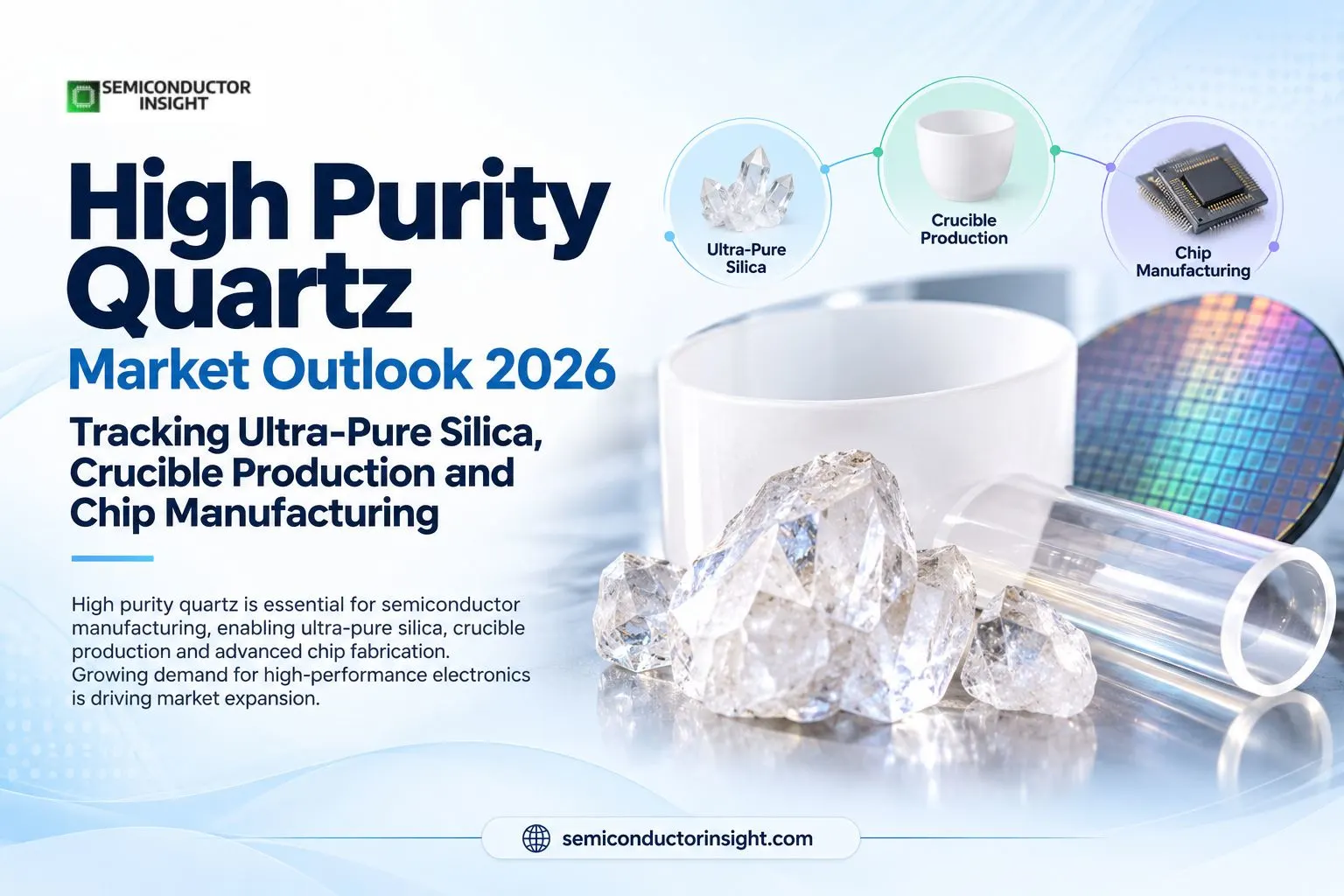
High Purity Quartz Market Outlook 2026 Tracking Ultra-Pure Silica, Crucible Production and Chip Manufacturing
High purity quartz (HPQ) occupies a specialised position in semiconductor manufacturing because the quality of the starting material can influence the reliability of silicon crystal growth. Although quartz is abundant in nature, deposits capable of meeting stringent purity and processing requirements are much less common.
Manufacturers use HPQ to produce fused-quartz crucibles, tubes and other components that withstand demanding temperatures while limiting contamination during semiconductor production.
- The US Geological Survey defines HPQ generally as quartz containing fewer than 100 parts per million of total impurities, equivalent to 99.99% purity. Ultra-high-purity grades can contain 10 parts per million or fewer.
The AI Chip Boom Is Changing the Material Requirements Upstream
The growing need for advanced processors, high-bandwidth memory and data-centre infrastructure is increasing the importance of reliable wafer manufacturing.
- According to SEMI, global silicon wafer shipments reached 12,973 million square inches in 2025, an increase of 5.8% year on year. On 21 October 2026, SEMI projected shipments of 14,420 million square inches for 2026, reflecting continued demand from AI-related computing and memory applications.
These figures do not directly measure HPQ consumption, but they illustrate the scale of the downstream manufacturing activity that depends on silicon wafers. As wafer producers pursue consistent crystal quality and tighter process controls, quartz crucible manufacturers must maintain purity, thermal stability and dependable performance throughout production.
Why a Few Parts per Million Can Change Material Selection?
The distinction between ordinary industrial quartz and semiconductor-grade HPQ is not simply a matter of silica content. Trace elements, inclusions and the behaviour of the material under high-temperature conditions also matter. During the Czochralski process, silicon is melted in a quartz crucible and drawn into a single-crystal ingot. That ingot is subsequently sliced into wafers used to manufacture integrated circuits.
- The OECD’s 2026 report on responsible sand and silicate supply chains explains how widely available geological resources can still produce concentrated downstream supply chains when only certain deposits and processing capabilities meet advanced manufacturing requirements.
- This creates a difference between having quartz resources and being able to supply consistently qualified, high-purity material.
Spruce Pine and the Search for More Resilient Supply Chains
Spruce Pine, North Carolina, remains a strategically important source of high-purity quartz. Sibelco’s IOTA® product range is sourced from two high-purity ore bodies in the area and serves applications including fused-quartz crucibles, semiconductor quartzware and photovoltaic manufacturing. The Quartz Corp also supplies HPQ for crucibles used to grow silicon ingots.
- The USGS 2026 quartz summary reports that two companies produced HPQ in the United States in 2025.
- It also notes that Chinese authorities announced more than 35 million tonnes of HPQ reserves in Henan and Xinjiang in April, with initial reported test grades of 99.995% to 99.998%.
- Those results are notable, although matching the purity of an established deposit does not automatically establish equivalent processing performance or commercially qualified supply.
New Processing Capacity Is Becoming a Strategic Differentiator
Emerging suppliers are attempting to build additional sources of refined quartz. In India, Semicon Global Inc. reports that production of 4N8 and 5N hyper- and ultra-high-purity quartz has commenced, with a targeted initial nameplate capacity of 25,000 tonnes per year. This is a company-reported capacity target, not evidence that the full volume is already being produced or accepted by semiconductor customers.
For new entrants, the critical milestones include repeatable impurity control, processing yield, customer qualification and the ability to deliver consistent batches. These requirements help explain why announcements of mineral reserves or planned capacity should be assessed separately from proven commercial supply.
A Brief Look at Our Detailed Analysis Related Report: https://semiconductorinsight.com/report/semiconductor-packaging-materials-market/
The Next Test for High Purity Quartz Suppliers
The most important competitive distinction is likely to be the ability to supply the correct grade reliably, rather than simply offering the highest headline purity. Semiconductor buyers need material that performs consistently through crucible fabrication, crystal growth and repeated production cycles.
For procurement teams, the key questions concern trace-element specifications, batch traceability, qualification status, production capacity and exposure to concentrated supply sources. For investors and materials suppliers, the opportunity lies in determining which new projects can progress from geological potential to dependable industrial output.
As semiconductor production becomes more demanding, HPQ remains a small but strategically significant link between mineral resources and the world’s advanced computing infrastructure.

Comments (0)