
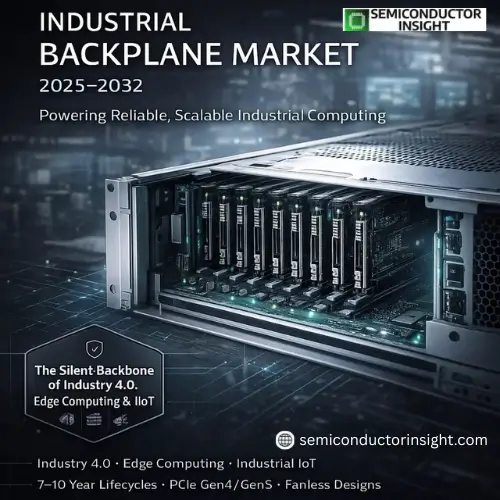
Hidden Architecture Powering Smart Factories: Boosting Industrial Backplane Market Size
Industrial Backplane Market is emerging as a silent enabler of next-generation automation, offering unmatched reliability, scalability, and long-term performance across industrial computing environments.
Before You Dive Deep into This Blog, Just Have a Quick Look at Detailed Report: https://semiconductorinsight.com/report/industrial-backplane-market/
Behind every rugged industrial computer, there is a backbone quietly orchestrating performance and that backbone is the industrial backplane. Unlike consumer-grade motherboards, industrial backplanes are built for endurance, modularity, and long operational lifecycles. As factories, energy plants, and transportation systems embrace digital transformation, demand for stable and expandable computing platforms is accelerating.
What makes this market particularly compelling is its low-visibility yet high-impact role. Industrial backplanes rarely make headlines, but without them, advanced automation, real-time monitoring, and mission-critical control systems simply wouldn’t function.
Why Industrial Backplanes Are Gaining Strategic Importance
Industrial environments demand more than raw processing power. They require reliability under extreme conditions and this is where backplanes outperform conventional designs.
Key value drivers include:
- Long operational lifespan, often exceeding 7-10 years
- Resistance to vibration, dust, heat, and electrical noise
- Modular architecture allowing easy upgrades without full system replacement
At a time when downtime equals lost revenue, industrial operators are prioritizing stability over short-term cost savings, directly benefiting the industrial backplane market.
Market Growth Catalysts You Can’t Ignore
Several structural trends are pushing this market forward, reshaping how industrial computing systems are designed and deployed.
Primary growth drivers:
- Rapid adoption of Industry 4.0 and smart manufacturing
- Increasing use of edge computing for real-time decision-making
- Expansion of industrial IoT (IIoT) networks
- Growing need for legacy system compatibility in factories and plants
At the same time, companies are moving away from single-board computing toward slot-based, scalable systems, where backplanes offer unmatched flexibility.
Technology Evolution: More Than Just Slots and Connectors
Modern industrial backplanes are no longer passive components. While passive backplanes still dominate due to reliability, design innovation is enhancing signal integrity, power efficiency, and data throughput.
Notable technological shifts include:
- Rising adoption of PICMG standards for interoperability
- Support for high-speed interfaces like PCIe Gen4 and Gen5
- Improved thermal design for fanless industrial systems
These advancements are enabling backplanes to support AI workloads, machine vision, and real-time analytics use cases once considered out of reach for industrial PCs.
Application Areas Driving Demand
Industrial backplanes serve a wide range of mission-critical applications, each contributing uniquely to market growth.
Major application segments:
- Factory automation and robotics control
- Power generation and smart grid systems
- Transportation signalling and traffic management
- Oil & gas monitoring and safety systems
- Medical and laboratory automation
In each of these sectors, system failure is not an option making backplanes a preferred foundation for dependable computing.
Regional Market Dynamics
Market expansion varies significantly by region, shaped by industrial maturity and automation investment.
- Asia-Pacific leads in volume, driven by manufacturing expansion and electronics production
- North America focuses on modernization of legacy industrial systems
- Europe emphasizes energy efficiency, sustainability, and industrial safety standards
Emerging economies are also contributing, as governments push infrastructure digitization and smart industrial policies.
Competitive Landscape: Stability over Speed
Unlike fast-moving consumer tech markets, the industrial backplane ecosystem rewards consistency, certification, and long-term support.
Key competitive factors include:
- Product longevity and backward compatibility
- Compliance with industrial safety standards
- Customization capability for niche applications
Manufacturers that offer stable supply chains and extended product support are gaining long-term contracts and customer loyalty.
Booming Growth in Upcoming Years: A Market Built for Endurance
Industrial Backplane Market is not driven by hype it’s driven by necessity. As industrial systems become more intelligent, connected, and data-driven, the need for a reliable hardware backbone will only intensify.
What lies ahead?
- Greater integration with AI-enabled edge systems
- Increased demand for compact and energy-efficient designs
- Strong opportunities in brownfield modernization projects
In a world obsessed with speed, industrial backplanes prove that reliability, flexibility, and longevity still define real technological value.

Comments (0)