
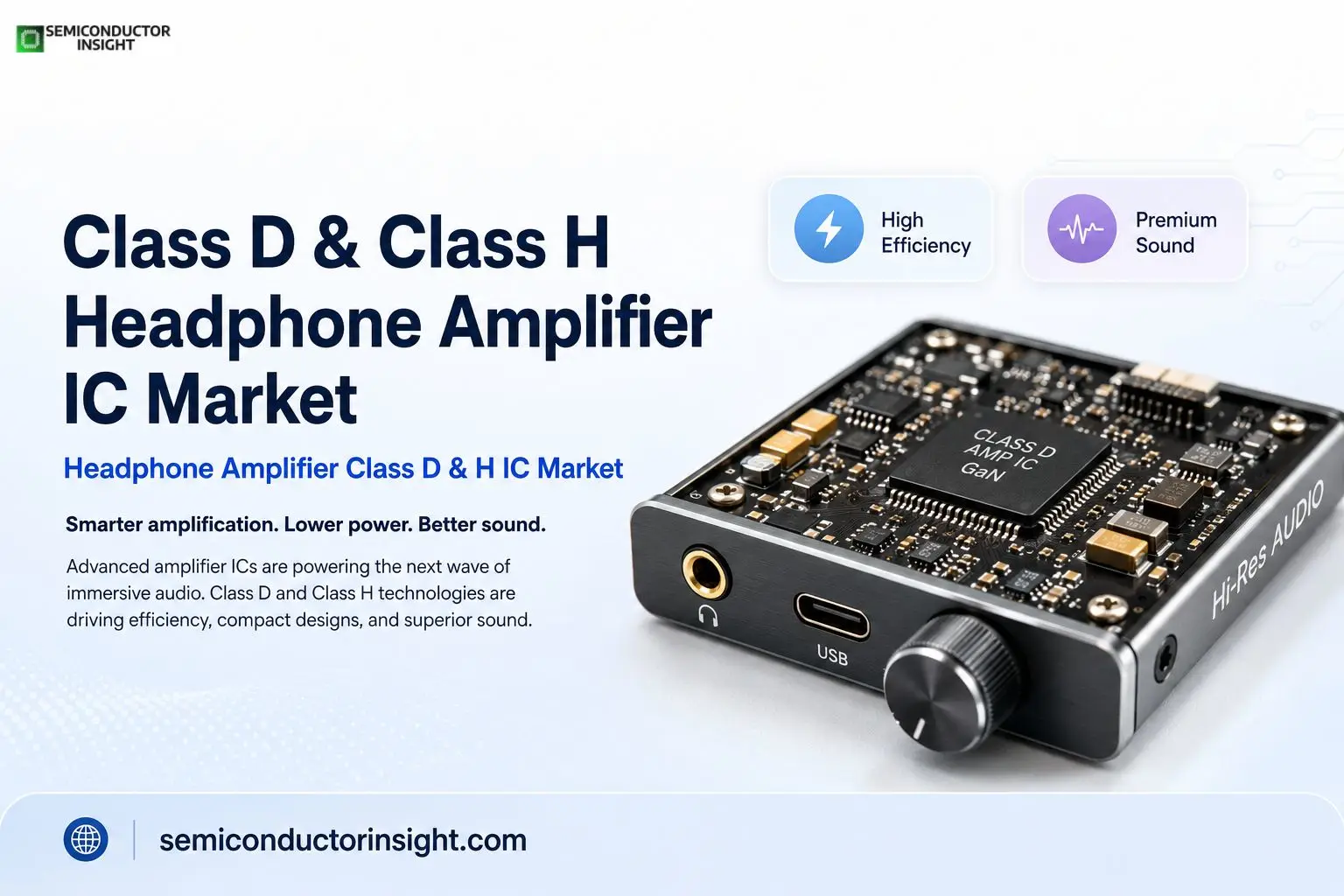
Headphone Amplifier IC Market Is Becoming the Silent Engine behind Premium Audio Devices!
The global appetite for immersive sound is no longer limited to studio headphones and audiophile equipment. Smartphones, gaming consoles, wireless earbuds, automotive infotainment systems, and portable DACs are all pushing semiconductor companies to redesign audio architectures around compact and power-efficient headphone amplifier ICs. Among the most discussed technologies today are Class D and Class H amplifier ICs, which are rapidly changing how modern devices balance sound quality, thermal efficiency, and battery life.
Semiconductor manufacturers are now competing not only on processing power but also on audio intelligence. The rise of high-resolution streaming platforms, spatial audio, and AI-enhanced sound optimization has turned headphone amplifier ICs into a crucial semiconductor segment for consumer electronics innovation.
Compact Electronics Are Reshaping Amplifier Architecture
- Traditional Class AB amplifiers dominated portable audio for years because of their clean analog sound reproduction.
- However, modern consumer devices demand thinner designs, lower heat generation, and longer battery performance. That pressure has accelerated the migration toward Class D and Class H amplifier ICs across smartphones, tablets, gaming accessories, and wireless audio products.
- Class D amplifiers operate through high-speed switching techniques, enabling efficiency levels above 85%.
- This dramatically reduces power loss and thermal output, making them ideal for compact semiconductor packages. Industry analysis from electronics engineering platforms highlights how Class D architectures are now widely integrated into mobile devices, smart speakers, and automotive infotainment systems due to their efficiency advantages.
- Class H amplifier ICs, meanwhile, are gaining attention in portable DACs and premium earbuds because they dynamically adjust voltage rails according to signal requirements.
- This improves battery efficiency without sacrificing audio headroom. Discussions among audio engineering communities increasingly point to Class H designs as a practical solution for ultra-compact high-fidelity devices.
Curious about the report? Dive into our newest updated version at no cost: https://semiconductorinsight.com/report/headphone-amplifier-class-d-h-ic-market/
Smartphone Makers Are Prioritizing Audio Differentiation Again
After years of focusing heavily on cameras and displays, smartphone brands are once again investing in audio differentiation. Flagship devices now integrate stereo speaker systems, spatial audio support, AI-powered sound enhancement, and advanced codec compatibility. These upgrades require sophisticated amplifier ICs capable of delivering strong output within extremely limited PCB space.
Recent industry reports indicate that smart audio amplifier shipments are growing rapidly because premium smartphones now require louder sound with lower distortion and improved thermal management. High-efficiency amplifier ICs also help manufacturers preserve battery life while supporting advanced features like Dolby Atmos and immersive gaming audio.
Companies such as Cirrus Logic, Infineon Technologies, and Texas Instruments are increasingly developing amplifier platforms that combine DSP integration, speaker protection, and low-noise amplification within highly miniaturized semiconductor packages.
GaN Technology Is Opening a New Chapter in Audio IC Innovation
- One of the most significant semiconductor developments influencing amplifier ICs is the adoption of gallium nitride technology. GaN transistors switch faster and more efficiently than traditional silicon components, enabling Class D amplifiers to achieve improved sound fidelity with lower heat generation.
- Engineering publications from semiconductor-focused platforms explain that GaN-powered Class D amplifiers can reduce distortion while supporting lightweight and compact audio designs. This is particularly important for gaming headsets, premium desktop DACs, and automotive entertainment systems where thermal constraints are critical.
- The shift toward GaN also aligns with sustainability goals across the electronics industry. Lower energy consumption and reduced cooling requirements directly support greener semiconductor manufacturing strategies and energy-efficient consumer electronics.
Gaming and Spatial Audio Are Fueling Semiconductor Demand
The gaming ecosystem has become one of the fastest-growing opportunities for headphone amplifier IC manufacturers. Competitive gaming headphones now require low latency, high dynamic range, and accurate positional sound processing. Semiconductor companies are responding with amplifier ICs optimized for immersive audio rendering and AI-based environmental tuning.
Portable DAC-amplifier combinations are also becoming increasingly popular among gamers and music enthusiasts. New product launches from audio brands demonstrate how manufacturers are integrating high-performance amplifier ICs into compact desktop systems with advanced DAC support, Bluetooth connectivity, and low-noise architectures.
The growth of lossless streaming services and high-resolution audio subscriptions is further strengthening demand for premium audio semiconductors capable of handling greater dynamic range and cleaner amplification.
Engineering Challenges Continue to Shape Market Competition
Despite strong momentum, amplifier IC manufacturers still face technical barriers. High-frequency switching in Class D designs can generate electromagnetic interference, requiring sophisticated PCB layouts and advanced filtering techniques. Semiconductor engineers are continuously working to minimize distortion and EMI issues while maintaining compact footprints.
There is also an ongoing debate among audiophiles regarding Class D sound characteristics compared to traditional analog architectures. However, recent discussions across audio communities suggest perceptions are changing as newer amplifier generations deliver significantly improved clarity and lower noise floors.

Comments (0)