
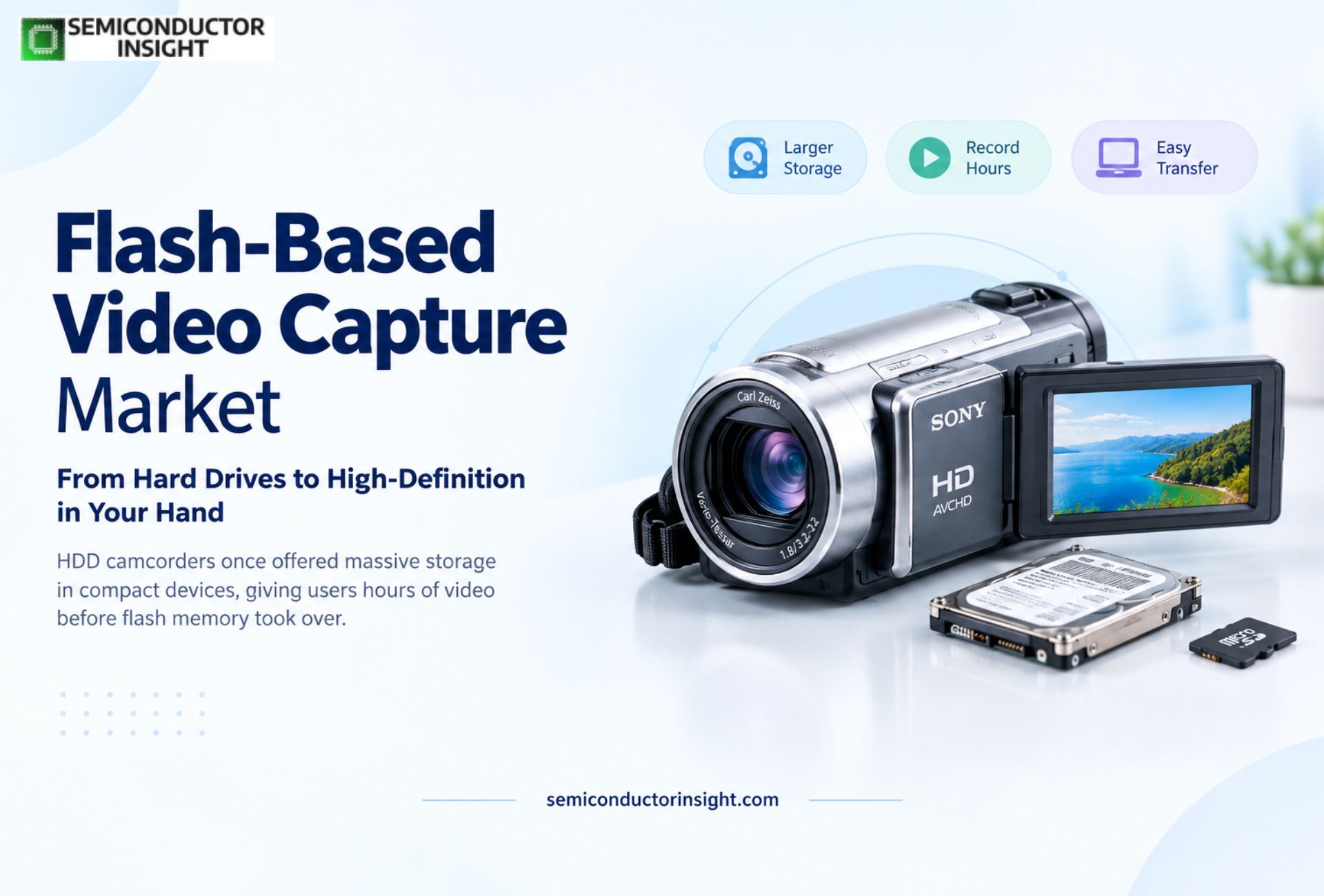
HDD Camcorders Market 2026: From 30GB Recording Drives to Flash-Based Video Capture
Before smartphones and compact solid-state cameras became the default way to record video, manufacturers were experimenting with a surprisingly ambitious idea: putting a miniature hard disk drive inside a handheld camcorder.
- Sony’s DCR-SR42, for example, used a 30GB internal HDD, while the DCR-SR200 carried 40GB of internal storage. Sony subsequently offered models such as the DCR-SR47 and DCR-SR67 with 60GB and 80GB HDD capacities respectively.
That progression captures the central story of HDD camcorders. Manufacturers were trying to eliminate removable recording media while giving consumers enough capacity to record hours of footage.
When a hard drive became part of the camera
- The attraction was straightforward. A hard disk could hold substantially more video than many memory cards available to consumers at the time, while allowing recordings to be transferred directly to a computer.
- JVC’s Everio range illustrates how far the concept developed. The GZ-MG360 featured a 60GB internal HDD capable of storing up to 75 hours of video, alongside a microSD slot. It also offered a 35x optical zoom, 2.7-inch widescreen LCD and USB 2.0 transfer.
- This combination effectively turned the camcorder into a self-contained video archive.
The architecture behind the recording experience
The technology stack was more complicated than simply placing a hard drive inside a camera.
Image sensor → image processor → video compression → HDD controller → 1.8-inch HDD → USB transfer
JVC’s GZ-HD3, for instance, combined a 1.8-inch embedded HDD, 60GB capacity, three CCD sensors and MPEG-2 high-definition recording. Its specification supported 1,440 × 1,080 and 1,920 × 1,080 still-image formats depending on mode.
This made the HDD a critical component within the complete imaging architecture rather than simply an accessory.
Capacity was the headline feature
The development path can be viewed through storage capacity.
30GB → 40GB → 60GB → 80GB
Sony’s product range demonstrates this progression particularly clearly. The DCR-SR42 provided 30GB, the DCR-SR200 increased that to 40GB, and later Handycam models reached 80GB.
The significance was practical. More capacity meant fewer interruptions during weddings, holidays, family events and other long-form recording situations.
But capacity alone could not determine the future of the format.
Why the hard drive eventually became the weak point?
- A miniature HDD brought mechanical components into a device that was expected to be carried, moved and operated while recording.
- That created an inherent design trade-off. Hard drives offered capacity, but flash memory offered a more attractive path for compact electronics because it contains no moving read/write heads or spinning platters.
- The emergence of memory-card recording therefore changed the engineering priorities of the camcorder industry.
- Sony and Panasonic’s 2006 AVCHD announcement is an important milestone because the companies explicitly expanded the format to support SD memory cards, Memory Stick and HDDs, alongside 8cm DVD.
- The industry was effectively preparing for multiple storage architectures at the same time.
The semiconductor story sits underneath the camera story
HDD camcorders are particularly interesting from a semiconductor perspective because storage was only one part of the transition.
The camera also required:
CCD/CMOS sensor + image signal processing + video codec + memory controller + storage interface + display electronics
As flash memory became faster, denser and more practical, manufacturers could remove the mechanical storage component and build increasingly compact recording systems.
This transition helped move consumer video toward today’s solid-state architecture.
Why these legacy devices still matter?
HDD camcorders have not completely disappeared from the technology conversation. They remain relevant to collectors, digital archivists and users recovering recordings from older consumer cameras.
Sony still maintains support pages and documentation for models such as the DCR-SR200 and DCR-SR42, including operating manuals and information concerning transferring recorded material.
That creates a second-life ecosystem around legacy media recovery, obsolete interfaces, battery replacement and digital preservation.
For More Detailed Insights, You Can Surf Our Latest Report Here: https://semiconductorinsight.com/report/hdd-camcorders-market/
A useful way to read the HDD camcorder era
The history can be simplified into four stages:
Tape recording → HDD recording → optical / hybrid recording → flash-memory recording
HDD camcorders occupied a relatively short but important stage in that progression. They demonstrated that consumers wanted large internal recording capacity, while the industry’s later shift toward flash showed that capacity had to be delivered alongside shock resistance, compactness, lower mechanical complexity and easier integration.
The lasting significance of the HDD camcorders market therefore lies less in the products themselves and more in the engineering transition they represent. The 30GB, 40GB, 60GB and 80GB generations helped establish the expectation that a personal video camera should carry substantial storage internally, setting the stage for the solid-state recording architecture that dominates digital imaging today.

Comments (0)