HDD Camcorders Market Insights
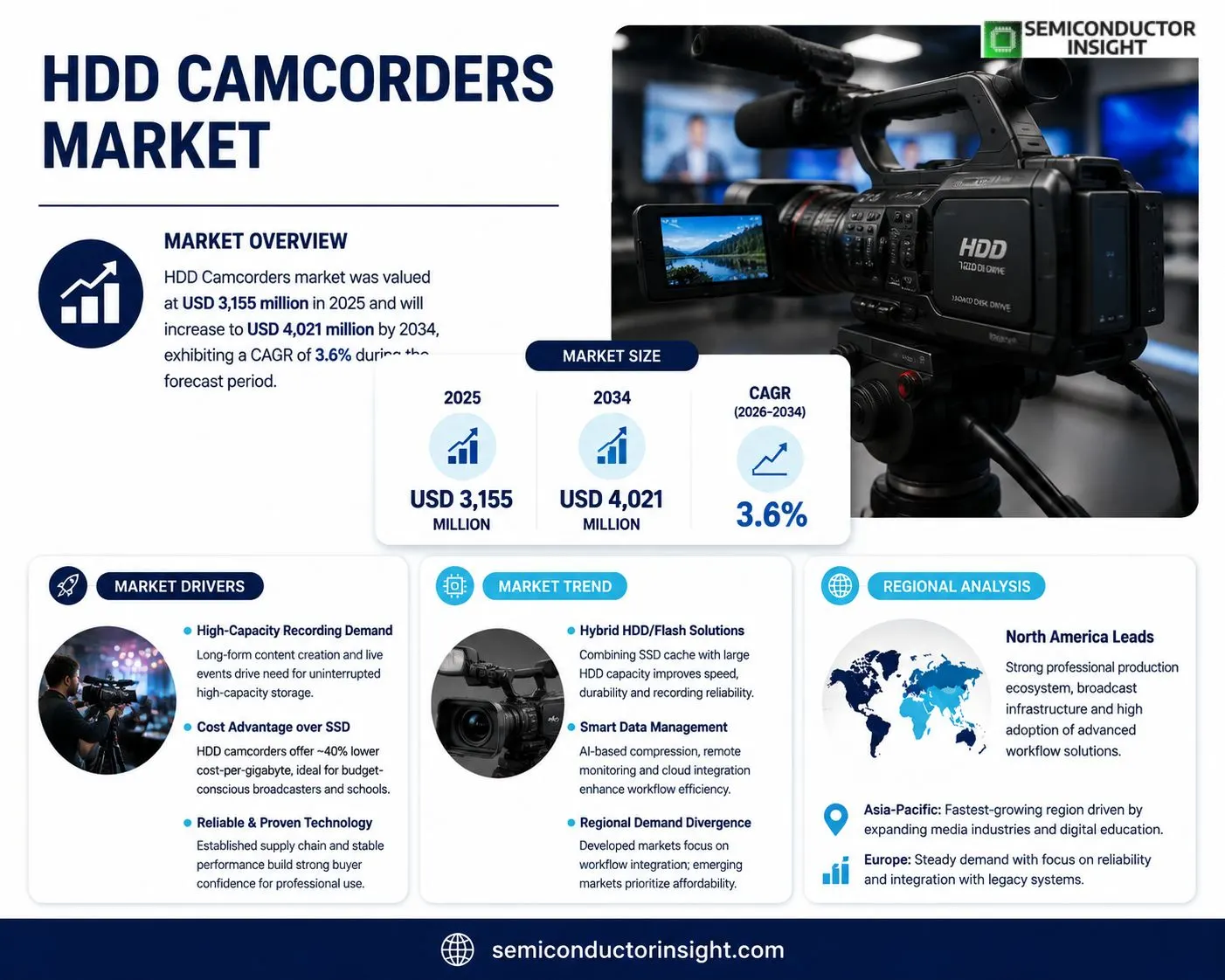
HDD Camcorders market was valued at USD 3155 million in 2025 and will increase to USD 4021 million by 2034, exhibiting a CAGR of 3.6 % during the forecast period.
A hard‑disk camcorder (HDD Camcorder) is a portable video recorder that incorporates a high‑capacity internal hard drive as its primary storage medium. Unlike tape‑based or removable‑card systems, the integrated drive enables long‑duration, uninterrupted capture of high‑definition video while allowing immediate transfer for nonlinear editing and archiving. The architecture leverages random‑access storage, eliminating sequential‑read constraints and supporting real‑time playback, which simplifies post‑production workflows for professional filmmakers, educators, and security operators.The sector remains relevant because professional production environments still demand reliable continuous recording and large on‑board storage capacity. Growth is supported by ongoing investments in broadcast infrastructure, government incentives for cultural content creation, and the adoption of hybrid HDD/flash models that address durability concerns. Nevertheless, competition from solid‑state media and cloud‑based solutions pressures manufacturers to innovate through smarter data management interfaces and tighter integration with modern editing suites.
MARKET DRIVERS
Growing Preference for On‑Device High‑Capacity Recording
The proliferation of long‑form content creation,from independent documentaries to expansive sports coverage,has heightened the need for devices that can store dozens of gigabytes without interruption. Manufacturers of HDD camcorders are responding by integrating larger platter capacities, which allow continuous 4K capture for up to eight hours. This capability reduces reliance on external storage units and streamlines field workflows, a factor that directly fuels demand in HDD Camcorders Market.
Cost Efficiency Relative to Solid‑State Alternatives
For broadcasters operating on tight budgets, the price‑per‑gigabyte advantage of magnetic disk drives remains compelling. While SSDs offer speed, the material cost advantage of HDD technology enables procurement of high‑capacity camcorders at roughly 40 % less than comparable SSD models. This price differential sustains purchases among regional news bureaus and educational institutions that prioritize volume over raw performance.
➤ “When a production schedule demands uninterrupted footage, the reliability of a proven HDD platform often outweighs the allure of newer storage formats.”
Furthermore, the established supply chain for hard‑disk components ensures steady inventory levels, mitigating lead‑time concerns that can disrupt project timelines. This logistical stability reinforces confidence among buyers, contributing to a steady upward trajectory for HDD Camcorders Market.
MARKET CHALLENGES
Technological Shift Toward Solid‑State Storage
Even as cost considerations keep HDD camcorders competitive, the industry faces mounting pressure from solid‑state solutions that deliver faster read/write cycles and superior shock resistance. Production houses that prioritize rapid data offloading are increasingly allocating budget to SSD‑based camcorders, eroding market share for traditional HDD models.
Other Challenges
Regulatory and Environmental Compliance
Stringent e‑waste directives in Europe and North America compel manufacturers to adopt recyclable materials and implement end‑of‑life take‑back programs. The added compliance costs can compress margins, especially for low‑price segments that dominate HDD Camcorders Market.
MARKET RESTRAINTS
Physical Limitations of Rotating Media
Hard‑disk mechanisms are inherently sensitive to vibration and temperature extremes. Field deployments in harsh environments,such as construction sites or outdoor sports venues,expose camcorders to conditions that can accelerate wear, leading to higher failure rates compared with solid‑state counterparts.The necessity for periodic maintenance, including head alignment and firmware updates, introduces downtime that can be costly for time‑critical operations. These operational concerns act as a dampening factor on broader adoption rates.
MARKET OPPORTUNITIES
Integration of Hybrid Storage Architectures
Developers are experimenting with hybrid designs that couple a modest SSD cache with a larger HDD core. This configuration delivers the speed advantage of solid‑state memory for burst recording while retaining the bulk capacity advantage of magnetic disks. Early adopters in sports analytics report a 30 % reduction in buffer overruns, positioning hybrid camcorders as a compelling upgrade path.
Expansion into Emerging Content Hubs
Regions such as Southeast Asia and Sub‑Saharan Africa are witnessing a surge in localized video production, driven by expanding internet penetration and mobile‑first audiences. The cost‑sensitive nature of these markets aligns well with the price point of HDD camcorders, presenting a fertile ground for volume growth.
Value‑Added Services and Firmware Innovation
Manufacturers that bundle advanced compression algorithms and remote monitoring tools can differentiate their offerings. By delivering real‑time bitrate optimization and cloud‑linked health diagnostics, vendors can command premium pricing while addressing reliability concerns, thereby unlocking new revenue streams within HDD Camcorders Market.
HDD Camcorders Market Trends
Professional Production Gains Momentum
Even as solid‑state alternatives dominate consumer shelves, HDD Camcorders Market continues to thrive in environments where uninterrupted, high‑capacity recording is non‑negotiable. Broadcast studios, documentary crews, and educational institutions prize the ability to capture dozens of hours of footage without swapping media, a capability that directly reduces downtime and post‑capture data loss. Recent product releases have emphasized ruggedized chassis, advanced image stabilization, and seamless export to non‑linear editing suites, reinforcing the link between hardware reliability and faster turnaround for content providers. This alignment of device durability with workflow efficiency explains why purchase decisions in professional circles increasingly favor HDD‑based camcorders over flash‑only counterparts, despite the latter’s weight advantage.
Other Trends
Hybrid HDD/Flash Solutions
Manufacturers are responding to mixed‑use scenarios by embedding a modest flash cache alongside the primary hard disk. The flash layer handles buffering for high‑bit‑rate bursts, while the HDD preserves bulk storage. Early adopters report smoother 4K recording and quicker file access during on‑set editing, which translates into tighter production schedules. This hybrid architecture also mitigates shock sensitivity, a long‑standing concern for field crews handling heavy gear. By offering both rapid data handling and massive capacity, these models carve a niche that satisfies traditional HDD users while courting engineers who value the convenience of flash memory.
Regional Divergence in Demand
North America remains anchored by large‑scale broadcasters that mandate continuous recording for live events, sustaining robust sales of high‑end HDD camcorders. In contrast, Asian markets such as China and India see growth driven by government‑backed cultural initiatives and expanding e‑learning platforms, where medium‑range units with integrated network upload features are gaining traction. European operators, accustomed to mature media ecosystems, prioritize devices that integrate tightly with existing asset‑management systems, prompting vendors to offer customized metadata workflows. Meanwhile, emerging regions in Latin America and the Middle East leverage the durability of HDD camcorders for security and on‑site inspection, where ruggedness outweighs the appeal of lighter flash devices. This geographic mosaic underscores that HDD Camcorders Market will evolve along distinct demand curves, each shaped by local production practices, regulatory support, and infrastructure readiness.
COMPETITIVE LANDSCAPE
Key Industry Players
Competitive Analysis of Leading HDD Camcorder Manufacturers
In the professional segment, Sony dominates the HDD camcorder space by leveraging its extensive optics portfolio and deep integration with broadcast‑grade workflow software. Its flagship models combine high‑capacity disks with advanced image stabilization, making them the default choice for large‑scale productions that require uninterrupted recording. Panasonic follows closely, differentiating itself through modular designs that allow field technicians to swap drives quickly, a feature that supports live‑event environments where downtime translates directly into revenue loss. Canon’s entry, though later, commands attention because of its hybrid HDD/flash models that address durability concerns while preserving the familiar tape‑replacement experience for legacy users. These three firms shape a tiered market structure: a top tier that supplies end‑to‑end solutions for broadcasters, a middle tier focused on field production, and a lower tier populated by niche specialists.Beyond the three market leaders, a cluster of innovators sustains the ecosystem. JVC remains relevant by targeting documentary filmmakers who value rugged chassis and straightforward file‑management tools. Blackmagic Design has carved a niche with its affordable professional camcorders that pair HDD storage with DaVinci Resolve integration, appealing to indie creators who need high‑quality output without prohibitive costs. Sharp and Hitachi continue to service education and security segments, where bulk purchases prioritize reliability over cutting‑edge features. Samsung, DJI, and GoPro have experimented with hybrid solutions, blending flash and HDD to mitigate shock vulnerability while retaining long‑recording capacity. Ricoh and Huawei, though smaller, supply regional markets in Asia with competitively priced units that meet local broadcasting standards. This diversified player base ensures that even as flash and cloud alternatives erode consumer demand, the professional segment retains depth and resilience.
List of Key HDD Camcorders Companies Profiled
- Sony
- Panasonic
- Canon
- JVC
- Blackmagic Design
- Sharp
- Hitachi
- Samsung
- DJI
- GoPro
- Ricoh
- Huawei
Segment Analysis:
| Segment Category | Sub-Segments | Key Insights |
| By Type |
|
Professional HDD Camcorder is the leading sub‑segment because:
|
| By Application |
|
Broadcast & Media Production dominates because:
|
| By End User |
|
Professional Filmmakers are the primary users because:
|
| By Storage Capacity |
|
Above 250 GB is most valued because:
|
| By Video Quality |
|
4K UHD is the driving quality tier because:
|
Regional Analysis: HDD Camcorders Market
North America
Enthusiasts seeking long‑duration recording for travel vlogging gravitate toward HDD camcorders because the media cost per hour remains lower than flash alternatives. Brands that bundle high‑capacity drives with intuitive editing software capture a loyal segment that values simplicity over cutting‑edge speed.
Corporate security firms favor HDD camcorders for continuous surveillance loops, where the predictable write endurance translates into fewer field replacements. Integration with existing video‑management platforms simplifies deployment, reinforcing the market foothold in verticals such as law‑enforcement training.
Domestic component sourcing mitigates exposure to semiconductor shortages, allowing manufacturers to maintain steady production runs. This logistical advantage keeps lead times short, a competitive edge for customers with tight project schedules.
FCC regulations on electromagnetic emissions favor HDD units that have long‑standing compliance records. Companies that proactively certify new drive models avoid costly redesigns and preserve market access across the United States and Canada.
Europe
European broadcasters remain cautious about fully abandoning HDD camcorders because legacy editing suites are calibrated to tape‑like data streams. This caution translates into incremental upgrades rather than wholesale replacement, prompting OEMs to focus on hybrid devices that support both HDD and SSD inputs. Government subsidies for media digitization projects further sustain demand, as public‑service entities prioritize proven reliability over speculative performance gains.
Asia‑Pacific
In the Asia‑Pacific region, burgeoning user‑generated content platforms have generated a niche market for affordable, high‑capacity camcorders. Small production houses in emerging economies appreciate the lower upfront cost of HDD storage, which aligns with budget constraints while still delivering broadcast‑grade video quality. Local distributors capitalize on this appetite by offering region‑specific warranty extensions that address tropical climate concerns.
South America
South American markets exhibit a blend of legacy broadcast infrastructure and fast‑growing online streaming services. Broadcasters with extensive archival libraries prefer HDD camcorders to ensure seamless migration of historic footage. Meanwhile, independent filmmakers adopt the technology for field shoots, attracted by the ease of swapping drives without complex data migration procedures.
Middle East & Africa
The Middle East & Africa see modest but steady interest in HDD camcorders, driven primarily by educational institutions and corporate training departments. The durability of hard‑disk media under harsh environmental conditions, coupled with robust after‑sales support from regional partners, makes the technology a pragmatic choice where operational continuity outweighs the lure of newer formats.
Report Scope
This market research report provides a comprehensive analysis of the HDD Camcorders Market , covering the forecast period 2026–2034. It offers detailed insights into market dynamics, technological advancements, competitive landscape, and key trends shaping the industry.
Key focus areas of the report include:
- Market Overview: The report begins with an overview outlining its current market scenario, key growth indicators, and industry transformation drivers. It discusses macroeconomic factors, demand–supply balance, regulatory landscape, and the strategic role of semiconductors in powering advancements across industries such as automotive, telecommunications, consumer electronics, and industrial automation.
- Market Size & Forecast: Historical data and future projections for revenue, unit shipments, and market value across major regions and segments.
- Segmentation Analysis: Detailed breakdown by product type, technology, application, and end-user industry to identify high-growth segments and investment opportunities.
- Regional Insights: Insights into market performance across North America, Europe, Asia-Pacific, Latin America, and the Middle East & Africa, including country-level analysis where relevant.
- Competitive Landscape: Profiles of leading market participants, including their product offerings, R&D focus, manufacturing capacity, pricing strategies, and recent developments such as mergers, acquisitions, and partnerships.
- Technology Trends & Innovation: Assessment of emerging technologies, integration of AI/IoT, semiconductor design trends, fabrication techniques, and evolving industry standards.
- Market Drivers & Restraints: Evaluation of factors driving market growth along with challenges, supply chain constraints, regulatory issues, and market-entry barriers.
- Stakeholder Insights: Insights for component suppliers, OEMs, system integrators, investors, and policymakers regarding the evolving ecosystem and strategic opportunities.
Primary and secondary research methods are employed, including interviews with industry experts, data from verified sources, and real-time market intelligence to ensure the accuracy and reliability of the insights presented.
FREQUENTLY ASKED QUESTIONS:
What is the current market size of HDD Camcorders Market?
-> HDD Camcorders Market was valued at USD 3,155 million in 2025 and is expected to reach USD 4,021 million by 2034, growing at a CAGR of 3.6% during the forecast period.
Which key companies operate in HDD Camcorders Market?
-> Key players include Sony, Panasonic, Canon, JVC, Ordro, Blackmagic Design, Sharp, Hitachi, GoPro, Samsung, Toshiba, Ricoh, Huawei, and DJI, among others.
What are the key growth drivers?
-> Key growth drivers include increasing demand for long‑duration professional video recording, educational content creation, broadcast journalism, security & surveillance applications, and supportive government policies for cultural and media production.
Which region dominates the market?
-> North America remains the dominant region due to its strong professional video production ecosystem, while Asia‑Pacific shows the fastest growth driven by expanding media industries and digital education initiatives.
What are the emerging trends?
-> Emerging trends include hybrid HDD/Flash solutions, enhanced remote‑control and intelligent data‑management features, and tighter integration with nonlinear editing (NLE) workflows.

Get Sample Report PDF for Exclusive Insights
Report Sample Includes
- Table of Contents
- List of Tables & Figures
- Charts, Research Methodology, and more...
 Download Sample Report PDF