
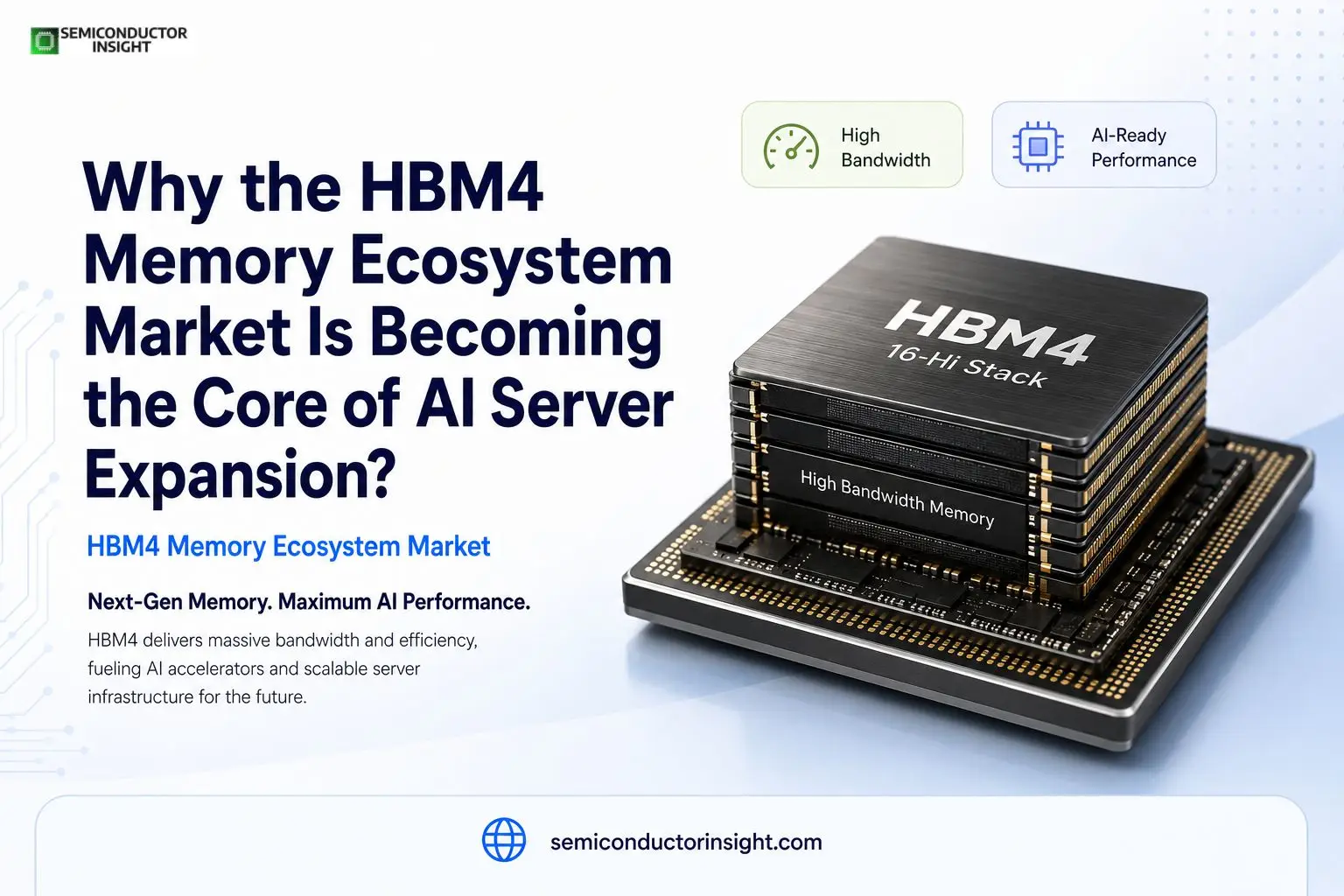
Why the HBM4 Memory Ecosystem Market Is Becoming the Core of AI Server Expansion?
Semiconductor architecture has entered a new performance age driven by artificial intelligence, where memory bandwidth is now as crucial as raw processor power. The market for the HBM4 memory ecosystem is now at the forefront of the next generation of computing infrastructure thanks to this change. Fourth-generation High Bandwidth Memory technology is becoming an essential part of AI accelerators, sophisticated GPUs, supercomputers, and cloud data centre platforms that handle massive amounts of data every second.
In contrast to traditional DRAM architectures, HBM4 employs sophisticated packaging techniques and vertically stacked memory dies coupled by through-silicon vias. This design dramatically increases bandwidth while reducing power consumption and physical footprint. As AI models continue expanding toward trillions of parameters, semiconductor companies are under growing pressure to improve memory throughput without increasing energy intensity.
Stay connected for additional in-depth information right here: https://semiconductorinsight.com/report/high-bandwidth-memory-hbm3-hbm3e-hbm4-market/
AI Training Clusters Are Consuming More Memory than Ever Before
The rapid expansion of generative AI infrastructure is changing memory demand patterns across global semiconductor supply chains. Training large language models now requires enormous memory capacity and ultra-fast data transfer rates between GPUs and processors.
According to technical disclosures from leading AI hardware developers, modern AI accelerators can demand memory bandwidth exceeding 1.5 TB per second in advanced configurations. HBM4 is expected to push this even further, supporting next generation GPU architectures designed for hyperscale AI workloads.
The scale of infrastructure investment is also accelerating. In 2025, several hyperscale cloud operators announced expanded AI server deployments containing thousands of GPU units interconnected through high-speed memory systems. Semiconductor packaging facilities in Taiwan and South Korea are responding by increasing production capacity for advanced memory integration technologies.
Advanced Packaging Is Becoming the Hidden Engine behind HBM4
The HBM4 ecosystem is not only about memory chips. It is deeply connected to advanced semiconductor packaging technologies including silicon interposers, chiplet integration, and 2.5D packaging platforms.
- Modern HBM systems require highly precise packaging environments capable of integrating logic dies and stacked memory structures within extremely compact spaces. This is creating unprecedented demand for advanced packaging services from outsourced semiconductor assembly and test providers.
- Taiwan continues to play a major role in this ecosystem. Taiwan Semiconductor Manufacturing Company has significantly expanded CoWoS packaging capacity to support AI chip demand.
- Industry reports from technology publications and semiconductor engineering journals indicate that CoWoS capacity reservations are now heavily influenced by AI accelerator programs tied to large cloud computing companies.
At the same time, OSAT providers are investing in next generation thermal management systems because HBM-integrated processors generate substantial heat densities during AI workloads.
Memory Manufacturers Are Entering a New Technology Race
The competition surrounding HBM4 development has intensified among major memory suppliers. Semiconductor manufacturers are focusing on higher stack counts, improved energy efficiency, and lower latency performance to support AI and high performance computing applications.
Samsung Electronics, SK hynix, and Micron Technology are all expanding investments in advanced memory technologies connected to AI infrastructure growth.
Recent semiconductor conference presentations revealed that HBM4 designs may support wider I/O interfaces and significantly higher transfer speeds compared to earlier HBM generations. This improvement is becoming essential for AI inference systems operating in real time environments such as autonomous systems, industrial robotics, and advanced cyber security platforms.
Data Centres Are Facing a New Thermal Equation
- One of the lesser discussed aspects of the HBM4 memory ecosystem market is its growing influence on data centre cooling architecture.
- AI clusters equipped with high performance accelerators require advanced thermal control because densely packed memory stacks and processors generate extreme heat loads.
- Liquid cooling systems are becoming increasingly common in AI focused facilities. Some hyperscale operators are deploying direct-to-chip cooling systems specifically optimized for GPU servers equipped with HBM architectures.
- According to data published by authorized energy and infrastructure organizations, high density AI racks can exceed 100 kilowatts per rack in certain configurations, far above traditional enterprise server deployments.
- This is creating opportunities for semiconductor material suppliers specializing in thermal interface materials, advanced substrates, and heat dissipation technologies.
Chiplet Ecosystems Are Expanding Around HBM Integration
The semiconductor industry is gradually moving toward modular chiplet architectures where processors, memory modules, and accelerators are assembled into unified packages. HBM4 is expected to become a central building block within this modular computing approach.
Instead of relying on monolithic chip designs, companies are increasingly combining specialized compute tiles with high bandwidth memory stacks to optimize performance and manufacturing efficiency. This architecture also improves scalability for AI systems handling complex training and inference tasks.
Recent examples from AI accelerator launches show growing adoption of heterogeneous integration techniques combining CPUs, GPUs, NPUs, and HBM structures within interconnected semiconductor platforms. This trend is expected to redefine semiconductor engineering strategies over the next several years.
The HBM4 memory ecosystem market is evolving into far more than a memory upgrade cycle. It represents a structural transformation in semiconductor architecture where memory, packaging, cooling, and AI acceleration technologies are becoming inseparable parts of a unified computing infrastructure.

Comments (0)