
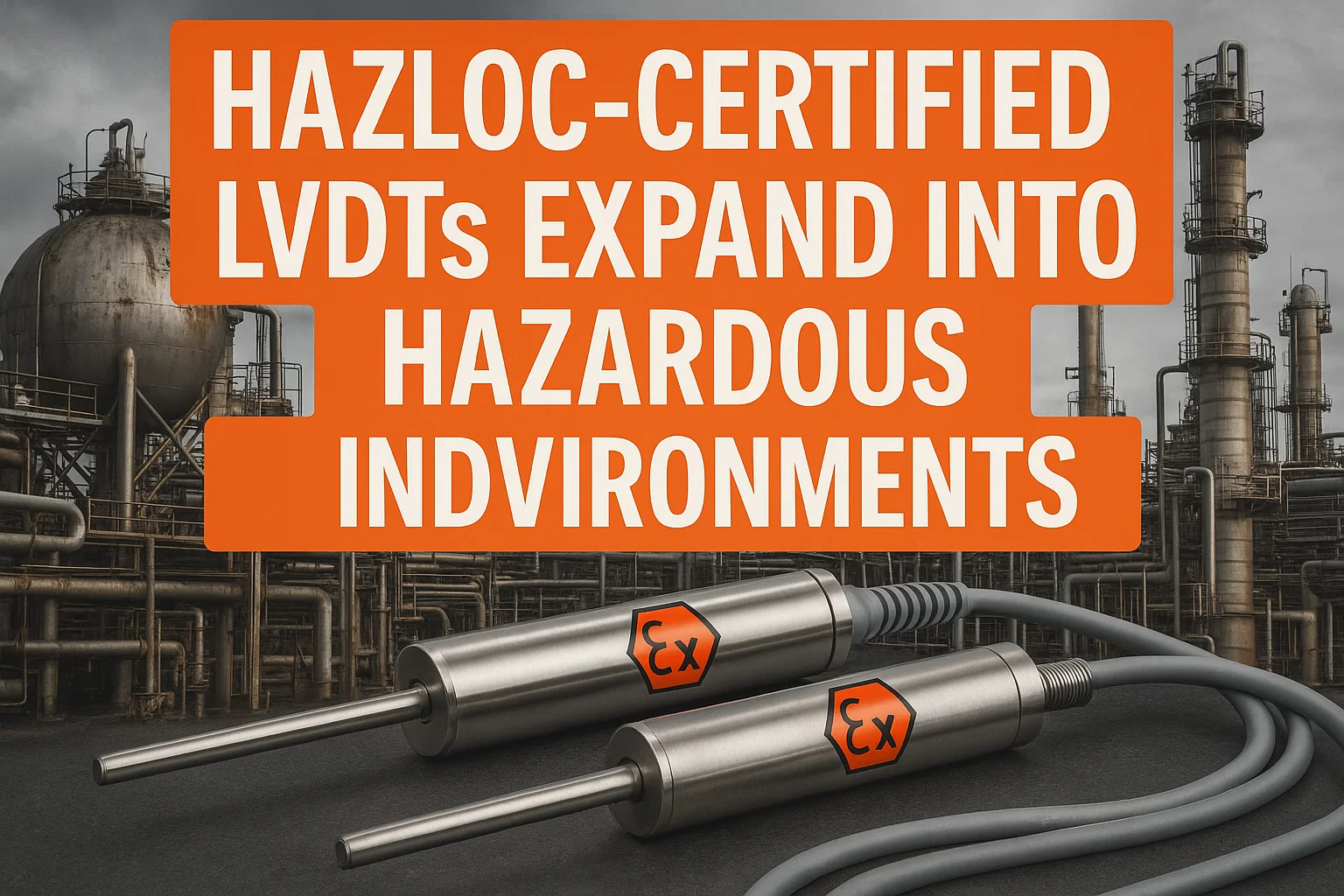
HAZLOC-Certified LVDTs Expand into Hazardous Industrial Environments
Linear Variable Displacement Transducers (LVDTs) might not be household names, but they sit at the very heart of modern engineering and industrial systems. Whether it’s monitoring the safe operation of a nuclear reactor, ensuring precision in aerospace systems, or providing reliable feedback in automotive testing rigs, these electromechanical sensors play a crucial role in converting linear motion into an electrical signal.
In 2024, the global LVDT market was valued at approximately US$ 839 million. With increasing demand from aerospace, energy, manufacturing, and research sectors, it is projected to grow to US$ 1,409 million by 2032, registering a CAGR of 8.1%. This growth isn’t just about more sales it reflects significant technological innovations, shifting industry needs, and a push toward smarter, more durable, and more environmentally resilient measurement solutions.
Access Your Free Sample Report- Linear Variable Displacement Transducers (LVDT) Market
What is an LVDT and Why Does It Matter?
Before diving into industry updates, let’s briefly revisit what an LVDT is.
An LVDT is a type of electromechanical sensor that measures linear displacement (movement along a straight path). It consists of a primary coil and two secondary coils, with a movable ferromagnetic core. When the core shifts position, it changes the induced voltage balance between the secondary coils. This electrical signal is then converted into a precise measurement of displacement.
Why do industries value LVDTs?
- Reliability: No electrical contact with the moving core, so they have extremely long lifespans.
- Precision: They can measure microns of movement with repeatable accuracy.
- Durability: They can operate in extreme temperatures, pressures, and harsh environments.
- Versatility: Widely used in aerospace, energy, manufacturing, automotive testing, and defense.
Market Growth: The Numbers Behind the Sensors
The LVDT market’s projected growth from $839 million in 2024 to $1.409 billion in 2032 reflects more than simple demand. Several global forces are driving this expansion:
- Next-generation nuclear power plants With increasing focus on clean energy, reactors (including advanced molten salt reactors) require high-temperature, radiation-resistant sensors like LVDTs.
- Aerospace & defense Aircraft development, space exploration, and defense applications demand precise, rugged sensors.
- Industrial automation Smart factories and robotics rely on accurate position feedback for efficiency and safety.
- Automotive sector Electric vehicle testing, crash safety systems, and suspension design all use LVDTs.
- Quality inspection & metrology Miniaturized, spring-loaded LVDTs allow real-time inline measurements in manufacturing.
This CAGR of 8.1% shows not only expanding adoption but also higher unit value as industries shift to digitally enhanced, specialized LVDTs.
Recent Technological Developments in LVDTs
1. Radiation and High-Temperature Resistant LVDTs for Nuclear Applications
One of the most exciting frontiers for LVDT technology is nuclear energy. Companies like NewTek are pioneering LVDTs that can survive extreme radiation levels and temperatures exceeding 1000°F (538°C). These sensors are critical for Molten Salt Reactors (MSRs) an emerging nuclear reactor type that promises safer, more efficient, and more sustainable energy.
Unlike conventional reactors, MSRs operate with liquid salt fuel at high temperatures. Monitoring displacement in such a setting requires sensors that won’t degrade under radiation or corrosion. Traditional sensors fail, but LVDTs designed with radiation-resistant materials and specialized coil construction can endure.
This innovation is more than just a technical upgrade it could directly influence the feasibility of next-generation nuclear power plants worldwide.
2. Digital Signal Processing in LVDT Signal Conditioners
In the past, LVDT signal conditioning was largely analog, requiring manual calibration and offering limited flexibility. Today, companies like eddylab GmbH have introduced digital signal conditioners such as the DEEneo series.
These systems leverage digital signal processing (DSP), offering:
- 16-bit resolution for ultra-precise measurement
- Built-in linearization to correct non-linearities in the LVDT response
- Easy setup via push-buttons or software (“eddySETUP”)
- Configurable measuring ranges, output types, and filters
This marks a shift toward plug-and-play LVDTs, reducing installation complexity, improving measurement accuracy, and lowering maintenance costs.
As industries transition to Industry 4.0, these digitally enabled LVDTs provide seamless integration with automation networks and smart systems.
Download Sample Report PDF- Linear Variable Displacement Transducers (LVDT) Market
3. Hazardous Environment Certifications (HAZLOC)
Not all industries deal with radiation, but many operate in hazardous or explosive atmospheres think oil refineries, chemical plants, or mining operations.
NewTek has introduced LVDTs certified under HAZLOC (Hazardous Location) standards in the U.S., meaning they are designed to function safely in potentially explosive atmospheres.
These certifications open up LVDT usage in industries previously hesitant due to safety concerns, expanding the technology’s reach.
4. Miniaturization and Rugged Designs
In sectors like aerospace, hydraulics, and materials testing, space is at a premium. Miniaturized LVDTs are becoming increasingly important.
Examples include:
- Vented miniature LVDTs by NewTek, designed for high-pressure environments while remaining compact.
- Retractable probe gage heads for inline metrology (highlighted by Metrology News), which prevent damage by retracting between inspections.
These designs balance small footprint with rugged durability, enabling sensors to work in environments where traditional LVDTs wouldn’t fit.
5. Durability and Environmental Protection
Harsh conditions like water immersion, vibration, corrosive chemicals, and pressure cycling are common in industrial settings.
Recent LVDTs incorporate:
- IP67/IP68 protection ratings for water and dust resistance
- Stainless steel or titanium housings for chemical and mechanical resilience
- Modular shaft designs for flexible integration
These improvements extend the operational lifespan of LVDTs, reduce downtime, and lower the total cost of ownership for industries.
Industry Applications: Where the Innovations Matter Most
Nuclear Power
- High-temperature, radiation-resistant LVDTs ensure safe operation of next-gen reactors.
- Critical in control rod positioning, valve monitoring, and structural health checks.
Aerospace and Defense
- Miniaturized, lightweight LVDTs support landing gear, flight controls, and missile guidance.
- Withstand vibration, shock, and extreme temperatures.
Automotive
- Used in crash testing to measure structural deformation.
- Essential in suspension systems and electric vehicle motor control.
Manufacturing and Automation
- Inline gage heads for quality assurance in high-volume production lines.
- Integration with robotics for precise motion feedback.
Oil & Gas / Hazardous Environments
- HAZLOC-certified LVDTs for drilling rigs, offshore equipment, and chemical processing plants.
Future Outlook: Where is the LVDT Industry Heading?
Looking ahead, the LVDT industry will evolve along three major paths:
- Smart LVDTs: Integration with IoT and predictive maintenance systems. Sensors that self-diagnose calibration drift or wear will become standard.
- Extreme-environment specialization: From nuclear to deep-sea applications, more LVDTs will be engineered to survive environments where other sensors fail.
- Miniaturization + Digitalization: As electronics shrink and DSP power grows, expect even smaller, smarter, and more cost-effective LVDTs.
The global market’s projected growth reflects not just more demand, but higher-value, more advanced sensors tailored for critical infrastructure and high-tech industries.
Click Here To Download Full Sample Report- Linear Variable Displacement Transducers (LVDT) Market
Challenges Ahead
Despite the promising growth, several challenges persist:
- High cost of specialized LVDTs (nuclear-grade sensors can be expensive).
- Competition from alternative sensors like magnetostrictive and optical sensors in certain applications.
- Integration hurdles in legacy systems that still rely on older analog signal conditioning.
Overcoming these challenges will require continued innovation, cost optimization, and stronger integration tools. With the market set to grow from US$ 839 million in 2024 to US$ 1.409 billion by 2032 at a CAGR of 8.1%, it’s clear that LVDTs are not just surviving in the sensor world they’re thriving.

Comments (0)