
MARKET INSIGHTS
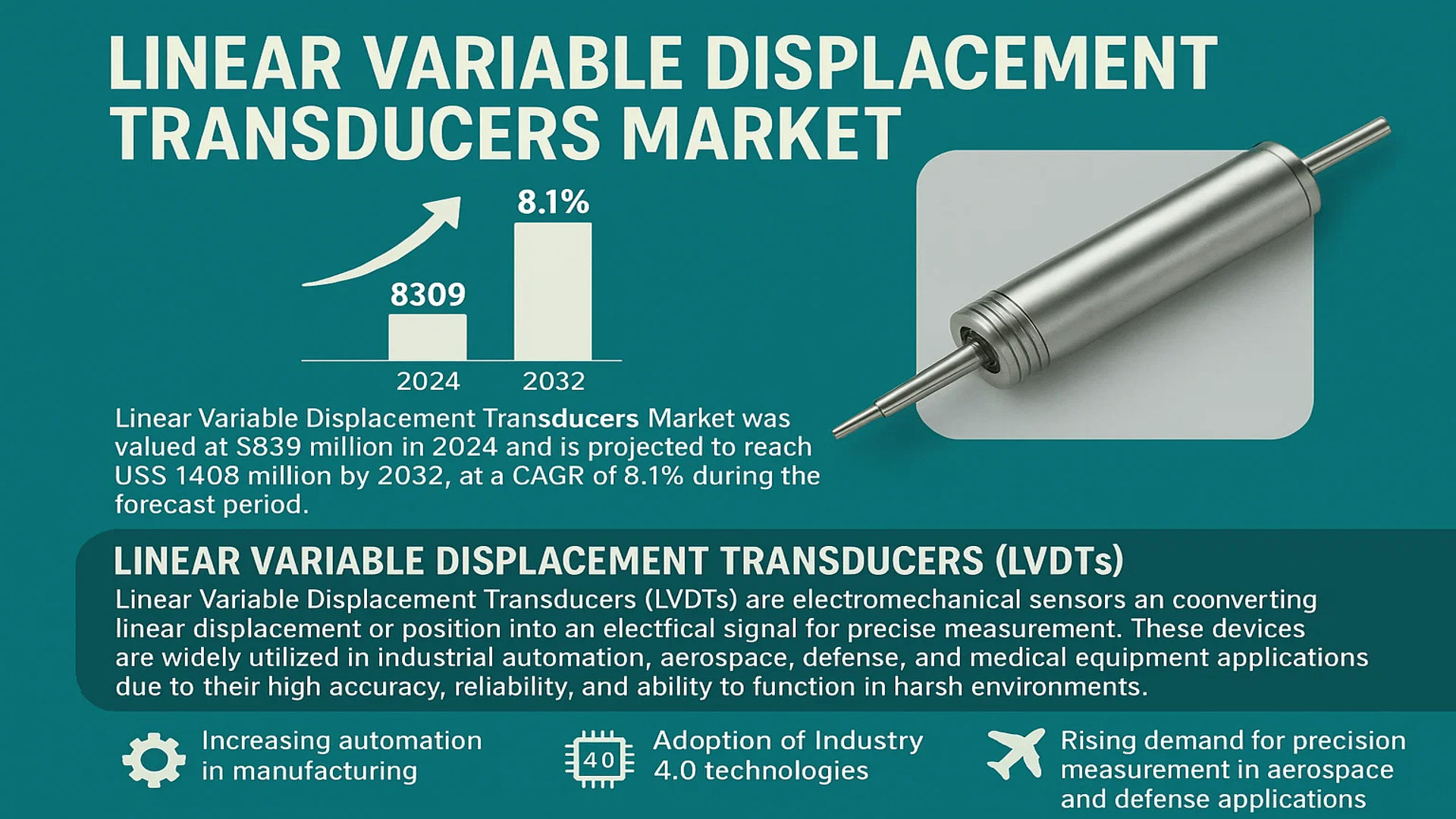
The global Linear Variable Displacement Transducers Market was valued at 839 million in 2024 and is projected to reach US$ 1409 million by 2032, at a CAGR of 8.1% during the forecast period.
Linear Variable Displacement Transducers (LVDTs) are electromechanical sensors that convert linear displacement or position into an electrical signal for precise measurement. These devices are widely utilized in industrial automation, aerospace, defense, and medical equipment applications due to their high accuracy, reliability, and ability to function in harsh environments. LVDTs consist of a primary winding and two secondary windings, which detect changes in linear movement with minimal friction or wear.
The market growth is driven by increasing automation in manufacturing, adoption of Industry 4.0 technologies, and rising demand for precision measurement in aerospace and defense applications. Furthermore, advancements in miniaturized LVDT designs for compact systems are expanding their use in medical and consumer electronics. Key players such as Honeywell, TE Connectivity, and Ametek are investing in R&D to enhance sensor performance and cater to diverse industry requirements.
MARKET DYNAMICS
MARKET DRIVERS
Industrial Automation and Industry 4.0 Adoption Fueling Demand for LVDTs
The rapid advancement of industrial automation across manufacturing sectors is creating significant demand for precision measurement devices like Linear Variable Displacement Transducers. As factories transition toward smart manufacturing under Industry 4.0 initiatives, the need for real-time position feedback in automated systems has grown substantially. LVDTs, with their ability to provide accurate linear position measurements in harsh industrial environments, are becoming indispensable components in automated production lines, robotic systems, and quality control processes. The global push for Industry 4.0 implementation, particularly in automotive and electronics manufacturing, is expected to sustain strong market growth through 2032.
Aerospace and Defense Sector Investments Driving High-Precision Requirements
Increasing defense expenditures and space exploration initiatives worldwide are creating robust demand for high-performance LVDTs capable of operating in extreme conditions. These transducers play critical roles in aerospace applications such as flight control systems, landing gear monitoring, and structural health monitoring of aircraft components. Modern defense systems rely on LVDTs for precision actuation measurement in missile guidance systems, radar positioning, and unmanned vehicle controls. The growing emphasis on predictive maintenance in military aviation and the resurgence of space programs are creating additional opportunities for specialized LVDT applications that require exceptional reliability and accuracy.
Medical Equipment Innovation Expanding LVDT Applications
The medical device industry’s increasing focus on precision instrumentation is opening new avenues for LVDT technology. These transducers are finding growing applications in surgical robotics, diagnostic imaging equipment, and prosthetics where sub-millimeter measurement accuracy is required. The ability of LVDTs to operate without physical contact makes them ideal for sterile medical environments. With the global medical equipment market experiencing steady growth, manufacturers are developing specialized LVDT variants that meet stringent medical regulatory requirements while providing the necessary precision for life-critical applications.
MARKET RESTRAINTS
High Costs of Precision LVDTs Limiting Market Penetration
While LVDTs offer superior performance in many applications, their relatively high cost compared to alternative position sensing technologies remains a significant market constraint. Precision LVDTs designed for specialized applications in aerospace, defense, and medical fields can be particularly expensive due to stringent quality requirements and low production volumes. This pricing pressure makes it challenging for standard industrial applications to justify LVDT adoption when lower-cost alternatives are available. The situation is exacerbated in developing markets where price sensitivity is higher and industrial automation budgets are more constrained.
Technical Complexity and Integration Challenges
The implementation of LVDT systems often requires specialized knowledge of signal conditioning and interface electronics, creating barriers to adoption in some markets. Many end-users face challenges integrating analog LVDT outputs with modern digital control systems, necessitating additional signal conversion components. While newer digital LVDT models address some of these issues, the transition from traditional analog designs is gradual due to existing system architectures in industrial environments. This technical complexity increases the total system cost and can deter potential users from adopting LVDT technology.
MARKET OPPORTUNITIES
Emerging Applications in Electric Vehicle Production
The rapid growth of electric vehicle manufacturing presents significant opportunities for LVDT applications in battery assembly processes and powertrain component positioning. EV batteries require precise alignment during assembly to ensure optimal performance and safety, creating demand for high-accuracy position measurement solutions. Additionally, the increasing automation in EV production lines favors the adoption of reliable displacement measurement technologies like LVDTs. As global automakers continue to expand their electric vehicle portfolios, this emerging application area is expected to become a key growth driver for the LVDT market.
Advancements in Compact and Smart LVDT Designs
Recent technological developments are enabling the production of more compact LVDT models with integrated digital interfaces, opening new possibilities for applications where space constraints previously limited their use. These next-generation smart LVDTs incorporate onboard signal conditioning and digital communication protocols, simplifying integration with modern industrial control systems. The development of miniaturized LVDTs suitable for portable diagnostic equipment and embedded systems is particularly promising, as it expands the technology’s applicability beyond traditional industrial settings into new market segments.
MARKET CHALLENGES
Competition from Alternative Sensing Technologies
LVDT manufacturers face increasing competition from emerging non-contact position sensing technologies such as optical encoders and capacitive displacement sensors. These alternatives often offer simpler digital interfaces, smaller form factors, and in some cases, comparable accuracy at lower price points. While LVDTs maintain advantages in harsh environments and high-reliability applications, the rapid advancement of competing technologies requires continuous innovation to maintain market position. This competitive pressure is particularly intense in price-sensitive industrial automation segments where the premium for LVDT’s ruggedness is harder to justify.
Supply Chain Complexities for Specialized Materials
The production of high-performance LVDTs requires specialized materials such as precision-machined ferromagnetic cores and high-quality winding wires, which can be subject to supply chain disruptions. Recent global events have highlighted vulnerabilities in sourcing these critical components, particularly for manufacturers serving aerospace and medical markets with stringent material certification requirements. Ensuring stable access to these specialized materials while managing costs presents ongoing challenges for LVDT producers, especially those operating in highly regulated industries where material substitutions are difficult to implement.
LINEAR VARIABLE DISPLACEMENT TRANSDUCERS MARKET TRENDS
Industry 4.0 and Automation Fueling Demand for Precision Measurement Solutions
The global push toward Industry 4.0 and smart manufacturing has significantly increased the adoption of Linear Variable Displacement Transducers (LVDTs) in automated systems. These transducers provide highly accurate, real-time feedback for position sensing in robotics, CNC machines, and quality control systems. With manufacturing facilities emphasizing predictive maintenance and digital twins, LVDTs serve as critical components in collecting precise displacement data to minimize downtime and optimize production efficiency. The growing integration of Industrial Internet of Things (IIoT) platforms has amplified demand for LVDTs with digital output capabilities, enabling seamless connectivity in data-driven industrial environments.
Other Trends
Aerospace & Defense Applications Driving High-Performance LVDT Adoption
LVDTs are increasingly deployed in aerospace and defense applications due to their reliability in extreme environments. These transducers are critical in monitoring flight control systems, landing gear mechanisms, and structural health monitoring in aircraft. The defense sector’s focus on modernizing military equipment and increasing investments in unmanned aerial vehicles (UAVs) has created substantial opportunities for ruggedized LVDT solutions. The ability to operate in high-vibration, high-temperature conditions while maintaining accuracy makes LVDTs indispensable for mission-critical aerospace applications.
Technological Advancements Expanding Application Scope
Continuous improvements in LVDT design and materials are broadening their usability across industries. Manufacturers are developing miniaturized versions without compromising performance, enabling integration into compact medical devices and consumer electronics. Recent innovations include enhanced signal conditioning electronics that improve noise immunity and digital interfaces for simplified connectivity. The medical equipment sector is adopting these advanced LVDTs for precision positioning in surgical robots and diagnostic imaging systems. Additionally, the automotive industry’s transition to electric vehicles is creating new applications in battery assembly and charging systems where precise displacement measurement is crucial.
The market is witnessing increasing preference for DC-operated LVDTs over traditional AC versions due to their simpler electronics and lower power consumption. This shift is particularly notable in portable and battery-powered applications. Meanwhile, research continues into novel core materials and winding techniques that promise further improvements in linearity and temperature stability. As industries demand higher measurement precision under challenging conditions, these technological developments will remain key drivers of market expansion.
COMPETITIVE LANDSCAPE
Key Industry Players
Technological Innovation and Expansion Drive Market Competition
The global Linear Variable Displacement Transducers (LVDT) market features a mix of established multinational corporations and specialized manufacturers, all vying for dominance in this rapidly evolving sector. The competitive environment is moderately consolidated, with leading players leveraging advanced R&D capabilities, strategic acquisitions, and tailored solutions to maintain their market positions. As industries increasingly prioritize automation and high-precision measurement, companies are focusing on expanding their portfolios to capture emerging opportunities.
Honeywell holds a prominent position in the market, thanks to its reputation for robust sensor technologies and extensive distribution networks. The company’s LVDT solutions, known for their durability in harsh industrial environments, are widely adopted in aerospace and automotive sectors. Similarly, TE Connectivity has strengthened its market share through continuous innovation, particularly in compact and high-accuracy transducers for medical and industrial automation applications.
Meanwhile, Sensata Technologies and Ametek have carved out significant niches by catering to specialized industries such as defense and energy. Their focus on ruggedized LVDTs capable of operating in extreme conditions has positioned them as preferred suppliers for critical applications. Additionally, Micro-Epsilon has gained traction by emphasizing miniaturization and advanced signal processing, meeting the demand for high-resolution measurements in compact spaces.
Investments in regional expansion and digital integration are further intensifying competition. Companies like Curtiss-Wright and Meggitt are expanding their footprint in Asia-Pacific and Europe to capitalize on growing industrialization. With advancements like wireless LVDTs and IoT-enabled sensors gaining prominence, market players are racing to align their offerings with next-generation automation trends.
List of Key LVDT Manufacturers Profiled
- Honeywell International Inc. (U.S.)
- TE Connectivity Ltd. (Switzerland)
- Sensata Technologies (U.S.)
- Curtiss-Wright Corporation (U.S.)
- G.W. Lisk Company (U.S.)
- Ametek, Inc. (U.S.)
- Micro-Epsilon (Germany)
- Meggitt PLC (U.K.)
- Omega Engineering (U.S.)
- Sensonics Ltd. (U.K.)
- Monitran Ltd. (U.K.)
- RDP Electronics (U.K.)
- Inelta Sensorsysteme (Germany)
- WayCon Positionsmesstechnik (Germany)
- Active Sensors LLC (U.S.)
Segment Analysis:
By Type
AC LVDT Segment Leads Due to High Precision and Reliability in Industrial Applications
The market is segmented based on type into:
- AC LVDT
- Features: Higher accuracy, robust performance in harsh environments
- DC LVDT
- Features: Compact size, lower power consumption
By Application
Industrial Equipment Segment Dominates Owing to Widespread Use in Automation and Manufacturing
The market is segmented based on application into:
- Industrial Equipment
- Aerospace & Defense
- Automotive
- Medical Equipment
- Consumer Electronics
- Others
By End-User
Manufacturing Sector Holds Largest Share Due to Industry 4.0 Adoption
The market is segmented based on end-user into:
- Manufacturing
- Aerospace & Defense
- Automotive
- Healthcare
- Energy
Regional Analysis: Linear Variable Displacement Transducers Market
Asia-Pacific
The Asia-Pacific region dominates the global LVDT market, accounting for over 40% of total demand, driven by rapid industrialization and infrastructure development. China remains the largest consumer, with its expansive manufacturing sector embracing automation across automotive, electronics, and machinery industries. India follows closely as the fastest-growing market, supported by government initiatives like Make in India that promote domestic manufacturing. Japan and South Korea contribute significantly through their advanced robotics and precision engineering sectors, where high-accuracy LVDTs are essential for quality control. While cost sensitivity remains a factor, the region shows increasing adoption of advanced DC LVDT models for their superior performance in harsh industrial environments.
North America
Characterized by technological leadership and stringent quality standards, North America holds 28% of the global LVDT market share. The U.S. aerospace and defense sector drives demand for rugged, high-precision transducers, particularly from manufacturers like Honeywell and TE Connectivity. Canada’s growing oil & gas industry utilizes explosion-proof LVDTs for pipeline monitoring. Recent federal investments in semiconductor manufacturing (CHIPS Act) and renewable energy infrastructure are creating new application areas for displacement measurement systems. The region also sees rising demand from medical device manufacturers requiring miniaturized LVDTs for surgical robotics and imaging equipment.
Europe
Europe maintains a strong position in the LVDT market (22% share) through its focus on industrial automation and quality manufacturing. Germany leads with its robust machinery sector, where LVDTs are critical for CNC equipment and automotive production lines. The region’s aerospace industry (Airbus, Safran) extensively uses high-temperature resistant transducers for engine and landing gear monitoring. Strict EU regulations on equipment safety and precision have accelerated the adoption of advanced LVDT solutions, particularly in the medical and energy sectors. However, economic uncertainties and energy price fluctuations have moderately impacted capital expenditures in some Eastern European markets.
South America
This emerging market shows gradual but steady growth in LVDT adoption, primarily driven by Brazil’s automotive and mining sectors. Argentina’s renewable energy projects are creating demand for transducers in turbine monitoring systems. The region faces challenges including currency volatility and reliance on imported components, which limit local manufacturing of advanced LVDTs. Most demand is met through international suppliers, with basic AC LVDT models dominating due to cost considerations. Infrastructure development projects and increasing automation in food processing present future growth opportunities for displacement sensor providers.
Middle East & Africa
The MEA region represents the smallest but fastest-growing LVDT market (projected 9.5% CAGR), led by UAE and Saudi Arabia’s industrial diversification efforts. Oil & gas applications account for over 60% of regional demand, with LVDTs used in refinery equipment and pipeline systems. South Africa’s mining sector and Israel’s defense industry provide niche opportunities for specialized transducer solutions. Market expansion is constrained by limited local technical expertise and preference for low-cost alternatives, though increasing investments in smart manufacturing and infrastructure are driving awareness about precision measurement technologies.
Report Scope
This market research report provides a comprehensive analysis of the global Linear Variable Displacement Transducers (LVDT) market, covering the forecast period 2024–2032. It offers detailed insights into market dynamics, technological advancements, competitive landscape, and key trends shaping the industry.
Key focus areas of the report include:
- Market Size & Forecast: Historical data and future projections for revenue, unit shipments, and market value across major regions and segments. The global LVDT market was valued at USD 839 million in 2024 and is projected to reach USD 1409 million by 2032, growing at a CAGR of 8.1%.
- Segmentation Analysis: Detailed breakdown by product type (AC LVDT, DC LVDT), application (Automotive, Aerospace & Defense, Consumer Electronics, Medical Equipment, Industrial Equipment), and end-user industry to identify high-growth segments.
- Regional Outlook: Insights into market performance across North America, Europe, Asia-Pacific, Latin America, and Middle East & Africa, including country-level analysis of key markets like US, China, Germany, and Japan.
- Competitive Landscape: Profiles of 15 leading market participants including Honeywell, TE Connectivity, Sensata Technologies, and Ametek, covering their product portfolios, market shares, and strategic developments.
- Technology Trends & Innovation: Assessment of emerging technologies including miniaturization, advanced materials, and integration with Industry 4.0 systems.
- Market Drivers & Restraints: Evaluation of factors driving market growth (industrial automation, aerospace investments) along with challenges (high costs, technical complexities).
- Stakeholder Analysis: Strategic insights for sensor manufacturers, system integrators, OEMs, and investors regarding market opportunities and competitive strategies.
The research methodology combines primary interviews with industry experts and secondary data from verified sources to ensure accuracy and reliability of market insights.
FREQUENTLY ASKED QUESTIONS:
What is the current market size of Global Linear Variable Displacement Transducers Market?
-> Linear Variable Displacement Transducers Market was valued at 839 million in 2024 and is projected to reach US$ 1409 million by 2032, at a CAGR of 8.1% during the forecast period.
Which key companies operate in Global LVDT Market?
-> Key players include Honeywell, TE Connectivity, Sensata Technologies, Ametek, Micro-Epsilon, and Meggitt, among others.
What are the key growth drivers?
-> Key growth drivers include industrial automation adoption, aerospace & defense investments, and Industry 4.0 implementation across manufacturing sectors.
Which region dominates the market?
-> North America currently leads in market share, while Asia-Pacific is expected to witness the highest growth rate during the forecast period.
What are the emerging trends?
-> Emerging trends include miniaturization of sensors, wireless LVDT solutions, and integration with IoT platforms for smart manufacturing applications.
Get Sample Report PDF for Exclusive Insights
Report Sample Includes
- Table of Contents
- List of Tables & Figures
- Charts, Research Methodology, and more...


