
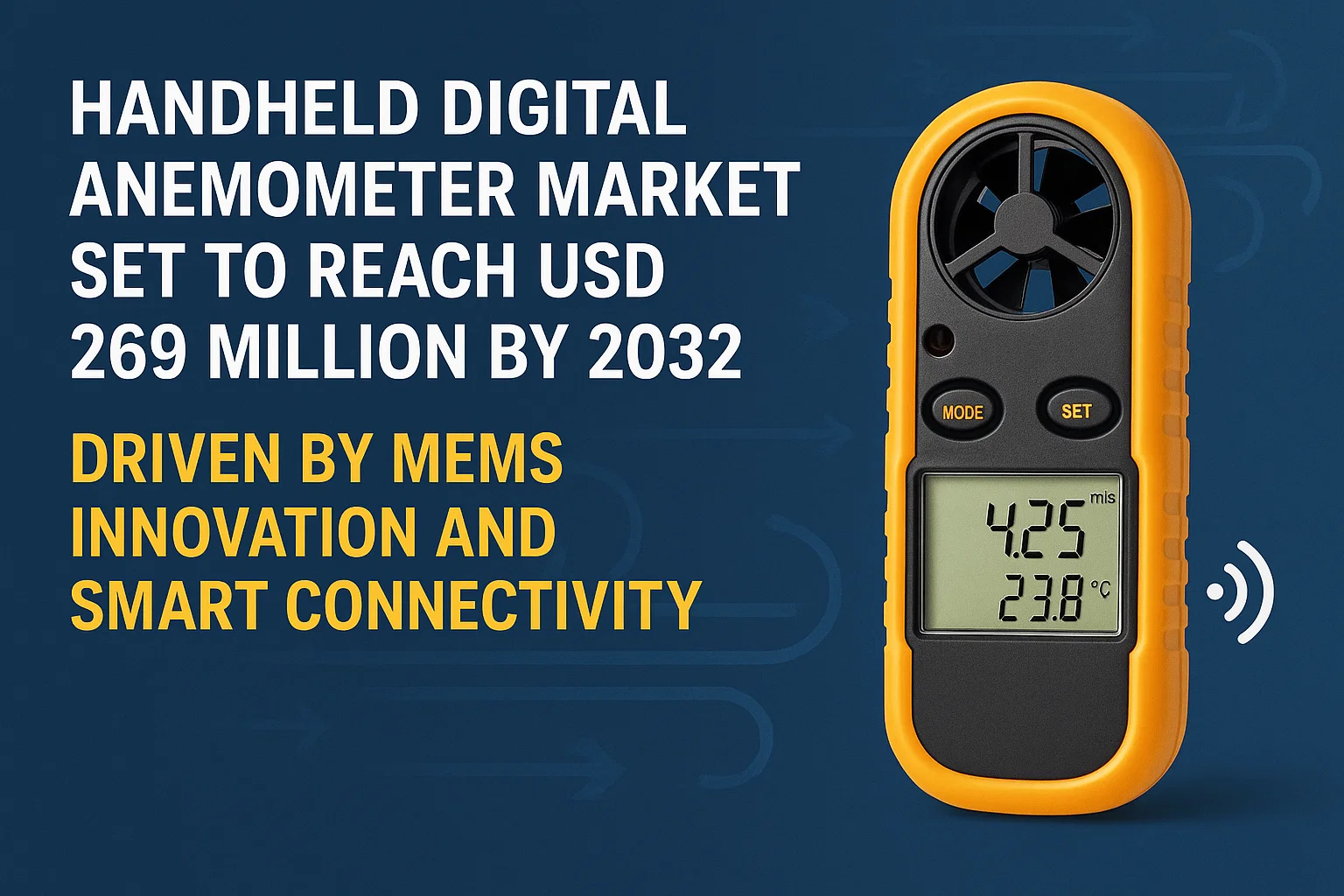
Handheld Digital Anemometer Market Set to Reach USD 269 Million by 2032, Driven by MEMS Innovation and Smart Connectivity
The global Handheld Digital Anemometer Market is undergoing significant transformation driven by technological advancements, expanding industrial applications, and growing demand for portable, precise wind-measurement devices. Valued at USD 191 million in 2024, the market is projected to grow steadily to USD 269 million by 2032, registering a compound annual growth rate (CAGR) of 5.1% during the forecast period.
As industries such as HVAC, renewable energy, environmental monitoring, and aerospace increasingly rely on real-time wind speed and airflow data, handheld digital anemometers have become indispensable tools. Recent developments, such as MEMS-based sensor innovations and connectivity upgrades, are reshaping the landscape, enabling these devices to be smaller, smarter, and more durable than ever before.
Access Your Free Sample Report- Handheld Digital Anemometer Market
1. Introduction to Handheld Digital Anemometers
A handheld digital anemometer is a portable instrument designed to measure wind speed, airflow velocity, and sometimes additional parameters such as temperature, humidity, and barometric pressure. These devices are widely used in:
- HVAC and building diagnostics – measuring air circulation and identifying inefficiencies in ventilation systems.
- Environmental and meteorological monitoring – tracking wind conditions for climate studies or outdoor activities.
- Industrial safety – monitoring ventilation in confined spaces, mines, or hazardous environments.
- Renewable energy – evaluating wind potential for turbine placement and performance.
- Aerospace and marine applications – measuring airflow and environmental variables for navigation and safety.
The transition from traditional mechanical vane anemometers to digital devices has been driven by the need for higher precision, user-friendly interfaces, and multi-parameter monitoring capabilities. With the integration of MEMS sensors, wireless connectivity, and smart analytics, handheld anemometers are now evolving into next-generation diagnostic tools for both professionals and researchers.
2. Market Growth Overview (2024–2032)
The handheld digital anemometer market has witnessed steady growth over the past few years, supported by increasing demand across industrial and environmental sectors. According to the latest projections:
- Market Size in 2024: USD 191 million
- Projected Market Size by 2032: USD 269 million
- CAGR (2024–2032):1%
Key Growth Drivers
- Rising HVAC adoption worldwide:
With stricter energy-efficiency regulations, HVAC professionals rely on precise airflow measurement to design and maintain systems, boosting demand for handheld anemometers. - Expansion of renewable energy projects:
As wind energy installations grow, the need for accurate wind assessments during planning and maintenance phases drives market growth. - Focus on occupational safety:
Industries such as mining, oil & gas, and construction use these devices to monitor air quality and ventilation, ensuring worker safety. - Technological advancements:
MEMS-based sensors, Bluetooth connectivity, and integration with mobile apps are making devices more appealing to modern users. - Increasing environmental concerns:
Climate scientists and environmental agencies are adopting handheld devices for field data collection to study wind patterns and pollution dispersal.
3. Recent Industry Developments
Several recent innovations and corporate activities have reshaped the handheld anemometer landscape. These developments highlight the shift towards miniaturization, ruggedness, and smart connectivity.
3.1 MEMS-Based Anemometer Sensors by Posifa Technologies
In June 2025, Posifa Technologies announced the showcasing of its PAV5000 series MEMS anemometer sensors at Sensors Converge 2025.
- Key features:
- MEMS-based solid-state design, making sensors more robust than fragile thermistor-based alternatives.
- Ideal for portable devices due to low power consumption and shock resistance.
- Suitable for HVAC diagnostics, industrial airflow monitoring, and integration into handheld instruments.
The earlier December 2024 launch of these sensors represented a paradigm shift, enabling manufacturers to design smaller, lighter, and more durable handheld devices.
This innovation addresses one of the market’s biggest challenges—sensor fragility during field use.
Impact on the market:
MEMS sensors are expected to significantly lower maintenance costs and improve accuracy, boosting adoption among industrial users and environmental researchers.
3.2 Improved Meteorological Design – Barani MeteoWind Compact²
In October 2024, Barani Design Technologies introduced an upgraded MeteoWind Compact² (Squared) instrument featuring:
- ICE-FREE black vane technology for extreme weather performance.
- Enhanced damping for smoother readings in turbulent conditions.
- Aerodynamic improvements for higher accuracy at low wind speeds.
Although primarily targeted at fixed meteorological stations, the design insights are influencing handheld devices, particularly in terms of ergonomics and sensitivity. Manufacturers are beginning to incorporate lightweight, low-inertia materials into portable vanes to improve responsiveness and reduce start-up thresholds.
3.3 Long-Duration Deployment of Sonic Anemometers
A team from Tufts University launched a custom sonic anemometer aboard a high-altitude balloon in May 2025.
- The mission aimed to circumnavigate the globe, capturing data on high-altitude wind patterns.
- Success in extreme environmental conditions validates the durability of modern sonic sensing technologies.
While sonic anemometers are traditionally larger and more expensive, this development demonstrates their potential miniaturization for handheld devices in the future, especially for high-precision scientific applications.
3.4 Industry Consolidation – STMicroelectronics and NXP Semiconductors
In July 2025, STMicroelectronics announced the acquisition of NXP Semiconductors’ sensor business for USD 950 million.
- This strategic move strengthens STMicro’s position in MEMS sensor technologies, which are crucial for the next generation of handheld anemometers.
- The acquisition is expected to streamline supply chains and accelerate innovation, benefiting manufacturers looking to integrate advanced sensing capabilities into portable devices.
Download Sample Report PDF- Handheld Digital Anemometer Market
3.5 Smart Connectivity for HVAC Professionals
HVAC technicians are increasingly demanding devices that integrate seamlessly with mobile apps and data-logging platforms.
Recent product updates have included:
- Bluetooth Low Energy (BLE) modules for wireless data transfer.
- Real-time diagnostics through smartphones and tablets.
- Cloud storage for long-term trend analysis.
These advancements reflect a broader shift towards connected diagnostic ecosystems, aligning handheld anemometers with Industry 4.0 standards.
4. Technology Trends Shaping the Market
The handheld digital anemometer market is evolving alongside broader technological shifts in sensor design, data analytics, and connectivity. Below are the most impactful trends:
| Trend | Description | Implications for Market |
| MEMS Sensor Integration | MEMS technology enables compact, rugged, and power-efficient wind measurement devices. | Boosts portability and reduces device fragility, expanding adoption in industrial fieldwork. |
| IoT and Smart Connectivity | Integration with smartphones and cloud platforms for real-time monitoring. | Opens new revenue streams for service-based analytics and remote diagnostics. |
| Multi-Parameter Measurement | Combining wind speed with temperature, humidity, and pressure in one device. | Increases utility and reduces the need for multiple instruments. |
| Self-Calibration & AI Algorithms | Devices automatically adjust for environmental factors using machine learning. | Enhances accuracy and reduces manual calibration needs. |
| Sustainability & Energy Efficiency | Low-power designs that extend battery life and reduce electronic waste. | Aligns with global sustainability goals and regulatory requirements. |
5. Applications Driving Market Demand
The versatility of handheld digital anemometers enables their adoption across diverse sectors:
5.1 HVAC Systems and Building Management
- Essential for airflow balancing, duct leakage detection, and energy efficiency audits.
- With the rise of green buildings, demand for precision airflow measurement tools is surging.
- Bluetooth-enabled devices are becoming popular among technicians for seamless data recording.
5.2 Renewable Energy Assessment
- Wind turbine site surveys require accurate handheld devices for preliminary measurements.
- Ongoing maintenance of wind farms relies on portable anemometers for quick diagnostics.
5.3 Environmental Monitoring and Research
- Climate scientists and field researchers use handheld devices to measure wind patterns affecting pollution dispersion, coastal erosion, and wildlife behavior.
- NGOs and government agencies deploy these tools for disaster management, such as tracking hurricanes or wildfires.
5.4 Industrial Safety
- Monitoring air circulation in mines, chemical plants, and confined spaces helps prevent accidents and ensure compliance with safety regulations.
- Growing occupational safety awareness is driving purchases in this sector.
6. Regional Insights
North America
- Leading region due to strong adoption in HVAC, renewable energy, and industrial safety sectors.
- Presence of key players like Kestrel Instruments and TSI Incorporated.
Europe
- Driven by strict environmental regulations and renewable energy expansion, especially in wind-rich countries like Germany and Denmark.
Asia-Pacific
- Fastest-growing region, led by China, India, and Japan.
- Rising urbanization and infrastructure projects create strong demand for HVAC diagnostics and environmental monitoring.
Latin America & Middle East
- Emerging opportunities in construction, oil & gas, and disaster management.
7. Competitive Landscape
The handheld digital anemometer market features a mix of established brands and innovative startups. Key players include:
- Kestrel Instruments – known for rugged, military-grade devices.
- TSI Incorporated – focuses on precision HVAC and industrial applications.
- Testo SE & Co. KGaA – offers multi-parameter handheld instruments.
- La Crosse Technology – consumer-focused weather monitoring tools.
- Posifa Technologies – MEMS sensor innovator shaping the future of portable devices.
Competition is intensifying as companies differentiate through:
- Sensor innovation.
- Smart connectivity features.
- Ruggedness for outdoor use.
- Cost-effectiveness for emerging markets.
8. Challenges and Opportunities
Challenges
- High competition and price pressure:
Low-cost manufacturers in Asia create downward pricing trends. - Calibration and accuracy issues:
Maintaining precise measurements under varying environmental conditions remains difficult. - Supply chain disruptions:
Semiconductor shortages could impact production timelines.
Opportunities
- Integration with AI-driven analytics platforms.
- Expansion in developing markets where HVAC adoption is rising.
- Customization for niche sectors like sports, agriculture, and drones.
Click Here To Download Full Sample Report- Handheld Digital Anemometer Market
9. Future Outlook
The next decade will see handheld digital anemometers become smarter, more connected, and highly specialized. By 2032, widespread adoption of MEMS sensors and IoT connectivity will make these devices integral to industrial workflows, environmental research, and smart city infrastructure.
Key predictions:
- Over 40% of new handheld devices will feature integrated wireless connectivity by 2028.
- AI-powered self-calibration will become a standard feature, reducing manual maintenance.
- Demand from renewable energy and climate science sectors will accelerate as global sustainability initiatives expand.
The handheld digital anemometer market is poised for steady growth, rising from USD 191 million in 2024 to USD 269 million by 2032.

Comments (0)