
The Growing Importance of Linear Absolute Encoders in Semiconductor Fabrication Systems
Semiconductor fabrication operates at a scale where accuracy is measured in nanometers, not millimeters. Linear absolute encoders have become indispensable in this environment, delivering exact position feedback without the need for recalibration. Their ability to retain positional data even after shutdowns makes them critical in high-value semiconductor processes where downtime translates directly into financial loss.
As chipmakers push below 5 nm and toward 2 nm nodes, positioning systems must achieve accuracy levels as tight as ±0.5 nanometers, placing linear absolute encoders at the center of precision engineering.
Market Landscape Backed by Deployment Data
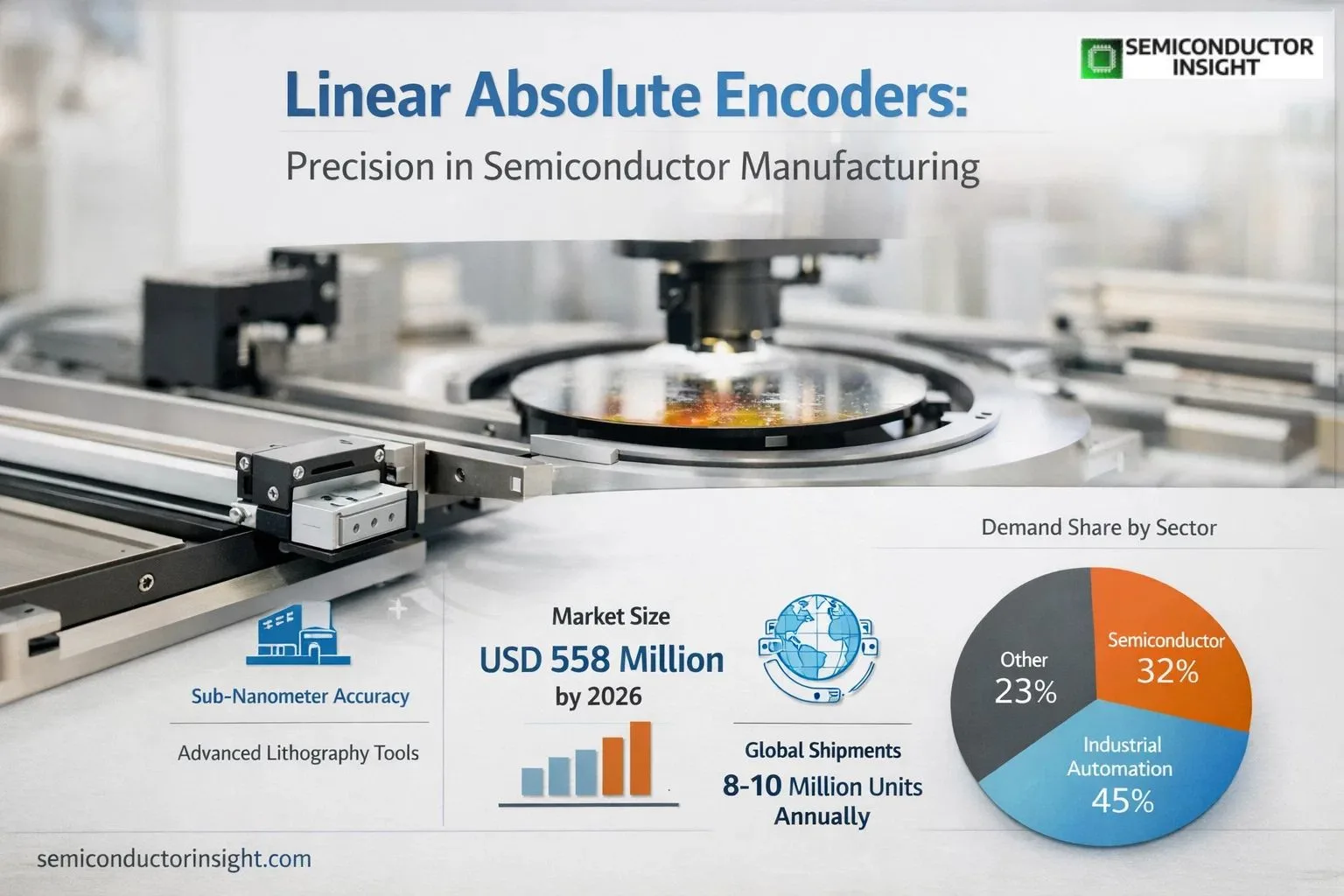
The linear absolute encoders market is steadily expanding, supported by semiconductor capital expenditure and industrial automation demand. The current market size is estimated at around USD 558 million in 2026, with semiconductor equipment contributing a significant share of high-value demand.
- Semiconductor applications account for nearly one-third of premium encoder revenues
- Annual global shipments are estimated at 8-10 million units across industries
- High-end encoder systems used in lithography tools range between USD 1,000 and USD 4,500 per unit
- Semiconductor fabs can deploy hundreds to thousands of encoders per facility depending on scale
This demand is closely tied to the rapid expansion of wafer fabrication capacity worldwide.
Inside the Technology: What Enables Absolute Precision
Linear absolute encoders function using coded scales that provide unique position values across the entire measurement length. This eliminates cumulative errors and ensures instant position detection.
Optical encoders lead in semiconductor environments, offering resolutions below 1 nm, thanks to advanced photoelectric sensing. These systems dominate high-end applications, contributing to over 65% of precision deployments in semiconductor tools.
Magnetic and inductive encoders, while slightly less precise, are gaining relevance in supporting processes due to their durability and ability to operate in environments exposed to contaminants and temperature variations.
Where Encoders Fit in a Semiconductor Fab
Within semiconductor fabrication facilities, linear absolute encoders are deeply embedded across critical systems. Their role extends far beyond simple motion tracking.
In lithography equipment, encoders ensure wafer stages align with extreme accuracy, often controlling movements across multi-axis systems operating at nanometer precision. In inspection systems, they enable scanning speeds exceeding 1 meter per second while maintaining positional accuracy.
Deposition and etching equipment also rely on encoders for synchronized layer formation, where even minor deviations can impact chip performance and yield.
You Can Freely Surf Our Latest Updated Report Here:
https://semiconductorinsight.com/report/linear-absolute-encoders-market/
Application Distribution Snapshot
Demand Share by End-Use Integration (%)
This breakdown highlights how semiconductor manufacturing stands out as a high-value, precision-driven segment, even though industrial automation leads in overall volume.
Innovation Trends Reshaping Encoder Capabilities
- The evolution of semiconductor technology is pushing encoder manufacturers to rethink performance boundaries.
- Recent advancements include ultra-fine interpolation techniques that enhance resolution beyond physical scale limitations, as well as compact encoder architectures designed for next-generation semiconductor tools where space optimization is critical.
- Thermal stability has also become a key focus area, with new systems capable of maintaining accuracy despite temperature fluctuations of ±5°C to ±10°C, a common challenge in high-speed fabrication environments.
- Additionally, digital communication interfaces are enabling seamless integration with smart factory systems, supporting real-time monitoring and predictive maintenance.
Investment Momentum and Demand Outlook
Semiconductor equipment investments have surpassed USD 100 billion annually, with a strong pipeline of new fabrication plants under development globally. Each facility requires extensive deployment of motion control systems, including high-precision encoders.
With more than 70 new fabs either planned or under construction, demand for linear absolute encoders is expected to remain strong, particularly for advanced nodes and EUV lithography systems. These environments demand not just accuracy, but consistency over long operational cycles.
Value Creation beyond Hardware
Linear absolute encoders are no longer viewed as standalone components they are integral to achieving higher yields and operational efficiency. By ensuring precise positioning, they directly influence defect reduction, throughput optimization, and cost control in semiconductor manufacturing.
As chip complexity increases and production tolerances tighten, the importance of these encoders continues to grow. They represent a critical intersection of materials science, precision engineering, and semiconductor innovation, quietly enabling the technologies that power modern electronics.

Comments (0)