
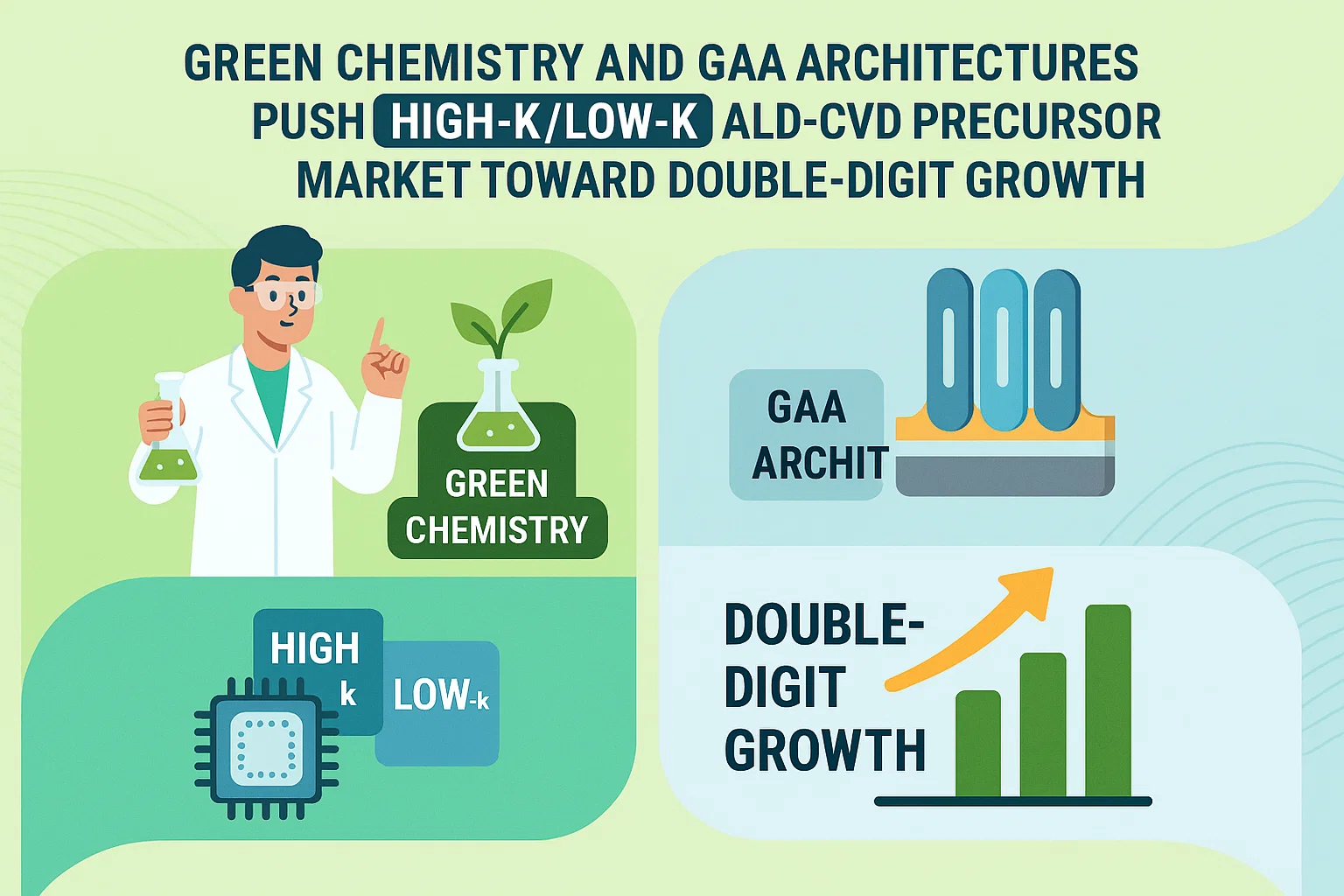
Green Chemistry and GAA Architectures Push High-k/Low-k ALD-CVD Precursor Market Toward Double-Digit Growth
The semiconductor industry, the silent powerhouse behind modern digital life, is undergoing a profound transformation. Central to this shift is the rapidly evolving market for high-k and low-k precursors used in Atomic Layer Deposition (ALD) and Chemical Vapor Deposition (CVD) processes. These advanced materials are critical for enabling the miniaturization, performance, and power efficiency of next-generation semiconductor devices.
Valued at USD 892.4 million in 2024, the High-k and Low-k Precursors for Semiconductor ALD and CVD market is projected to grow at a CAGR of 7.5%, reaching USD 1.47 billion by 2032.
Access Your Free Sample Report- High-k and Low-k Precursors for Semiconductor ALD and CVD Market
Understanding the Role of High-k and Low-k Precursors
What Are High-k and Low-k Dielectrics?
- High-k materials (high dielectric constant) are used to improve capacitance without increasing leakage currents, especially in gate dielectrics for transistors.
- Low-k materials (low dielectric constant) reduce parasitic capacitance between metal interconnects, thereby increasing signal speed and reducing power consumption.
In both cases, ALD and CVD techniques are crucial to depositing these materials in ultra-thin, conformal layers with atomic precision. The precursors—chemical compounds that decompose during deposition—determine the purity, uniformity, and electrical properties of these films.
Market Momentum: Key Statistics and Forecast (2025–2032)
| Year | Market Size (USD) |
| 2024 | $892.4 million |
| 2025 | $959.9 million |
| 2028 | $1.19 billion |
| 2032 | $1.47 billion |
- CAGR (2025–2032): 7.5%
- Growth Drivers: Advanced nodes (≤5nm), 3D architectures (GAA, FinFETs), chiplet packaging, demand for faster and greener materials.
- Top Growth Regions: Asia-Pacific, North America, and EU.
Recent Developments Shaping the Industry
- Applied Materials Launches Precursor Suite for Advanced Packaging
In late 2023, Applied Materials unveiled a new portfolio of high-k and CVD ALD precursors tailored for 2.5D and 3D heterogeneous integration. With chiplet-based architectures rising in popularity, traditional deposition techniques are struggling to meet conformality and thermal budget demands. Applied’s innovations now allow for:
- Lower-temperature deposition on sensitive substrates.
- Enhanced step coverage for 3D stacked chips.
- Compatibility with hybrid bonding and TSV (Through-Silicon Vias).
These advancements are vital for enabling gate-all-around (GAA) transistor structures in sub-5nm nodes.
- Environmental Sustainability Driving Precursor Reformulation
One of the biggest industry-wide pushes is the move away from halogenated and PFAS-based precursors due to environmental and health concerns. In 2024, several suppliers reported success in introducing:
- Halogen-free metal-organic precursors.
- Fluorine-free ruthenium compounds like Ru(EtCp)₂.
- Greener alternatives with reduced carbon footprints and improved safety profiles.
This trend aligns with global ESG mandates and EU’s REACH regulations, influencing both product design and fab procurement policies.
- Asia-Pacific Fab Expansion Fuels Precursor Demand
Asia-Pacific remains the epicenter of demand, contributing over 60% of global precursor consumption. Key developments include:
- TSMC’s and Samsung’s advanced node ramp-up requiring new hafnium and zirconium-based precursors.
- SK Hynix and Micron adopting low-temperature ALD chemistries for 3D NAND charge trap layers.
- Chinese fabs like SMIC investing in domestic precursor supply chains to combat export restrictions.
Regional governments are also subsidizing local precursor development under strategic autonomy initiatives.
- Innovation in Precursor Chemistry: Low-T Decomposition & Multimetal Blends
Companies such as Merck, Air Liquide, and Entegris are developing novel precursor formulas that enable:
- Low-temperature decomposition: Ideal for BEOL (Back End of Line) or fragile substrates.
- Multimetal heterometallic precursors: Enable deposition of composite oxides (e.g. Hf-La-Al-O blends) for tunable dielectric constants.
- Improved vapor pressure and shelf life, enabling easier transport and in-fab handling.
Download Sample Report PDF- High-k and Low-k Precursors for Semiconductor ALD and CVD Market
For instance, La(iPrCp)₃ and TEMAZr precursors are now widely used in logic and DRAM devices where precise bandgap control is needed.
- AI and Machine Learning Enter Precursor Optimization
Advanced fabs are now leveraging AI algorithms to:
- Simulate and predict precursor performance.
- Optimize precursor dosing for improved uniformity and lower waste.
- Accelerate discovery of new ligands and chemical combinations for novel applications.
This trend is particularly beneficial for ferroelectric HfO₂, a material gaining traction in memory and AI accelerators.
Technological Landscape: Key Applications of High-k and Low-k Precursors
Logic Devices
- GAA and FinFET transistors now rely on high-k gate stacks (e.g. HfO₂/TiN).
- Requires atomic-level control over precursor purity and reactivity.
Memory
- 3D NAND and DRAM capacitors need uniform deposition of high-k layers across deep trenches.
- ALD’s conformality is ideal here, using TEMAHf and similar precursors.
Interconnects
- Low-k precursors (e.g. organosilanes) reduce RC delay in metal lines.
- Emerging ruthenium and cobalt barriers use CVD precursors to replace traditional Ta/TaN layers.
Advanced Packaging
- 2.5D and 3D packages involve TSVs, hybrid bonding, and RDLs, needing ultra-thin dielectrics and diffusion barriers.
- Precursors must meet tight thermal and mechanical constraints.
Regional Dynamics: Who’s Leading the Charge?
Asia-Pacific
- Dominated by TSMC, Samsung, UMC, and SK Hynix.
- Governments (China, Taiwan, South Korea) investing in precursor R&D hubs.
- New ALD/CVD tools in fabs triggering a surge in demand for regional precursor production.
North America
- U.S. remains a tech leader in precursor R&D and equipment.
- Companies like Entegris, DuPont, and Lam Research partner with universities and national labs.
- Focus on sustainability, proprietary chemistries, and advanced deposition tools.
Europe
- Strength in green chemistry and regulation compliance.
- Merck KGaA and Air Liquide leading development of safe, scalable precursors.
- EU Chips Act funding local supply chain resilience and innovation.
Industry Challenges: What Could Slow Growth?
- Regulatory Hurdles: Restrictions on PFAS, REACH compliance, and waste disposal costs.
- Supply Chain Complexity: Geopolitical tensions and raw material dependencies.
- Technical Barriers: Thermal budgets, precursor shelf life, and residue management.
- High Cost of ALD: Despite precision, ALD is still costlier than some PVD/CVD methods for specific use-cases.
However, most of these challenges are catalysts for innovation, not roadblocks.
Key Players to Watch
| Company | Notable Contributions |
| Applied Materials | Advanced precursor delivery systems and platform integration. |
| Merck KGaA | Green high-k precursor chemistries and EU production. |
| Air Liquide | Low-T CVD precursors and sustainability leadership. |
| Entegris | Precursor purification and delivery technologies. |
| JSR Corporation | Organosilicon low-k precursors for interconnects. |
| DuPont | Metal-organic compounds for DRAM and NAND fabs. |
Future Outlook: Where Is This Headed?
The next 5–10 years will see a materials arms race between fabs and suppliers. With transistor scaling hitting physical limits, materials innovation becomes the primary enabler of Moore’s Law and performance gains. Some forecasts suggest:
- By 2028, over 70% of all new deposition processes will involve ALD or CVD with advanced precursors.
- Integration of high-k ferroelectrics could reshape nonvolatile memory architectures.
- Low-k air-gap replacements may emerge for ultra-low dielectric constant needs (<2.0).
- Hybrid deposition methods (e.g. ALD-CVD or PEALD) will offer precision + throughput balance.
Furthermore, AI-designed precursor molecules and automated chemical synthesis could drastically shorten product development cycles, propelling the market toward the USD 1.5 billion milestone even faster.
From the nanoscale trenches of DRAM capacitors to the ultra-thin gates in next-gen transistors, high-k and low-k precursors for ALD and CVD are powering the future of electronics. The industry’s push for faster, smaller, and greener chips is firmly anchored in the materials revolution now underway.
With a projected market value of USD 1.47 billion by 2032, driven by a CAGR of 7.5%, this segment is not just a component of the semiconductor supply chain—it’s the crucible of tomorrow’s innovation.

Comments (0)