
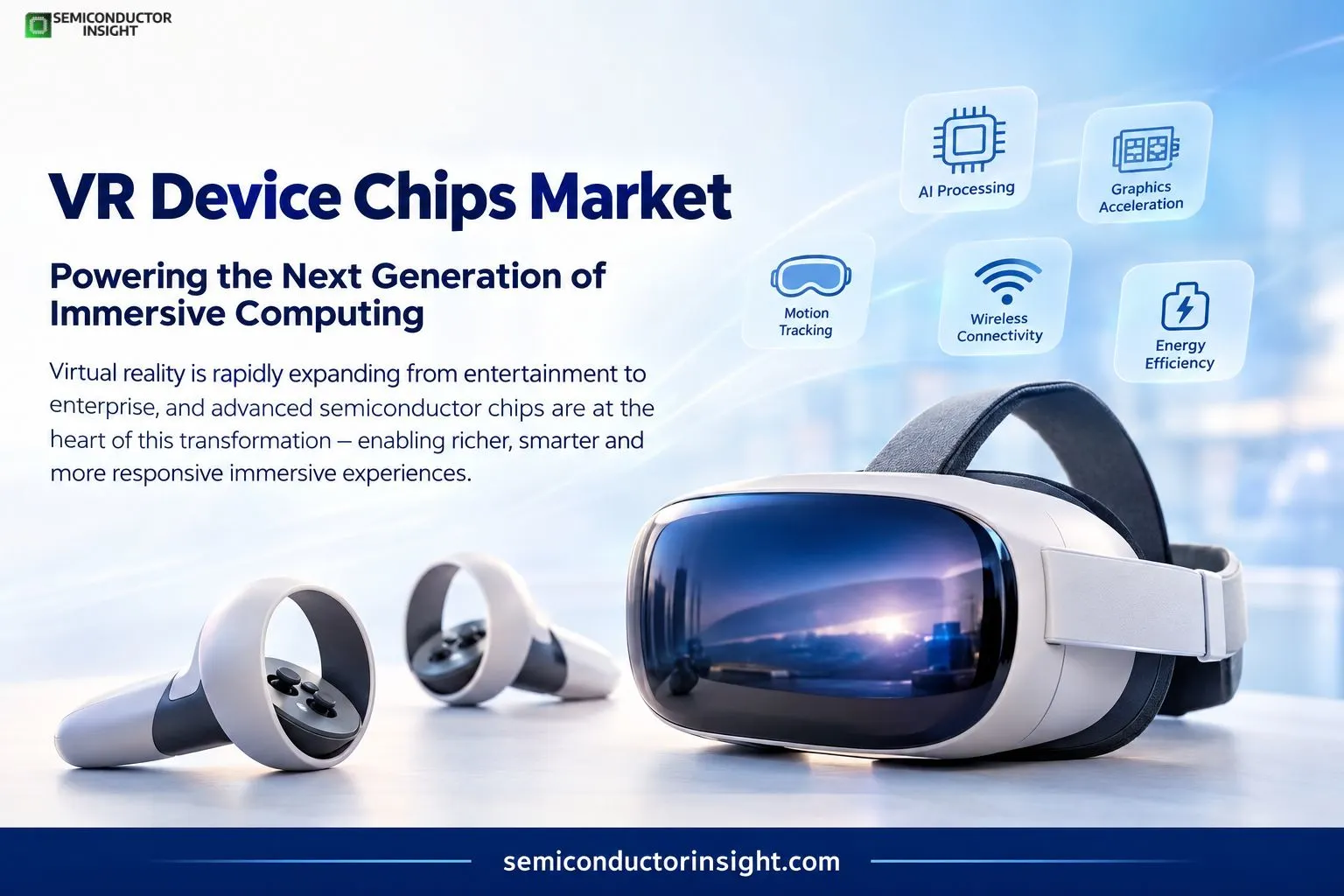
Global VR Device Chips Market 2026 Over 30 Million Headsets Driving High Performance Semiconductor Demand
Virtual reality has evolved from a niche entertainment platform into a broader computing ecosystem supporting education, industrial design, healthcare, manufacturing, defence, and enterprise collaboration. At the centre of this transformation lies VR Device Chips Market, where semiconductor innovation determines how realistically virtual environments are rendered, processed, and experienced.
Modern VR chipsets combine artificial intelligence, graphics acceleration, computer vision, connectivity, and power management into compact systems capable of handling demanding workloads with minimal latency. As headset manufacturers continue introducing lighter and more capable devices, chip designers are focusing on delivering desktop level performance within mobile power limits.
The Computing Engine behind Every Virtual Experience
- A VR headset relies on far more than a graphics processor. Today’s chip platforms integrate multiple specialised processing blocks that operate simultaneously to create immersive experiences.
- A typical VR chipset includes multi core CPUs, GPUs, AI accelerators, image signal processors, digital signal processors, motion tracking engines, memory controllers, wireless connectivity modules, and advanced security processors.
- These components continuously process user movement, eye tracking, hand gestures, voice commands, and high resolution displays within milliseconds.
- This level of integration allows standalone headsets to operate independently without requiring a powerful external computer.
Hardware Numbers Reflect the Expanding XR Ecosystem
The broader extended reality ecosystem is creating measurable demand for advanced semiconductor solutions.
According to the International Data Corporation (IDC), global shipments of augmented reality and virtual reality headsets exceeded 7 million units in 2024 despite temporary market adjustments. Meanwhile, Meta has announced cumulative sales of its Quest headset family reaching well over 30 million units, making it one of the largest installed VR ecosystems globally.
Modern premium headsets now feature displays exceeding 2,000 × 2,000 pixels per eye, refresh rates of 90 Hz to 120 Hz, and motion tracking systems capable of processing thousands of sensor measurements every second. These hardware specifications significantly increase demand for high efficiency semiconductor architectures.
AI Is Quietly Becoming the Most Important VR Chip Feature
Artificial intelligence has become an essential capability rather than an optional enhancement.
Dedicated neural processing units now perform eye tracking, scene reconstruction, gesture recognition, environmental mapping, voice interaction, and predictive rendering directly on the device. Instead of sending every workload to cloud servers, AI processing happens locally, reducing latency while improving privacy.
Several recently introduced XR platforms also employ AI powered foveated rendering, allocating maximum graphics performance only where the user’s eyes are focused. This approach reduces computational load without sacrificing visual quality, enabling longer battery life and smoother experiences.
You can freely browse our most recent updated report to learn more about it before scrolling further: https://semiconductorinsight.com/report/vr-device-chips-market-2/
Semiconductor Innovation Moves Beyond Graphics Performance
- The latest generation of VR chips is no longer designed solely around faster graphics.
- Manufacturers are adopting advanced packaging technologies, heterogeneous computing architectures, chiplet integration, and smaller fabrication nodes to improve overall efficiency.
- High bandwidth memory interfaces, low latency cache systems, and specialised image processing engines are enabling more realistic mixed reality experiences while keeping thermal output under control.
- These architectural improvements are especially important as headset designs become thinner and lighter without compromising computing capability.
Enterprise Adoption Is Changing Chip Design Priorities
While gaming remains an important application, enterprise adoption is influencing semiconductor development in new ways.
Manufacturing companies increasingly use VR for equipment maintenance training, automotive firms rely on immersive product design environments, healthcare organisations conduct surgical simulations, and engineering teams collaborate using digital twins.
Enterprise users demand extended operating hours, stronger cybersecurity, higher reliability, and consistent performance. As a result, semiconductor vendors are optimising chipsets for professional workloads that require continuous operation rather than short gaming sessions.
Product Launches Keeping the Innovation Cycle Active
Devices such as Apple Vision Pro, Meta Quest 3, and Sony PlayStation VR2 have introduced higher resolution displays, advanced sensor arrays, spatial computing capabilities, and advanced eye tracking technologies.
Supporting these systems requires semiconductor platforms capable of processing multiple high speed camera feeds, depth sensors, inertial measurement units, and AI workloads simultaneously.
Every new headset generation raises performance expectations, encouraging semiconductor companies to develop more specialised processors for immersive computing applications.
Energy Efficiency Becoming a Defining Performance Metric
Raw computing power alone is no longer sufficient for next generation VR devices. Battery life, thermal efficiency, and compact form factors have become equally important performance indicators.
Chip designers are reducing energy consumption through adaptive workload scheduling, dynamic voltage scaling, intelligent power gating, and AI based resource allocation. These improvements enable extended usage while maintaining consistent frame rates and reducing heat generation, which directly enhances user comfort during prolonged sessions.

Comments (0)