
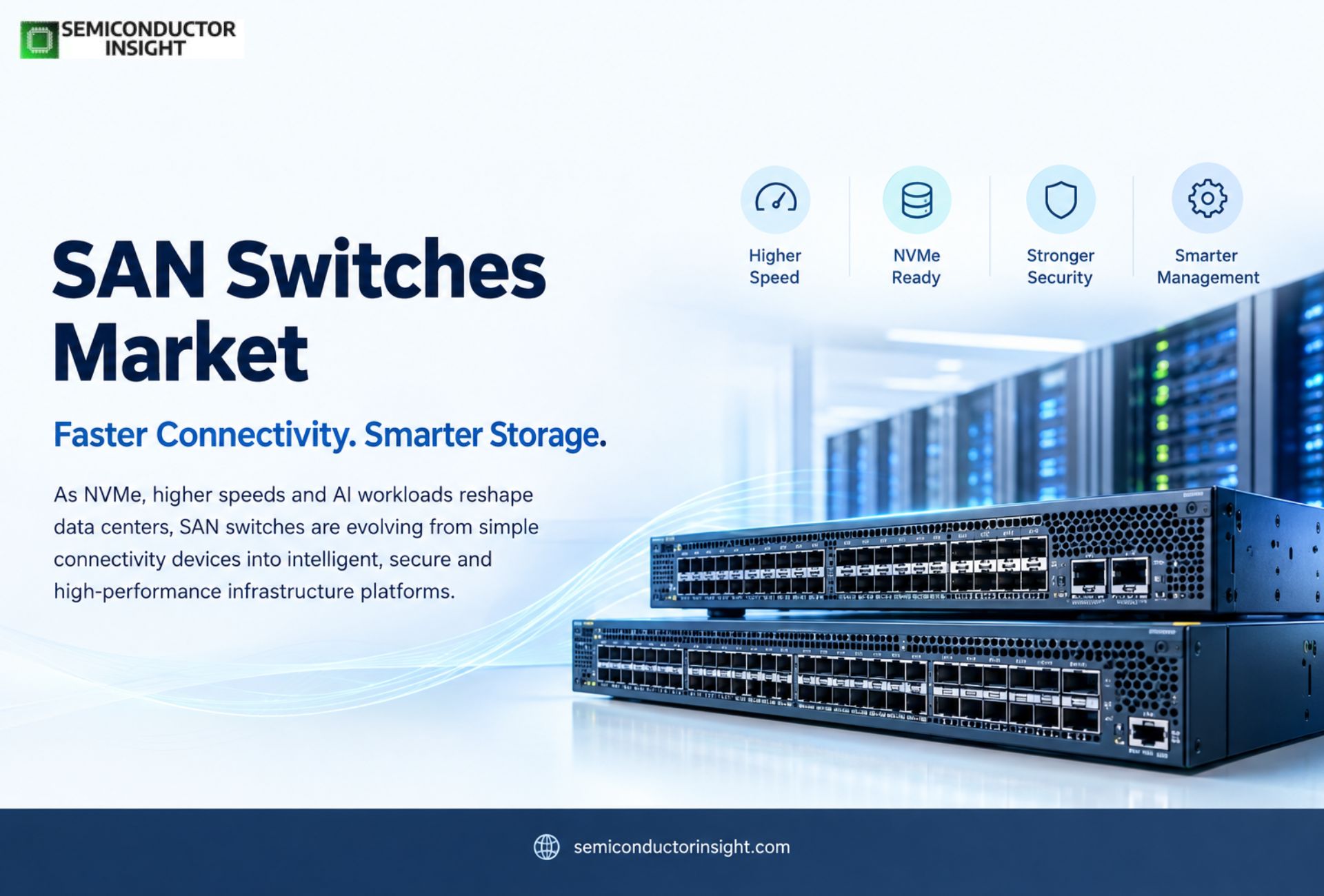
Global SAN Switches for 2026 Connects 64G and 128G Fibre Channel with Next-Generation Storage Infrastructure
Storage Area Network switches occupy a less visible part of the semiconductor and data-center infrastructure stack, but their role becomes increasingly important as enterprise storage moves toward all-flash arrays, NVMe and increasingly demanding AI workloads. A SAN switch connects servers to shared storage through a dedicated fabric, allowing storage traffic to be managed separately from conventional application networking.
The technology is also moving well beyond the traditional 16G and 32G Fibre Channel generations. Current platforms now reach 64G, while the newest generation is pushing toward 128G connectivity. This transition is occurring alongside improvements in telemetry, automated fabric management, cybersecurity and low-latency switching.
The Speed Race Has Reached the Storage Fabric
- The specifications of current products demonstrate how quickly SAN infrastructure is advancing.
- Broadcom’s Brocade portfolio includes the G820 with 24 to 56 ports operating at 128G and a total line rate of 7.168 Tb/s. Its G730 provides 48 to 128 ports at 64G and a total line rate of 8.192 Tb/s.
- Cisco’s current MDS portfolio similarly includes 24-, 48- and 96-port 64G Fibre Channel configurations. The MDS 9396V, for example, provides 96 ports and is designed for high-speed connectivity to all-flash arrays and high-performance hosts.
- These numbers reveal an important shift: SAN development is increasingly being measured not only by port count, but also by aggregate bandwidth, latency, density and the ability to accommodate newer storage protocols.
The New SAN Architecture Is Built Around NVMe
NVMe over Fibre Channel is changing how SAN switches are positioned inside modern storage environments. NVMe was developed around the characteristics of flash and solid-state storage, while Fibre Channel provides a purpose-built fabric for controlled, reliable storage connectivity.
Modern SAN switches are consequently being designed to support both established Fibre Channel environments and NVMe/FC workloads. Cisco’s MDS 9148V supports 64G Fibre Channel and NVMe/FC, while IBM’s SAN24C-7 provides up to 24 ports at 64 Gbps and supports transition to NVMe/FC without requiring a SAN hardware upgrade.
This compatibility is important for enterprises that cannot replace their complete storage infrastructure every time a new protocol emerges.
A Modern SAN Fabric Now Looks Like This
High-performance servers
↓
Fibre Channel host adapters
↓
64G / 128G SAN switches
↓
Redundant SAN fabric
↓
All-flash or NVMe storage arrays
↓
Databases, virtualization, AI and mission-critical applications
The architecture is increasingly supported by telemetry and automation, allowing administrators to monitor congestion, latency and fabric health rather than relying entirely on manual troubleshooting.
Port Density Is Becoming a Design Metric
Higher port density is one of the clearest changes in current SAN hardware. Earlier systems often served smaller environments with comparatively modest port counts, whereas current platforms can consolidate substantially more storage connections inside a compact rack footprint.
Broadcom’s Brocade G720, for example, can scale from 24 to 64 ports and provides 48 64G SFP+ ports alongside eight double-density 2×64G SFP-DD ports. Broadcom also states that its Gen 7 architecture delivers 50% lower switching latency than the previous generation on the G720.
This type of scaling gives data-center operators the option to increase connectivity without proportionally increasing the number of physical switches.
You Can Freely Surf Our Latest Updated Report Here: https://semiconductorinsight.com/report/san-switches-market/
128G Is Opening the Next Upgrade Window
The arrival of 128G Fibre Channel represents a notable technology milestone. IBM’s SAN56B-8, introduced for modern data centers, provides 56 128G SFP+ ports and can scale from 24 to 56 ports in eight-port increments.
Broadcom’s G820 similarly supports 128G connectivity with up to 56 ports and a 7.168 Tb/s total line rate.
The practical implication is that storage fabrics are gaining bandwidth without requiring organizations to abandon Fibre Channel altogether. For existing SAN users, this creates an incremental upgrade path rather than an immediate infrastructure reset.
SAN Security Is Becoming a Hardware-Level Requirement
- Storage networks increasingly carry databases, backups, virtual-machine data and other business-critical information, making security a fabric-level consideration.
- Modern SAN platforms incorporate capabilities such as zoning, authentication, secure boot, role-based access control and hardware-based isolation.
- IBM’s SAN96C-6, for example, supports VSAN fabric isolation, hardware zoning through access-control lists, Fibre Channel Security Protocol authentication and role-based access control.
- The direction is clear: SAN switches are no longer being evaluated purely as connectivity hardware. Security, visibility and operational resilience are becoming part of the switch specification itself.
The Management Layer Is Getting Smarter
Another significant change is the movement toward autonomous SAN operations. IBM’s Gen 7 SAN infrastructure describes self-learning, self-optimizing and self-healing capabilities, while Cisco’s current MDS platforms incorporate analytics and telemetry directly into the switching architecture.
Cisco also documents SAN port channels that aggregate Fibre Channel interfaces to improve bandwidth utilization and availability, with transparent failover between uplinks.
This means the SAN switch is evolving from a relatively passive connection point into an intelligent infrastructure component capable of contributing to performance monitoring and operational automation.
Where SAN Switches Fit Into the 2026 Data Center
The strongest use cases remain environments where storage availability, predictable latency and controlled data movement are essential. Banking platforms, healthcare databases, enterprise virtualization, large-scale analytics, backup infrastructure and high-performance computing all depend on storage networks that can maintain connectivity under demanding workloads.
The emergence of AI infrastructure adds another layer to this requirement. AI systems are heavily dependent on high-throughput storage pipelines for training datasets, checkpoints and inference workloads. While Ethernet-based architectures are prominent in AI data-center networking, Fibre Channel remains relevant where enterprises maintain dedicated storage fabrics and need a controlled path between compute hosts and high-performance storage.
The Technology Story Is No Longer Just About Faster Ports
SAN switches market in 2026 is being reshaped by a combination of faster Fibre Channel generations, greater port density, NVMe compatibility, integrated analytics and stronger security. The movement from 32G to 64G and now 128G demonstrates how storage connectivity is being upgraded alongside flash storage and increasingly data-intensive computing.
The more important development is that SAN switches are becoming intelligent infrastructure platforms rather than simple connectivity devices. Their value increasingly comes from how efficiently they connect storage, identify fabric conditions, protect traffic and provide a controlled upgrade path for organizations moving toward next-generation data-center architectures.

Comments (0)