
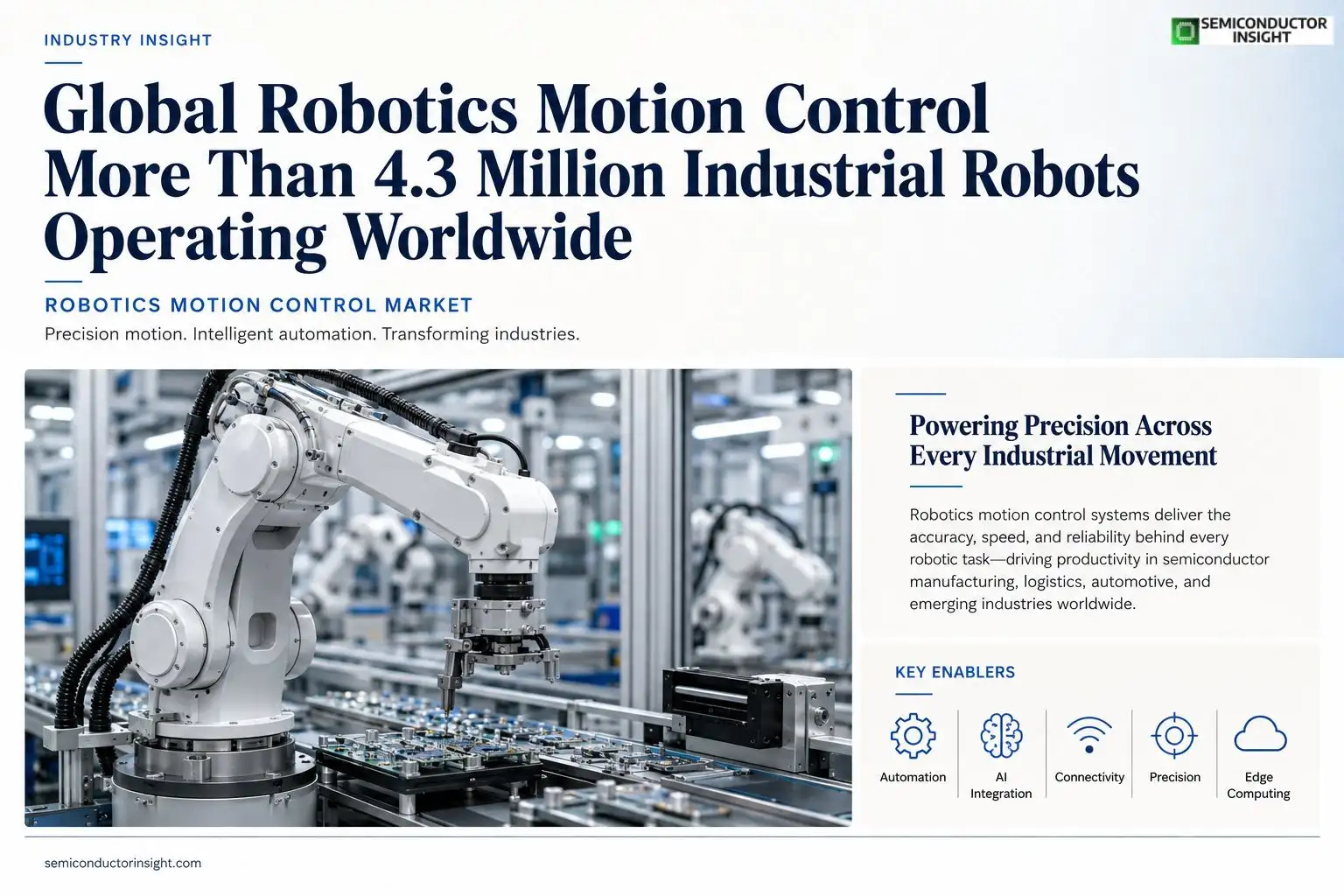
Global Robotics Motion Control Market 2026: More Than 4.3 Million Industrial Robots Operating Worldwide Supported by Advanced Motion Control Systems
The conversation around robotics often focuses on machines, sensors, and artificial intelligence. Yet behind every precise robotic movement lies a less visible but equally important technology: motion control. Whether assembling semiconductor chips, sorting packages in logistics hubs, or welding electric vehicle batteries, robotics motion control systems determine how accurately, efficiently, and safely machines perform their tasks.
As industries worldwide invest heavily in automation, robotics motion control technologies are becoming the operational backbone of smart manufacturing, advanced warehousing, and next-generation industrial infrastructure.
The Silent Technology Guiding Every Robotic Movement
Motion control systems coordinate motors, drives, controllers, feedback devices, and software algorithms to ensure robots execute movements with exceptional precision.
From micro-scale semiconductor fabrication to large-scale automotive assembly, these systems regulate:
· Position accuracy
· Speed control
· Torque management
· Path optimization
· Synchronization of multiple robotic axes
Without advanced motion control, even the most sophisticated robot would struggle to perform complex tasks consistently.
Motion Control Technology Chain
Sensors
↓
Controllers
↓
Servo Drives
↓
Motors
↓
Robot Movement
↓
Real-Time Feedback
↓
Continuous Optimization
Semiconductor Manufacturing Raises Precision Requirements
The semiconductor industry has become one of the strongest adopters of advanced robotics motion control systems. Modern chip fabrication requires extraordinary positioning accuracy, often measured in microns or even nanometres.
As AI processors, advanced memory chips, and high-performance computing devices become increasingly complex, semiconductor production facilities are expanding investments in robotic automation capable of maintaining consistent precision throughout manufacturing processes.
Recent fab expansion projects across the United States, Taiwan, South Korea, Japan, and Europe are creating additional demand for highly specialized motion control platforms integrated into wafer handling, packaging, inspection, and testing operations.
Industrial Robot Deployment Continues Breaking Records
According to statistics published by the International Federation of Robotics, the global operational stock of industrial robots has surpassed 4 million units.
Global Robotics Snapshot
The industrial automation sector continues to expand steadily, supported by the rising deployment of industrial robots across manufacturing, logistics, electronics, and automotive operations. With more than 4.3 million operational industrial robots and over 500,000 new installations each year, the need for advanced motion control systems is becoming increasingly important.
Servo motors, drives, and controllers serve as the core motion components in these setups, enabling higher performance, precision, and productivity in every new robotic installation.
Warehouses Are Becoming Dynamic Motion Ecosystems
ü The rise of e-commerce has transformed distribution centers into highly automated environments where motion control technology plays a central role.
ü Autonomous mobile robots, robotic picking systems, automated guided vehicles, and sorting platforms rely on coordinated motion control to navigate complex environments while handling thousands of products every hour.
ü Major logistics operators continue deploying intelligent robotic fleets capable of dynamically adjusting movement paths based on real-time warehouse conditions. These systems help improve throughput while reducing operational bottlenecks.
Warehouse Automation Flow Map
Order Received
↓
Warehouse Management System
↓
Motion Controller
↓
Autonomous Robot
↓
Item Retrieval
↓
Sorting and Routing
↓
Shipment Processing
Electric Vehicle Production Demands Perfect Synchronization
Battery manufacturing and EV assembly have emerged as major opportunities for robotics motion control technologies.
Modern battery production involves highly repetitive processes including cell stacking, laser welding, adhesive dispensing, module assembly, and quality inspection. These operations require motion systems capable of maintaining exact positioning over thousands of production cycles.
Recent EV manufacturing investments announced across North America, Europe, China, and India highlight how robotic automation is becoming fundamental to scaling production efficiently.
Our most recent updated related study is available for free at this link: https://semiconductorinsight.com/report/robotics-motion-control-market/
Software Is Becoming as Important as Hardware
Historically, motion control focused heavily on mechanical and electronic components. Today, software innovation is increasingly driving performance improvements.
Advanced motion control platforms now integrate:
o AI-assisted trajectory planning
o Predictive maintenance analytics
o Digital twin simulations
o Edge computing capabilities
o Machine vision synchronization
These technologies allow robotic systems to adapt dynamically to changing production conditions while minimizing downtime.
Collaborative Robots Introduce a New Motion Philosophy
The emergence of collaborative robots, or cobots, has created new requirements for motion control design. Unlike traditional industrial robots operating behind safety barriers, cobots work alongside human operators.
This environment requires motion systems capable of:
o Instant speed adjustment
o Collision detection
o Force-sensitive operation
o Safe trajectory planning
The ability to balance productivity with human safety is making advanced motion control one of the most strategically important technologies in collaborative automation.
Precision Becomes the Currency of Industrial Automation
The next phase of robotics adoption will not be defined solely by the number of robots deployed but by how intelligently they move. As semiconductor manufacturing, AI infrastructure, logistics automation, and advanced production systems continue evolving, robotics motion control technologies are becoming essential enablers of industrial performance.
From microscopic chip fabrication processes to large-scale automated warehouses, motion control systems are increasingly serving as the intelligence layer that transforms robotic hardware into productive, reliable, and highly efficient industrial assets.

Comments (0)