
Global PMNT Single Crystals Market Driving Breakthroughs in Piezoelectric Technologies
In the fast-evolving world of semiconductors and advanced electronics, materials that deliver exceptional electromechanical properties are no longer optional they’re essential. PMNT single crystals (lead magnesium niobate-lead titanate, or PMN-PT) stand out as a standout relaxor ferroelectric material.
With piezoelectric coefficients often reaching 1500-2000 pC/N or higher several times that of conventional PZT ceramics PMNT offers superior sensitivity, broader bandwidth, and better energy conversion efficiency. For device makers pushing the limits of miniaturization and performance, this translates directly into competitive advantage.
What Makes PMNT Single Crystals Unique in Semiconductor Contexts?
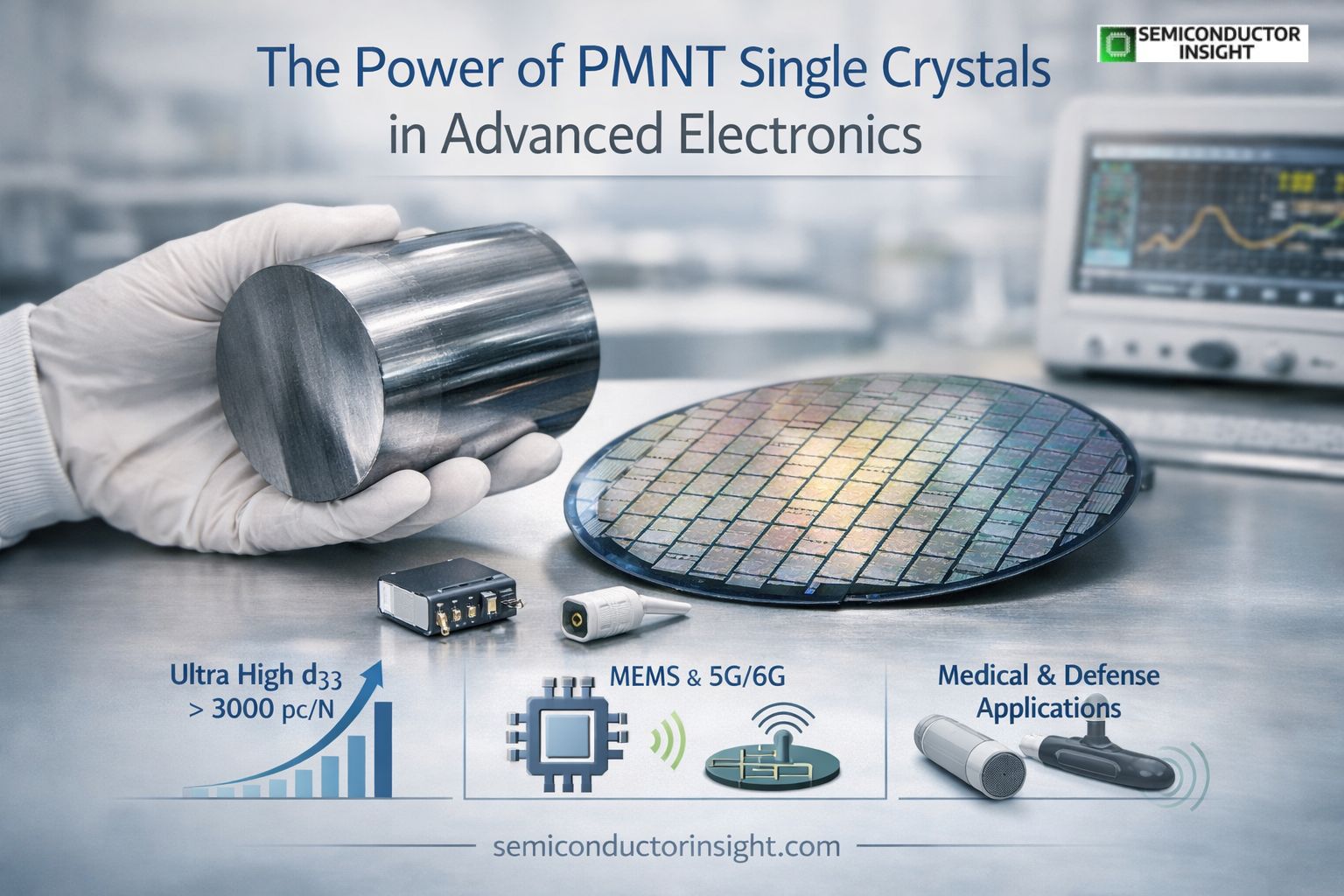
PMNT single crystals have strongly aligned domains that allow for tailored domain layouts, in contrast to polycrystalline ceramics. This leads to remarkable d33 values, sometimes surpassing 3000 pC/N in doped variations like Sm-PMN-PT, and electromechanical coupling factors (k33) that approach 0.93. These qualities are particularly useful in applications that need for accurate sensing or actuation under various circumstances.
In semiconductor-adjacent fields, PMNT integrates well with silicon processes. Researchers have successfully grown epitaxial PMN-PT heterostructures on Si wafers, opening doors to hybrid devices that combine ferroelectric and semiconductor functionalities. This compatibility supports emerging needs in MEMS (micro-electro-mechanical systems), RF filters for 5G/6G, and ferroelectric field-effect transistors for low-power computing.
Current Market Dynamics and Growth Indicators
- Demand for PMN-PT single crystals has accelerated alongside the push for higher-resolution medical imaging, advanced defence systems, and efficient energy harvesters.
- Production volumes have grown steadily, with manufacturers expanding boule diameters and improving yields through refined Bridgman and flux growth techniques.
- In recent years, capacity additions focused on 3-4 inch crystals have helped address supply constraints while lowering per-unit costs by 20-30% in some segments.
- Global interest remains strong in Asia Pacific regions, particularly where electronics manufacturing clusters drive transducer and sensor production.
- North American and European players emphasize high-reliability variants for aerospace and naval applications.
- While exact market sizing varies by source, consistent reports point to steady expansion in the low hundreds of millions USD range, supported by double-digit percentage growth in key end-use sectors through the late 2020s.
- Volume growth is notable in medical ultrasound probes, where PMNT has enabled thinner, more sensitive arrays that improve diagnostic accuracy without increasing device size.
Key Applications Transforming Industries
- Medical ultrasound remains a flagship success story. PMNT-based transducers deliver broader bandwidth and higher sensitivity than traditional PZT, resulting in clearer images at higher frequencies. Companies like ALPINION have commercialized full lines of affordable PMN-PT probes, demonstrating how single-crystal technology can move from research labs to widespread clinical use.
- In defense and marine sectors, PMNT excels in sonar transducers. Its low-frequency performance and high conversion efficiency enhance detection ranges in underwater acoustic systems.
A 2024-2025 case study on naval applications showed PMN-PT 1-3 composites doubling thickness-mode coupling compared to standard PZT, directly improving system sensitivity while reducing power consumption.
- Semiconductor-related uses are expanding too. High-frequency needle transducers (as small as 0.4 mm aperture) fabricated with PMN-PT support precision industrial processes and minimally invasive medical tools.
- Energy harvesting prototypes using PMN-PT generate significantly higher power density than PZT equivalents under similar vibration ideal for powering wireless IoT sensors in industrial or automotive settings.
- Recent experiments with PMN-PT nanobelts and thin films even point toward flexible or skin-conformal sensors for wearable health monitoring.
Lastly, for more in-depth information, don’t forget to read our most recent exclusive report: https://semiconductorinsight.com/report/pmnt-single-crystals-market/
Why PMNT Single Crystals Matter for Your Operations?
For semiconductor and electronics professionals, PMNT isn’t just another exotic material it’s a strategic enabler. Whether you’re designing high-bandwidth transducers, compact actuators for precision positioning, or sensors that must perform reliably in harsh environments, the material’s combination of high piezoelectric response, low acoustic impedance, and process compatibility delivers measurable gains in performance and efficiency.
As industries demand smarter, smaller, and more energy-efficient devices, PMNT single crystals are positioned to play an even larger role. Staying ahead means evaluating these crystals early in your material selection process especially as supply chains mature and application examples multiply.

Comments (0)