PMNT Single Crystals Market Insights
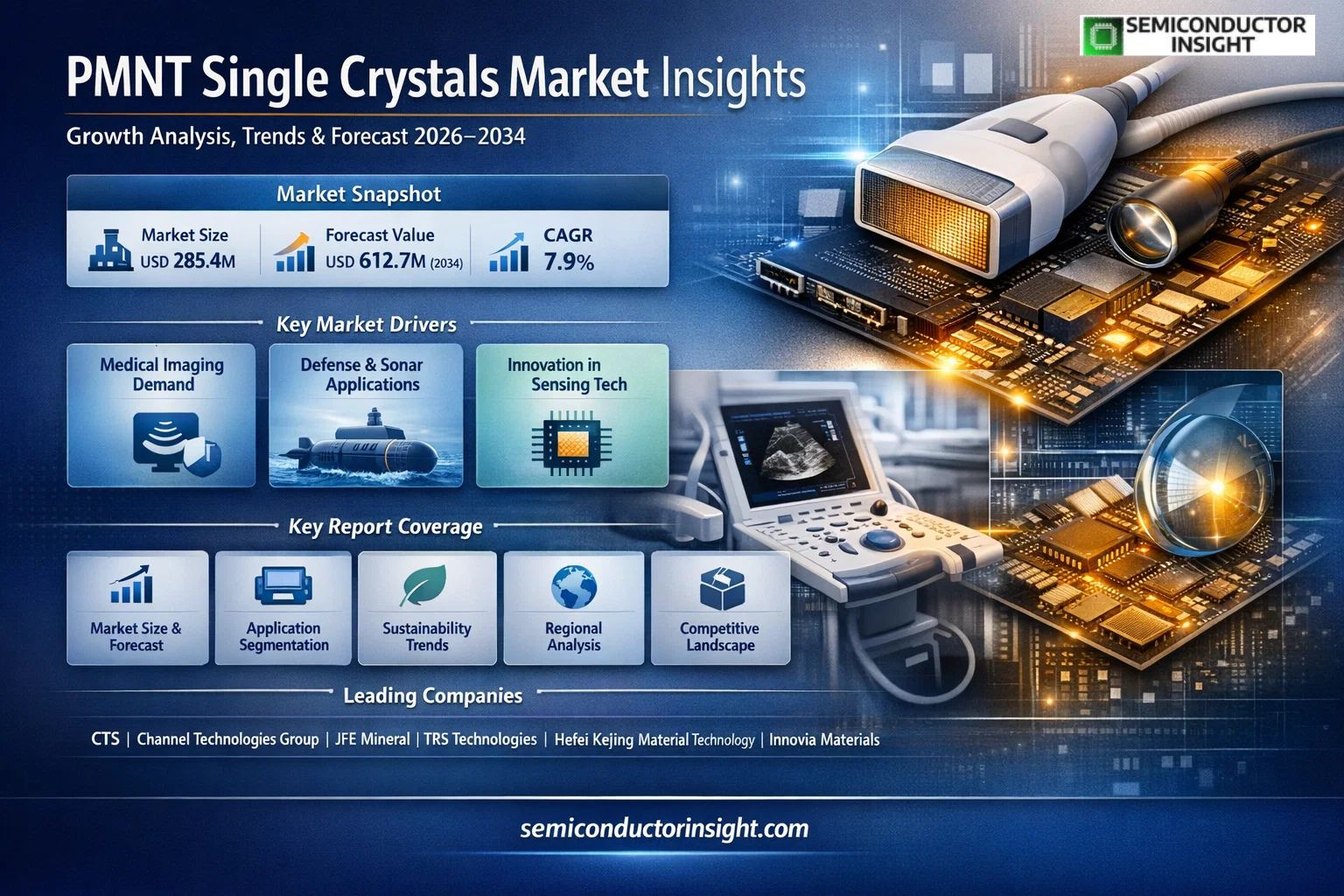
Global PMNT Single Crystals market size was valued at USD 285.4 million in 2025. The market is projected to grow from USD 308.6 million in 2026 to USD 612.7 million by 2034, exhibiting a CAGR of 7.9% during the forecast period.
PMNT single crystal is a high-performance relaxor ferroelectric single crystal distinguished by its exceptional piezoelectric effect. Characterized by a high voltage constant, large electromechanical coupling coefficient, high dielectric constant, and notably low loss, PMNT single crystals deliver piezoelectric performance approximately 10 times superior to that of conventional piezoelectric materials. These remarkable properties position PMNT single crystals as a critical advanced material across a broad range of industries, including optics, medical equipment, and electronics.
The market is gaining strong momentum, driven by rising demand for high-sensitivity ultrasonic transducers in medical imaging systems, growing adoption in sonar and defense applications, and accelerating innovation in electronic sensing technologies. Key global manufacturers operating in the PMNT Single Crystals space include CTS, Channel Technologies Group, JFE Mineral, TRS Technologies, Hefei Kejing Material Technology, and Innovia Materials (Shanghai), among others, collectively shaping the competitive landscape of this specialized advanced materials market.
MARKET DRIVERS
Rising Demand for High-Performance Piezoelectric Materials in Ultrasonic and Medical Imaging Applications
PMNT single crystals market is experiencing significant growth momentum driven by the increasing adoption of high-performance piezoelectric materials across ultrasonic transducer and medical imaging sectors. PMNT (lead magnesium niobate–lead titanate) single crystals exhibit superior electromechanical coupling coefficients and strain values compared to conventional PZT ceramics, making them highly sought after for next-generation ultrasound probe development. Medical device manufacturers are actively transitioning toward PMNT-based transducers to achieve higher resolution imaging, particularly in cardiology, radiology, and oncology diagnostics. The demand for minimally invasive procedures and point-of-care diagnostics has further accelerated the integration of PMNT single crystals into compact, high-sensitivity ultrasound equipment.
Expanding Defense and Sonar Applications Fueling Market Expansion
Defense modernization programs across North America, Europe, and Asia-Pacific are increasingly incorporating PMNT single crystal-based sonar systems and acoustic sensors, creating a robust demand stream for the market. The superior sensitivity and bandwidth characteristics of PMNT crystals enable enhanced underwater acoustic detection capabilities that are critical for naval defense platforms. Government-funded research programs and increased defense budgets in key economies have led to sustained procurement of PMNT-based piezoelectric components for sonar arrays, hydrophones, and underwater communication systems. This defense-driven demand continues to serve as a strong and consistent market driver throughout the forecast period.
➤ PMNT single crystals demonstrate electromechanical coupling coefficients (k33) exceeding 90% and piezoelectric strain coefficients (d33) ranging between 1,500–2,500 pC/N, significantly outperforming conventional polycrystalline PZT materials and solidifying their position as the preferred choice in precision acoustic and sensing applications.
The ongoing miniaturization trend in electronic and medical devices is further amplifying the relevance of PMNT single crystals, as their exceptional performance-to-size ratio allows device manufacturers to develop smaller yet more powerful transducer assemblies. Collaborations between crystal growth technology providers and OEMs are enabling the commercialization of customized PMNT crystal orientations tailored to specific frequency and application requirements, thereby broadening the addressable market and reinforcing the long-term growth trajectory of PMNT single crystals market.
MARKET CHALLENGES
Complex and Cost-Intensive Crystal Growth Processes Limiting Scalable Production
One of the primary challenges confronting PMNT single crystals market is the inherently complex and resource-intensive nature of the crystal growth process. Techniques such as the modified Bridgman method and flux growth require stringent temperature control, specialized crucibles, and extended processing times, resulting in high production costs per unit. The low yield rates associated with defect-free, large-diameter PMNT crystal growth further compound manufacturing inefficiencies. These production barriers restrict the ability of manufacturers to rapidly scale output in response to growing end-user demand, particularly from high-volume sectors such as consumer ultrasound and industrial NDT applications.
Other Challenges
Supply Chain Vulnerabilities for Raw Material Procurement
PMNT single crystals market faces notable supply chain risks tied to the sourcing of high-purity precursor materials, including lead oxide, magnesium niobate, and titanate compounds. Geopolitical tensions, export restrictions, and concentration of raw material suppliers in specific regions introduce procurement uncertainty that can disrupt production timelines and inflate input costs for crystal manufacturers.
Regulatory Constraints Related to Lead-Based Compositions
As PMNT single crystals contain lead as a principal constituent, manufacturers operating in regions governed by RoHS and REACH directives face increasing regulatory scrutiny. Compliance requirements and the potential for future restrictions on lead-containing piezoelectric materials present a strategic challenge, compelling market participants to invest in parallel research toward lead-free alternative compositions while managing existing product lines.
MARKET RESTRAINTS
High Production Costs and Limited Commercial Suppliers Constraining Market Accessibility
PMNT single crystals market is restrained by the significant capital investment required for setting up and maintaining crystal growth infrastructure, which has resulted in a limited number of commercially viable manufacturers globally. The high unit cost of PMNT single crystals relative to PZT ceramics continues to restrict adoption among price-sensitive end-user segments, particularly in emerging economies where cost competitiveness remains a critical procurement criterion. This pricing gap narrows the potential customer base and slows the penetration of PMNT-based solutions in cost-driven applications despite the material’s superior performance attributes.
Thermal Instability and Depoling Risks Under Elevated Operating Conditions
A key technical restraint affecting the broader deployment of PMNT single crystals is their relatively lower Curie temperature and phase transition temperature (T_RT) compared to hard PZT ceramics, which limits their suitability for applications involving sustained high-temperature or high-electric-field operating environments. In industrial sensing, downhole oil and gas, and certain aerospace applications where thermal stability is a non-negotiable requirement, PMNT single crystals face performance reliability concerns. Ongoing material engineering efforts to develop ternary crystal compositions such as PIN-PMN-PT aim to address this restraint; however, these advanced formulations remain at a higher cost tier, further reinforcing the market’s accessibility challenges.
MARKET OPPORTUNITIES
Emergence of Wearable Ultrasound and Portable Diagnostic Devices Opening New Application Frontiers
The rapid growth of wearable health monitoring technologies and portable point-of-care diagnostic devices presents a compelling opportunity for PMNT single crystals market. The shift toward continuous, non-invasive physiological monitoring — including cardiac output tracking, vascular imaging, and fetal monitoring via wearable patches — demands piezoelectric materials that can deliver high sensitivity and broadband performance in compact, flexible form factors. PMNT single crystals, with their outstanding electromechanical properties, are well-positioned to enable the next generation of wearable ultrasound transducers, and increased R&D investment in this segment is expected to translate into tangible commercial opportunities over the coming years.
Growing Adoption in Energy Harvesting and Smart Structural Monitoring Systems
Beyond traditional acoustic and medical imaging uses, PMNT single crystals market stands to benefit significantly from expanding interest in piezoelectric energy harvesting systems and structural health monitoring (SHM) platforms. Infrastructure modernization initiatives, smart city developments, and the proliferation of IoT-connected sensing networks are creating demand for self-powered, high-efficiency piezoelectric harvesters capable of converting ambient mechanical vibrations into usable electrical energy. PMNT single crystals, owing to their high electromechanical coupling efficiency, offer a material advantage in low-frequency, low-amplitude vibration harvesting scenarios, positioning them as a strategically important material for emerging smart infrastructure and Industry 4.0 applications.
Strategic Investments in Domestic Crystal Manufacturing to Reduce Geopolitical Supply Risks
Governments and private stakeholders in North America, Europe, and East Asia are increasingly recognizing the strategic importance of establishing domestic PMNT single crystal manufacturing capabilities to reduce dependence on concentrated foreign supply chains. Policy-driven incentives, defense procurement mandates requiring domestic sourcing, and public-private partnerships aimed at scaling advanced materials production are creating a favorable environment for new market entrants and capacity expansion among existing producers. These structural investments are anticipated to gradually lower production costs through economies of scale, improve supply reliability, and stimulate broader commercial adoption of PMNT-based piezoelectric solutions across diverse end-use industries.
Trends
Growing Demand from Medical and Electronics Sectors Driving PMNT Single Crystals Market Expansion
PMNT single crystals market is witnessing sustained growth momentum, primarily driven by increasing adoption across medical equipment, optics, and electronics applications. PMNT single crystals, recognized as high-performance relaxor ferroelectric single crystals, offer exceptional piezoelectric properties including high voltage constants, large electromechanical coupling coefficients, high dielectric constants, and low loss characteristics. These properties position PMNT single crystals significantly above conventional piezoelectric materials, with performance advantages estimated at approximately ten times that of standard alternatives. This superior performance profile continues to attract end-use industries seeking advanced material solutions for precision-driven applications.
Other Trends
Medical Equipment Applications Leading Adoption
Among the key application segments, medical equipment represents one of the most prominent growth areas within PMNT single crystals market. The crystals’ exceptional electromechanical coupling and low acoustic loss make them highly suitable for ultrasonic transducers and imaging systems used in diagnostic equipment. As healthcare infrastructure expands across both developed and emerging economies, demand for high-sensitivity, high-resolution medical imaging devices continues to rise, directly supporting the uptake of PMNT single crystals in this segment. Medical-grade piezoelectric components require stringent performance reliability, a standard that PMNT single crystals are well-positioned to meet consistently.
Electronics and Optics Sectors Broadening Market Scope
Beyond medical applications, the electronics and optics segments are increasingly contributing to overall PMNT Single Crystals market demand. In electronics, these crystals are utilized in sensors, actuators, and transducers where precision and energy efficiency are critical. The optics sector leverages the crystals’ unique electro-optic properties for advanced photonic and laser applications. As miniaturization trends intensify across consumer electronics and industrial devices, manufacturers are actively exploring PMNT single crystals as a material of choice to meet evolving performance benchmarks. This broadening application scope continues to diversify the market’s demand base.
Competitive Landscape and Manufacturing Developments
Global PMNT Single Crystals market features a concentrated competitive environment, with key manufacturers including CTS, Channel Technologies Group, JFE Mineral, TRS Technologies, Hefei Kejing Material Technology, and Innovia Materials (Shanghai) playing significant roles. These players are investing in refining crystal growth techniques and scaling production capacities to address rising global demand. The presence of manufacturers across North America and Asia, particularly China and the United States, reflects a geographically distributed supply chain that supports both regional and international market needs.
Regional Dynamics Shaping PMNT Single Crystals Market Trajectory
From a regional perspective, Asia — led by China and Japan — holds a prominent position in PMNT single crystals market, supported by strong manufacturing ecosystems and robust downstream demand in electronics and medical sectors. North America, particularly the United States, remains a significant market owing to advanced medical technology infrastructure and defense-related applications. Europe also contributes meaningfully through its precision engineering and industrial electronics industries. As global investments in advanced materials research continue to increase, PMNT single crystals market is expected to see diversified regional growth with emerging economies progressively expanding their share in overall consumption and production.
COMPETITIVE LANDSCAPE
Key Industry Players
PMNT Single Crystals Market – Global Competitive Dynamics and Leading Manufacturer Profiles
Global PMNT (Lead Magnesium Niobate-Lead Titanate) Single Crystals market is characterized by a moderately consolidated competitive landscape, with a handful of specialized manufacturers commanding significant revenue shares. CTS Corporation stands out as one of the foremost players, leveraging decades of expertise in advanced piezoelectric materials and precision crystal growth technologies. The company’s strong R&D capabilities and vertically integrated manufacturing processes have allowed it to maintain a competitive edge in high-performance relaxor ferroelectric single crystal production. Channel Technologies Group and JFE Mineral similarly hold prominent positions, each offering differentiated product portfolios tailored to demanding applications in medical ultrasound imaging, defense sonar systems, and high-frequency electronic transducers. The top five global players collectively accounted for a substantial share of the total market revenue in 2025, underscoring the importance of scale, technical know-how, and established supply chain relationships in sustaining market leadership within the PMNT Single Crystals sector.
Beyond the dominant incumbents, several niche yet strategically significant players are shaping the competitive dynamics of PMNT single crystals market. TRS Technologies has distinguished itself through its focus on next-generation piezoelectric compositions and customized crystal solutions for aerospace and non-destructive testing applications. China-based manufacturers, including Hefei Kejing Material Technology and Innovia Materials (Shanghai), have rapidly expanded their production capacities and are increasingly competitive on cost efficiency, positioning themselves as preferred suppliers for the Asia-Pacific demand base. The growing adoption of PMNT single crystals in optical systems, advanced medical equipment, and miniaturized electronic components is intensifying competition, prompting both established leaders and emerging players to invest in capacity expansion, product innovation, and strategic partnerships to secure long-term market share in this high-growth specialty materials segment.
List of Key PMNT Single Crystals Companies Profiled
- CTS Corporation
- Channel Technologies Group
- JFE Mineral Co., Ltd.
- TRS Technologies
- Hefei Kejing Material Technology Co., Ltd.
- Innovia Materials (Shanghai) Co., Ltd.
- H.C. Starck
- Siemens Healthineers (Piezo Components Division)
- PI Ceramic GmbH
- Physik Instrumente (PI) GmbH & Co. KG
- Morgan Advanced Materials
- Piezo Systems, Inc.
- Murata Manufacturing Co., Ltd.
- Meggitt PLC (Sensing Systems Division)
- Boston Piezo-Optics Inc.
Segment Analysis:
| Segment Category | Sub-Segments | Key Insights |
| By Type |
|
Flaky PMNT Single Crystals represent the dominant form factor in Global market, driven by their superior adaptability to thin-film transducer configurations and ease of integration into compact device architectures.
|
| By Application |
|
Medical Equipment stands as the leading application segment for PMNT single crystals, fueled by the expanding global demand for advanced diagnostic imaging and therapeutic ultrasound technologies.
|
| By End User |
|
Healthcare & Medical Device Manufacturers constitute the largest and most strategically significant end-user group in PMNT single crystals market, consistently driving demand for high-purity, high-performance crystal materials.
|
| By Crystal Growth Technique |
|
Bridgman Method is the most widely adopted crystal growth technique for PMNT single crystal production, recognized for its capacity to yield large-diameter, compositionally uniform crystals suitable for commercial-scale applications.
|
| By Purity Grade |
|
Medical Grade PMNT Single Crystals command the highest value in the market hierarchy, reflecting the uncompromising purity, homogeneity, and performance consistency requirements of clinical and diagnostic device applications.
|
Regional Analysis: PMNT Single Crystals Market
Asia-Pacific
Asia-Pacific hosts a highly integrated supply chain for PMNT single crystals, encompassing raw material sourcing, crystal growth, and component fabrication. China’s vertically integrated production model enables cost-efficient scaling, while Japan’s precision-focused manufacturing culture ensures consistently high crystal quality. This dual advantage allows the region to serve both high-volume commercial applications and demanding niche sectors requiring exceptional piezoelectric performance.
The region benefits from sustained investment in next-generation crystal growth methodologies, including the Bridgman and flux techniques refined by leading research institutions. South Korean and Japanese organizations are at the forefront of developing PMNT single crystals with enhanced thermal stability and broader operational bandwidths, making them increasingly suitable for advanced medical imaging, defense sonar systems, and industrial non-destructive testing applications.
Rapid expansion in medical diagnostics infrastructure, particularly in China and India, is generating strong downstream demand for high-performance piezoelectric transducers utilizing PMNT single crystals. Defense modernization programs across the region are similarly spurring procurement of sonar and underwater acoustic systems. Consumer electronics and industrial automation sectors add further diversification to the region’s robust demand profile for PMNT-based components.
Government policies across Asia-Pacific actively support advanced materials development through funding programs, export incentives, and strategic industrial planning. China’s national technology roadmaps prioritize functional crystal materials as critical inputs for electronics and defense. Japan and South Korea maintain rigorous quality standards that enhance global competitiveness, while regional trade frameworks facilitate smoother intra-regional flow of PMNT single crystal materials and finished devices.
North America
North America represents a highly mature and innovation-driven segment of Global PMNT single crystals market. The United States is home to several pioneering research institutions and defense contractors that have historically played a defining role in advancing single crystal piezoelectric technologies. Demand from the defense and aerospace sectors remains a primary growth catalyst, as PMNT single crystals are integral to sonar transducers, acoustic sensors, and precision guidance systems. The region’s sophisticated medical device industry, particularly in ultrasound diagnostics and therapeutic equipment, further underpins steady market demand. Canadian research institutions contribute meaningfully to materials science advancement, while strong intellectual property frameworks across the region support ongoing commercialization of PMNT crystal innovations. Strategic collaboration between national laboratories, academic centers, and private sector manufacturers continues to shape a competitive and forward-looking North American market landscape, with increasing focus on developing crystals with superior compositional homogeneity and performance consistency for next-generation applications.
Europe
Europe occupies a significant position in PMNT single crystals market, characterized by strong scientific research traditions and a well-developed industrial base for precision electronic components. Germany, France, and the United Kingdom are among the most active contributors, leveraging their established expertise in functional ceramics, piezoelectric devices, and medical technology. European Union-funded research programs have accelerated collaborative investigations into PMNT crystal properties and growth refinement, positioning the bloc as an important center for materials innovation. The region’s stringent quality and environmental standards influence material development trajectories, encouraging the adoption of advanced crystal compositions with improved performance and reduced environmental impact. Demand from the automotive sector, particularly in ultrasonic sensing for advanced driver assistance systems, is emerging as a notable growth avenue. Defense and industrial non-destructive evaluation applications also sustain consistent European demand for high-quality PMNT single crystals throughout the forecast period.
South America
South America represents an emerging frontier in PMNT single crystals market, currently characterized by nascent but gradually expanding industrial and research activity. Brazil leads the region in terms of scientific infrastructure and materials research capability, with several universities and public research agencies investigating piezoelectric materials and their applications. Growing investments in healthcare modernization across Brazil, Argentina, and Chile are beginning to stimulate demand for advanced ultrasound and diagnostic equipment that utilizes high-performance PMNT single crystal transducers. The region’s relatively underdeveloped domestic manufacturing base for specialized single crystal materials means that it currently relies predominantly on imports from Asia-Pacific and North American suppliers. However, increasing government attention to developing advanced materials capabilities and attracting foreign technology partnerships suggests that South America’s role in the broader PMNT single crystals market ecosystem may expand meaningfully over the coming decade.
Middle East & Africa
The Middle East and Africa region currently occupies a developing position within Global PMNT single crystals market, with demand largely driven by healthcare infrastructure investment and selective defense modernization initiatives. Gulf Cooperation Council nations, particularly the United Arab Emirates and Saudi Arabia, are actively expanding their medical technology sectors, creating incremental demand for advanced diagnostic imaging equipment incorporating PMNT-based transducers. South Africa serves as a modest hub for materials research activity on the African continent, with academic institutions contributing to foundational understanding of piezoelectric crystal applications. The region’s overall market participation remains constrained by limited domestic production capacity and a relatively smaller base of end-use industries requiring specialized PMNT single crystal components. Nevertheless, growing international partnerships, infrastructure development programs, and increasing awareness of advanced functional materials are expected to gradually elevate the region’s engagement with PMNT single crystals market through the forecast horizon of 2026 to 2034.
Report Scope
This market research report provides a comprehensive analysis of PMNT single crystals market, covering the forecast period 2026–2034. It offers detailed insights into market dynamics, technological advancements, competitive landscape, and key trends shaping the industry.
Key focus areas of the report include:
- Market Overview: The report begins with an overview outlining its current market scenario, key growth indicators, and industry transformation drivers. It discusses macroeconomic factors, demand–supply balance, regulatory landscape, and the strategic role of PMNT single crystals in powering advancements across industries such as optics, medical equipment, electronics, and industrial automation.
- Market Size & Forecast: Historical data and future projections for revenue, unit shipments, and market value across major regions and segments.
- Segmentation Analysis: Detailed breakdown by product type, technology, application, and end-user industry to identify high-growth segments and investment opportunities.
- Regional Insights: Insights into market performance across North America, Europe, Asia-Pacific, Latin America, and the Middle East & Africa, including country-level analysis where relevant.
- Competitive Landscape: Profiles of leading market participants, including their product offerings, R&D focus, manufacturing capacity, pricing strategies, and recent developments such as mergers, acquisitions, and partnerships.
- Technology Trends & Innovation: Assessment of emerging technologies, integration of AI/IoT, piezoelectric material design trends, crystal fabrication techniques, and evolving industry standards.
- Market Drivers & Restraints: Evaluation of factors driving market growth along with challenges, supply chain constraints, regulatory issues, and market-entry barriers.
- Stakeholder Insights: Insights for component suppliers, OEMs, system integrators, investors, and policymakers regarding the evolving ecosystem and strategic opportunities.
Primary and secondary research methods are employed, including interviews with industry experts, data from verified sources, and real-time market intelligence to ensure the accuracy and reliability of the insights presented.
FREQUENTLY ASKED QUESTIONS:
What is the current market size of PMNT Single Crystals Market?
-> Global PMNT Single Crystals Market was valued at USD 285.4 million in 2025 and is expected to reach USD 612.7 million by 2034, growing at a CAGR of 7.9% during the forecast period 2026–2034.
Which key companies operate in PMNT Single Crystals Market?
-> Key players include CTS, Channel Technologies Group, JFE Mineral, TRS Technologies, Hefei Kejing Material Technology, and Innovia Materials (Shanghai), among others. In 2025, Global top five players held approximately % of the market in terms of revenue.
What are the key growth drivers?
-> Key growth drivers include rising demand for high-performance piezoelectric materials, growing adoption of PMNT single crystals in medical equipment, optics, and electronics, superior electromechanical coupling coefficients compared to conventional piezoelectric materials, and increasing investments in ultrasonic transducer and sonar technologies.
Which region dominates the market?
-> Asia-Pacific is a key growth region, with China projected to reach USD million by 2034, while North America, particularly the U.S. market estimated at USD million in 2025, remains a significant contributor to global market revenue.
What are the emerging trends?
-> Emerging trends include expanding use of PMNT single crystals in advanced medical imaging devices, growing adoption in high-frequency electronic and optical applications, development of Flaky and Lumpy product type segments — with the Flaky segment projected to reach USD million by 2034 at a % CAGR — and increasing R&D focus on improving crystal growth techniques to reduce production costs and enhance material performance.

Get Sample Report PDF for Exclusive Insights
Report Sample Includes
- Table of Contents
- List of Tables & Figures
- Charts, Research Methodology, and more...