
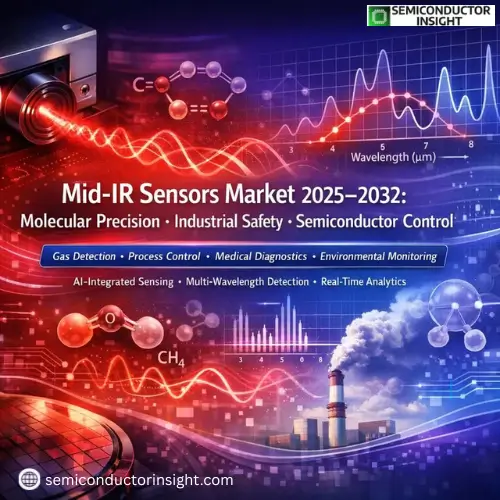
Global Mid-IR Sensor Industry Outlook: Innovations, Applications, and Growth Drivers
Mid-infrared (Mid-IR) sensors are rapidly emerging as a critical technology in modern industries, particularly in semiconductor fabrication, industrial safety, environmental monitoring, and healthcare diagnostics.
Detecting wavelengths between 3-8 μm, Mid-IR sensors offer the ability to precisely identify molecular vibrations and chemical compositions that are invisible to near-infrared or visible-light sensors.
This capability allows industries to implement highly accurate, real-time monitoring systems that improve safety, efficiency, and product quality.
As sectors such as semiconductors, pharmaceuticals, and environmental monitoring face growing demand for precision, Mid-IR sensor market is positioned for strong growth.
Drivers of Market Growth
Several factors are fueling the growth of the Mid-IR sensor market:
- Industrial Gas Detection:
Real-time detection of hazardous gases in chemical plants, oil & gas facilities, and semiconductor fabs enhances worker safety and regulatory compliance.
- Environmental Monitoring:
Tracking greenhouse gas emissions, air pollutants, and industrial emissions is critical for climate initiatives and legal standards.
- Medical Diagnostics:
Non-invasive analysis such as breath testing, metabolic monitoring, and early disease detection relies on Mid-IR spectroscopy.
- Semiconductor Process Control:
Accurate detection of thin films, contamination, and chemical residues ensures higher yield and lower defect rates.
Integration of quantum cascade lasers (QCLs) with Mid-IR sensors has enhanced sensitivity, allowing detection of low-concentration gases and biomolecules with high precision.
Technology Trends Driving Market Adoption
- Miniaturization and Portability:
- Compact Mid-IR sensors can now be embedded into portable devices, drones, and industrial equipment.
- Integration with AI and IoT:
- Sensors feed real-time data into AI-powered platforms for predictive analysis and automated control.
- Enhanced Sensitivity and Selectivity:
- Advanced optical filters, improved detector materials, and multi-wavelength detection expand application range.
- Multi-Wavelength Detection:
- Allows simultaneous monitoring of several gases or compounds, reducing system complexity.
Emerging materials like grapheme-based detectors are further increasing sensitivity and response speed, making sensors applicable even in highly demanding semiconductor or pharmaceutical processes.
Applications across Industries
- Semiconductor Fabrication:
- Real-time chemical analysis for deposition and etching processes.
- Monitoring of ambient gases in cleanrooms to prevent contamination.
- Healthcare & Medical Diagnostics:
- Non-invasive glucose monitoring and early disease detection.
- Breathe analysis for metabolic disorders and disease markers.
- Industrial Safety:
- Detection of combustible, toxic, or corrosive gases.
- Integration into smart factories for automated alerts.
- Environmental Monitoring:
- Tracking air quality, greenhouse gas emissions, and regulatory compliance.
- Real-time environmental data for research and sustainability initiatives.
Flowchart: Mid-IR Sensor Integration Workflow
Material Selection & Sensor Design → Fabrication → Calibration → Device Integration → Real-Time Monitoring → Data Analysis → Actionable Insights
Geographic Market Perspectives
- North America:
- Leads adoption due to industrial infrastructure, environmental regulations, and advanced semiconductor and healthcare industries.
- Europe:
- Growth supported by stringent environmental monitoring laws and industrial safety standards.
- Asia-Pacific:
- Rapid expansion from industrialization, semiconductor manufacturing growth, and increased healthcare technology adoption.
Observation: Regional adoption trends are closely linked to regulatory frameworks, industry-specific demand, and local technological capability.
Competitive Landscape
Market players differentiate themselves through:
- Development of high-sensitivity, low-noise sensors for precise detection.
- Integration with IoT and AI platforms for predictive maintenance and automation.
- Collaboration with semiconductor, healthcare, and industrial OEMs for customized solutions.
Some companies are focusing on hybrid sensor platforms that combine Mid-IR detection with near-infrared or visible light sensors to broaden application use cases.
Challenges & Opportunities
Challenges:
- High manufacturing costs due to advanced detector materials.
- Need for precise calibration and alignment in complex industrial or medical setups.
- Sensitivity to environmental factors such as temperature fluctuations and humidity.
Opportunities:
- Growing demand in semiconductor fabs for precise process control.
- Expansion into healthcare wearable for non-invasive monitoring.
- Adoption in environmental and climate research for continuous monitoring.
As We Wrap Up, Go Through Our Detailed Insights Here:
https://semiconductorinsight.com/report/mid-ir-sensors-market/
The Mid-IR sensor market is poised for robust growth, driven by technological innovation, regulatory demand, and multi-industry applications. With miniaturized sensors, AI-enabled analytics, and high-precision detection capabilities, Mid-IR sensors are transforming industrial monitoring, semiconductor fabrication, and medical diagnostics.
Mid-IR sensors are redefining the way industries perceive and act upon critical data. From enhancing safety in industrial plants to enabling precision semiconductor manufacturing and non-invasive medical diagnostics, these sensors are a cornerstone of the high-tech economy. The target market’s trajectory points to continued expansion, powered by innovation, integration, and growing industrial adoption.

Comments (0)