Market Insights
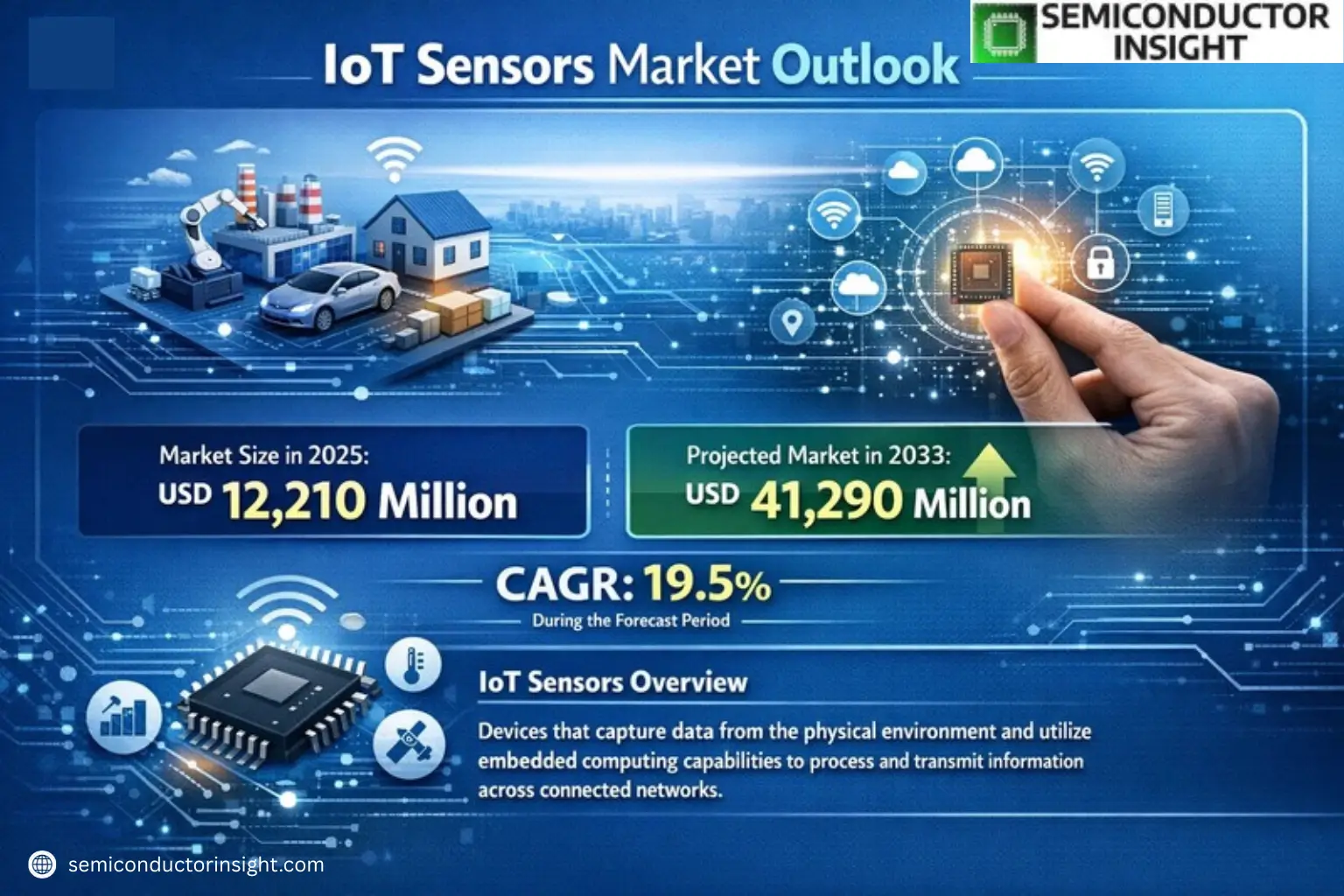
Global IoT Sensors Market was valued at USD 12,210 million in 2025 and is projected to reach USD 41,290 million by 2033, exhibiting a CAGR of 19.5% during the forecast period.
IoT Sensors are devices that capture data from the physical environment and utilize embedded computing capabilities to process and transmit this information across connected networks. These sensors enable autonomous functionality by collecting, analyzing, and sharing real-time data with other IoT-enabled systems. Key sensor types include pressure sensors, environmental sensors, optical sensors, chemical sensors, and motion sensors.
The market growth is driven by increasing adoption across smart city initiatives, industrial automation, and connected healthcare applications. Pressure sensors dominate the market with a 31% share in 2020 due to widespread use in automotive and industrial monitoring systems. Geographically, the Americas lead in consumption with 46% market share in 2020, followed by Europe at 35.11%, while Asia-Pacific emerges as the fastest-growing region fueled by China’s rapid IoT infrastructure development.
MARKET DRIVERS
Rising Demand for Smart Devices and Automation
IoT Sensors Market is experiencing significant growth due to the increasing adoption of smart devices across industries. The surge in automation and real-time data monitoring is pushing enterprises to integrate IoT Sensors for predictive maintenance and operational efficiency. Over 45% of industrial facilities now rely on IoT sensor networks for asset tracking.
Government Initiatives and Smart City Projects
Global investments in smart city infrastructure have accelerated IoT sensor deployment, particularly in traffic management and environmental monitoring. Countries are allocating over USD 100 billion annually toward IoT-enabled urban development, driving market expansion.
Advancements in AI and edge computing are further optimizing sensor capabilities, enabling more precise data collection with reduced latency.
MARKET CHALLENGES
High Implementation Costs and Complexity
Deploying IoT sensor networks requires substantial capital expenditure for hardware, software, and integration, which may deter small and medium enterprises. Nearly 60% of companies cite budget constraints as a primary barrier to adoption.
Other Challenges
Data Security Concerns
Cybersecurity risks remain a critical challenge, with IoT Sensors often vulnerable to breaches. Approximately 42% of organizations report security incidents involving compromised sensor networks in the past two years.
MARKET RESTRAINTS
Interoperability Issues Across Platforms
The lack of standardized protocols creates integration hurdles between IoT Sensors and existing infrastructure. This fragmentation reduces system efficiency and increases maintenance costs for end-users.
MARKET OPPORTUNITIES
Expansion in Industrial IoT (IIoT) Applications
Manufacturing sectors are leveraging IoT Sensors for condition-based monitoring, with the IIoT market expected to reach USD 250 billion by 2026. Energy-efficient sensor designs and 5G compatibility present additional growth avenues.
Advancements in Miniaturized Sensor Technology
Nanotechnology innovations are enabling smaller, more durable IoT Sensors with improved battery life, opening applications in wearable tech and precision agriculture.
IoT Sensors Market Trends
Accelerated Growth in IoT Sensor Adoption
Global IoT Sensors Market was valued at USD 12.21 billion in 2025 and is projected to reach USD 41.29 billion by 2033, growing at a CAGR of 19.5%. This rapid expansion is driven by increasing smart infrastructure deployments and industrial automation demand across key sectors. Pressure sensors currently lead market adoption with 31% share, followed by environmental and optical sensors.
Other Trends
Regional Market Developments
The Americas dominate IoT sensor consumption with 46% market share, primarily in connected health and automotive applications. Europe holds 35% share with strong smart city deployments, while APAC emerges as the fastest-growing region led by China’s industrial IoT expansion and smart agriculture projects.
Sector-Specific Application Growth
Smart city applications accounted for 24.04% of IoT sensor demand in 2020, with significant projects in Europe. Connected health solutions show strongest growth in North America, while smart agriculture adoption accelerates across APAC. Industrial IoT applications demonstrate consistent expansion globally, particularly in predictive maintenance systems.
Technology and Competitive Landscape
Leading manufacturers including Bosch, Honeywell, and NXP are expanding sensor portfolios with enhanced connectivity and edge computing capabilities. Market consolidation is increasing through strategic acquisitions, with top five manufacturers controlling significant market share. Emerging innovations focus on energy-efficient designs and multi-sensor fusion technologies.
Future Market Prospects
IoT Sensors Market is transitioning toward AI-integrated solutions with improved data processing capabilities at the edge. 5G network deployments are creating new opportunities for real-time monitoring applications, while sustainability requirements drive demand for low-power sensor designs across all verticals.
COMPETITIVE LANDSCAPE
Key Industry Players
Strategic Positioning in the USD 41.29 Billion IoT Sensors Market
Global IoT Sensors Market is dominated by established electronics and semiconductor giants, with Bosch and Honeywell leading through diversified sensor portfolios and strong R&D capabilities. These players hold significant market share in smart city and industrial IoT applications, leveraging their expertise in pressure, environmental, and motion sensors. The competitive landscape remains fragmented with regional players gaining traction, particularly in APAC markets where demand for smart agriculture and connected buildings is accelerating.
Niche specialists like Sensirion (environmental sensors) and InvenSense (motion sensors) compete through technological differentiation in specific sensor categories. Chinese manufacturers like Huagong Tech and Zhonghang Electronic Measuring Instruments are rapidly expanding their global footprint with cost-competitive offerings, particularly in the optical and chemical sensor segments. The market sees increasing vertical integration as semiconductor companies (STMicroelectronics, NXP) develop complete IoT solutions combining sensors with connectivity chips.
List of Key IoT Sensors Companies Profiled
- Bosch Sensortec
- Honeywell International
- NXP Semiconductors
- Infineon Technologies
- Analog Devices Inc.
- Panasonic Corporation
- TDK InvenSense
- Texas Instruments
- Silicon Laboratories
- ABB Ltd.
- STMicroelectronics
- TE Connectivity
- Huagong Tech
- Sensirion AG
- Zhonghang Electronic Measuring Instruments
Segment Analysis:
| Segment Category | Sub-Segments | Key Insights |
| By Type |
|
Pressure Sensors dominate the IoT sensor landscape due to their critical role in industrial automation and smart infrastructure applications. Key factors driving their adoption include:
|
| By Application |
|
Smart City Applications represent the most significant opportunity for IoT sensor deployment due to:
|
| By End User |
|
Government & Municipalities are the primary adopters of IoT sensor technology because:
|
| By Connectivity |
|
Wireless Sensors are experiencing rapid adoption due to several key advantages:
|
| By Technology |
|
MEMS Technology dominates the IoT sensor market due to several competitive factors:
|
Regional Analysis: Global IoT Sensors Market
North America maintains dominance in industrial IoT Sensors with automated factories adopting vibration, pressure and proximity sensors for predictive maintenance and process optimization. Major manufacturers are retrofitting legacy equipment with wireless sensor networks.
Cities across the U.S. and Canada are implementing large-scale environmental sensor networks for air quality monitoring and traffic management. Municipalities partner with sensor manufacturers to develop customized urban IoT solutions with robust data analytics.
The region leads in medical-grade IoT Sensors for remote patient monitoring and diagnostic devices. Strict FDA regulations drive sensor quality standards while venture funding fuels development of novel biosensors and wearable health trackers.
Smart grid deployments across North America utilize advanced current and voltage sensors for real-time monitoring. Oil and gas operators implement ruggedized IoT Sensors for pipeline integrity management and asset tracking in remote locations.
Europe
The European IoT Sensors Market emphasizes sustainability and precision engineering across industrial applications. Germany and the Nordic countries lead in manufacturing sensor solutions with stringent EU compliance standards for data privacy and energy efficiency. Automotive sensors account for significant market share with major OEMs integrating more connected car technologies. The region shows strong growth in environmental monitoring sensors for climate initiatives and smart building applications. Collaborative research projects between universities and corporations drive innovations in MEMS-based sensor technologies while maintaining strict GDPR-compliant data practices.
Asia-Pacific
Asia-Pacific represents the fastest-growing IoT Sensors Market, led by China’s massive smart city initiatives and Japan’s precision sensor manufacturing. Chinese tech giants are vertically integrating sensor production for domestic IoT deployments in transportation and utilities. India demonstrates accelerating adoption in agricultural and industrial IoT applications. South Korea and Taiwan lead in advanced sensor fabrication technologies, supplying global electronics manufacturers. The region benefits from substantial government support for IoT infrastructure development and local manufacturing ecosystems for cost-effective sensor solutions.
South America
South America’s IoT Sensors Market shows focused growth in agricultural and mining applications, with Brazil and Argentina deploying soil condition and equipment monitoring sensors. Urban areas are implementing smart utility meters and transportation sensors, though infrastructure development remains uneven. Local manufacturers collaborate with global players to adapt sensor technologies for regional environmental conditions. Government initiatives promote industrial IoT adoption while addressing challenges in connectivity infrastructure across rural areas.
Middle East & Africa
The Middle East leads in smart city sensor deployments, particularly in Gulf countries implementing large-scale urban IoT projects. Oil and gas sector drives demand for harsh-environment sensors with increasing automation. Africa shows growing adoption in agricultural IoT and mobile-based sensor applications, leveraging leapfrog technologies. Regional players focus on developing rugged, low-power sensor solutions suited to local climate conditions, with increasing partnerships between telecom providers and sensor manufacturers.
Report Scope
This market research report provides a comprehensive analysis of the IoT Sensors Market, covering the forecast period 2025–2033. It offers detailed insights into market dynamics, technological advancements, competitive landscape, and key trends shaping the industry.
Key focus areas of the report include:
- Market Overview: The report begins with an overview outlining its current market scenario, key growth indicators, and industry transformation drivers. It discusses macroeconomic factors, demand–supply balance, regulatory landscape, and the strategic role of IoT Sensors in powering advancements across industries such as smart cities, connected industries, connected buildings, and smart agriculture.
- Market Size & Forecast: Historical data and future projections for revenue, unit shipments, and market value across major regions and segments.
- Segmentation Analysis: Detailed breakdown by product type, technology, application, and end-user industry to identify high-growth segments and investment opportunities.
- Regional Insights: Insights into market performance across North America, Europe, Asia-Pacific, Latin America, and the Middle East & Africa, including country-level analysis where relevant.
- Competitive Landscape: Profiles of leading market participants, including their product offerings, R&D focus, manufacturing capacity, pricing strategies, and recent developments such as mergers, acquisitions, and partnerships.
- Technology Trends & Innovation: Assessment of emerging technologies, integration of AI/IoT, sensor design trends, and evolving industry standards.
- Market Drivers & Restraints: Evaluation of factors driving market growth along with challenges, supply chain constraints, regulatory issues, and market-entry barriers.
- Stakeholder Insights: Insights for component suppliers, OEMs, system integrators, investors, and policymakers regarding the evolving ecosystem and strategic opportunities.
Primary and secondary research methods are employed, including interviews with industry experts, data from verified sources, and real-time market intelligence to ensure the accuracy and reliability of the insights presented.
FREQUENTLY ASKED QUESTIONS:
What is the current market size of IoT Sensors Market?
-> IoT Sensors Market was valued at USD 12,210 million in 2025 and is projected to reach USD 41,290 million by 2033, exhibiting a CAGR of 19.5% during the forecast period.
Which key companies operate in IoT Sensors Market?
-> Key players include Bosch, Honeywell, NXP, Infineon, Analog Devices, Panasonic, InvenSense, TI, Silicon Laboratories, ABB, STMicroelectronics, TE Connectivity, Huagong Tech, Sensirion, Zhonghang Electronic Measuring Instruments, Vishay, Hanwei Electronics, Semtech, and Omron, among others.
What are the key growth drivers?
-> Key growth drivers include increasing adoption of IoT platforms, demand for autonomous devices, and advancements in connected technologies across industries.
Which region dominates the market?
-> Americas is the largest consumption region, with a revenue market share of nearly 46% in 2020, followed by Europe (35.11%). APAC is the fastest-growing region, especially China.
What are the emerging applications?
-> Emerging applications include smart cities (24.04% market demand in 2020), connected health, connected cars, and smart agriculture.

Get Sample Report PDF for Exclusive Insights
Report Sample Includes
- Table of Contents
- List of Tables & Figures
- Charts, Research Methodology, and more...
 Download Sample Report PDF