

Global Drone and Aerial Photography Market Technology Evolution and Future Scope
Drone and Aerial Photography Market is expanding rapidly as industries increasingly rely on aerial data capture, high-resolution imaging, and autonomous surveillance capabilities. From media production and infrastructure inspection to environmental monitoring and mapping, drones are transforming how visual information is collected and processed.
What makes this market particularly transformative is the growing role of semiconductor technologies. Every drone used for aerial photography depends on advanced chips, sensors, and imaging electronics that enable precision navigation, stable flight, and ultra-clear visuals. The evolution of semiconductor components is directly shaping the speed, efficiency, and commercial scalability of aerial photography platforms.
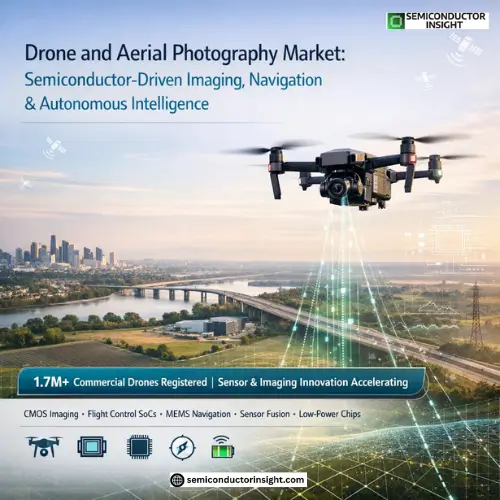
The expansion of commercial drone usage is significant, with over 1.7 million commercial drones registered globally for operational applications, highlighting strong demand for advanced on-board electronics and imaging technologies.
Semiconductor Imaging Sensors Driving Aerial Visual Intelligence
The foundation of aerial photography lies in image sensing technology, particularly CMOS image sensors, multispectral cameras, and thermal imaging modules. These semiconductor devices convert light signals into high-quality digital images and enable drones to capture detailed visual data in complex environments.
Recent innovations in imaging semiconductors have significantly improved aerial data quality. Upgraded CMOS sensors now offer nearly 41% higher dynamic range, enabling better performance in low-light and high-contrast environments.
Image sensors remain one of the most dominant drone components, largely due to the increasing demand for aerial photography and surveillance applications. The rising adoption of high-resolution cameras, mapping systems, and visual analytics tools is pushing semiconductor manufacturers to focus on miniaturization and energy efficiency.
This evolution is redefining how industries use drones for cinematic production, real estate imaging, infrastructure inspection, and environmental mapping.
Flight Control Chips and System on Chip Architectures
Behind every stable aerial shot lies a complex ecosystem of main control chips and system on chip architectures that manage flight stability, data processing, and camera operations. These semiconductor components coordinate sensor input, navigation algorithms, and real-time flight decisions.
The UAV main control chip segment continues to grow steadily due to rising demand for high-performance and low-power processors.
Sensor integration alone accounts for nearly 35.59% of total chip component demand, showing the importance of integrated semiconductor design in drone systems.
Modern drone processors are designed for lightweight operation, faster image processing, and improved energy management, allowing longer flight time and smoother aerial capture.
MEMS Sensors and Navigation Precision Engineering
- Aerial photography requires exceptional flight stability and positioning accuracy. This capability is achieved through micro electromechanical systems MEMS sensors, inertial measurement units, and barometric pressure sensors.
- These semiconductor devices monitor altitude, speed, orientation, and environmental conditions in real time. Inertial sensors alone represent about 31.75% of total drone sensor deployment, reflecting their critical role in navigation and stabilization.
- Recent semiconductor advancements have improved altitude accuracy by nearly 28% and motion stability by around 29%, enhancing image clarity and reducing vibration distortions.
- Such innovations enable drones to operate effectively in challenging environments such as high-wind zones, urban landscapes, and industrial inspection sites.
Don’t Forget to Surf Our Updated Related Report for More Detailed Analysis:
https://semiconductorinsight.com/report/drone-chips-market/
Sensor Fusion Architecture and Multi Modal Data Capture
A major technological shift in aerial photography systems is the adoption of sensor fusion architecture, where multiple semiconductor sensors work together to generate accurate data outputs.
Modern drones combine inputs from LiDAR sensors, thermal cameras, visual sensors, and distance measurement chips. This integrated approach reduces system failure risk and improves environmental awareness. Sensor fusion is increasingly becoming the standard design approach in next-generation drone platforms.
The increasing use of hybrid navigation sensors capable of functioning in GPS-restricted environments represents about 18% of new product launches, reflecting growing demand for autonomous aerial systems.
Miniaturization and Power Efficient Semiconductor Design
Drone platforms demand lightweight and energy-efficient components. Semiconductor manufacturers are focusing heavily on low-power chipsets, compact processors, and efficient power management units.
Nearly 28% of drone manufacturers are launching low-power sensor systems to enhance operational efficiency and extend flight duration.
Miniaturization allows drones to carry more advanced imaging payloads without compromising battery life or flight performance. This trend is particularly important for consumer drones and compact aerial photography systems.
Quick Glance on Semiconductor Components in Drone Architecture
Image Sensors → Signal Processing Chips → Flight Control Processors → MEMS Navigation Sensors → Power Management ICs → Wireless Connectivity Modules → Aerial Data Output
The development of semiconductors in imaging sensors, processing units, and navigation circuits is directly related to the coming years of drone and aerial photography market growth. Continuous innovation in chip design, power efficiency, and sensor integration will enable drones to deliver sharper images, longer flight time, and improved operational accuracy.
As semiconductor technologies continue to evolve, aerial photography systems will become more accessible, efficient, and commercially scalable across industries. The growing convergence of imaging electronics and autonomous flight technologies positions this market as a critical segment within the broader semiconductor ecosystem.

Comments (0)