
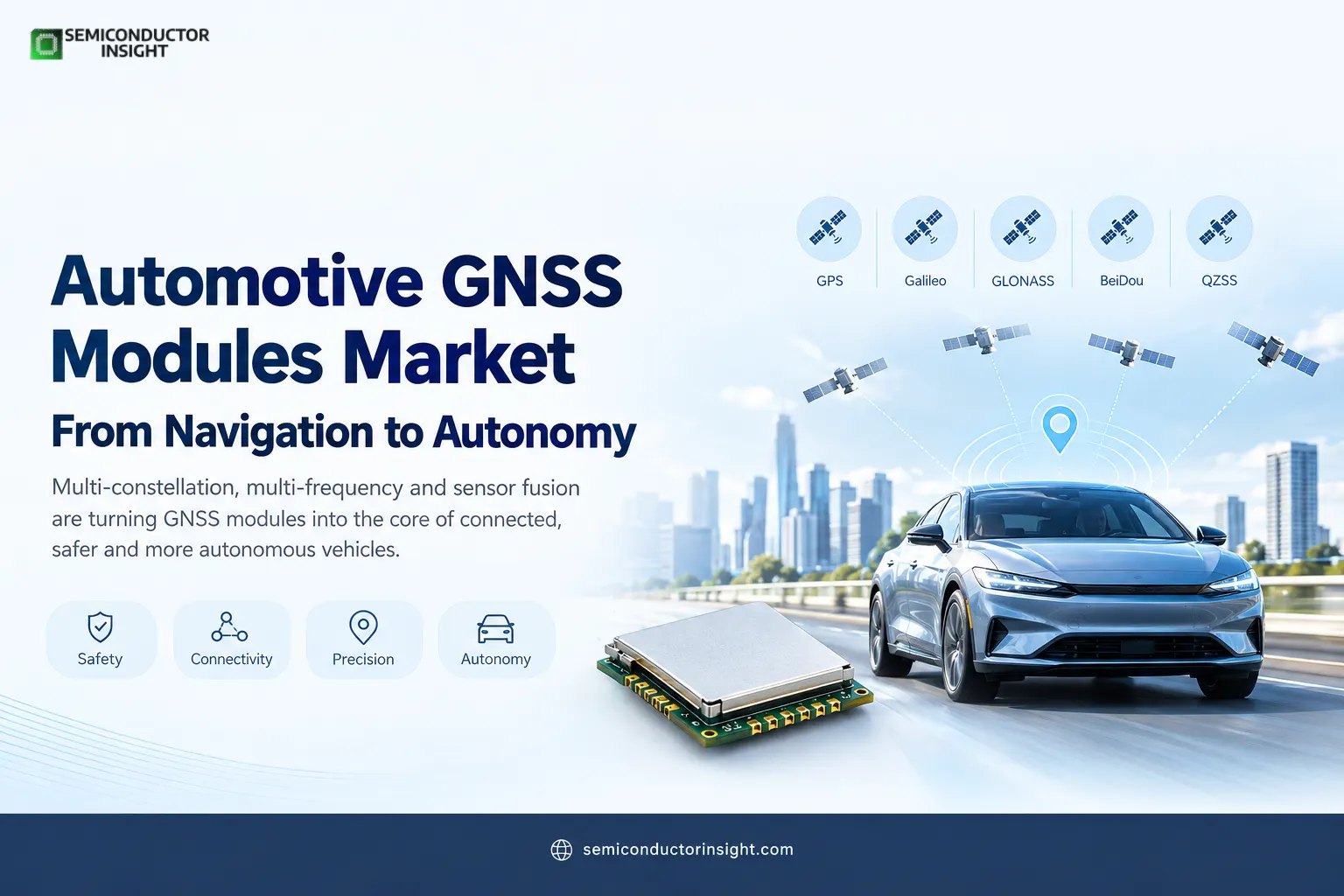
Global Automotive GNSS Modules Market 2026: Multi-Constellation Positioning Enters the ADAS Era
Automotive GNSS Modules Market is changing as positioning moves from a navigation convenience to an essential input for connected and automated vehicles. Modern modules are expected to interpret signals from multiple satellite constellations, maintain location information in difficult environments and increasingly support advanced driver assistance systems.
The semiconductor inside the module is therefore becoming part of a much larger localization architecture involving inertial sensors, cameras, correction services, vehicle networks and software.
Six Billion Devices Put the Scale of GNSS into Perspective
The European Union’s December 2025 Galileo factsheet estimated that more than 6 billion GNSS-enabled devices were already in use worldwide. Galileo itself has had 34 satellites launched since 2012, while its Open Service provides approximately 1 metre positioning accuracy under stated conditions.
For automotive electronics, this installed base matters because GNSS reception is no longer limited to standalone navigation units. Satellite positioning is increasingly embedded into connected cars, emergency systems, telematics, digital maps and automated-driving architectures.
The shift can be represented as:
Satellite signals → GNSS module → Sensor fusion → Vehicle position → ADAS / navigation / connectivity
The module is the semiconductor gateway that turns signals arriving from space into usable vehicle-location data.
Accuracy Is Becoming a Semiconductor Specification
- Traditional vehicle navigation can tolerate several metres of positioning uncertainty. Automated driving requires a considerably richer location picture.
- Galileo’s High Accuracy Service provides real-time correction information for precise-point-positioning algorithms, while its full-service objectives include 20 cm horizontal and 40 cm vertical accuracy at the 95th percentile.
- Recent Galileo performance data shows how quickly satellite positioning technology is progressing. During Q1 2026, Galileo reported dual-frequency signal-in-space ranging accuracy between 0.15 m and 0.57 m for individual satellites.
- HAS orbit corrections were at or better than 0.19 m for Galileo and 0.20 m for GPS during the quarter.
- These figures describe satellite-system performance rather than the final accuracy of a vehicle, but they illustrate why automotive receiver architectures are moving toward multi-frequency and correction-enabled designs.
The Module Is No Longer Working Alone
Urban streets create a difficult positioning environment. Tall buildings can block or reflect satellite signals, tunnels remove direct satellite visibility and dense road infrastructure can produce multipath effects.
Automotive GNSS modules increasingly compensate by combining satellite measurements with other information.
GNSS + IMU + wheel speed + map data + vehicle sensors = continuous localization
Dead reckoning allows a vehicle to estimate movement when satellite reception temporarily deteriorates. Qualcomm’s automotive positioning platforms, for example, combine multi-constellation GNSS with dead reckoning and other positioning technologies. Its automotive 4G platform supports GPS, Galileo, GLONASS, BeiDou and QZSS simultaneously.
This multi-source approach is particularly important when positioning becomes an input to ADAS rather than simply a map-display function.
A Major 2026 Product Development Targets L2 Plus Through L4
- In May 2026, u-blox introduced the ZED-X20K and ZED-A20K automotive GNSS modules. The company positioned the two devices for different stages of automated-driving development, with the ZED-X20K targeting ADAS applications and the ZED-A20K designed around functional-safety requirements for L3 and L4 systems.
- The launch illustrates a broader change in module architecture. Automotive customers increasingly need positioning components designed around vehicle safety requirements rather than generic consumer navigation.
Quad-Frequency Reception Opens another Design Path
Frequency diversity is becoming another important area of semiconductor development. In June 2026, Qualcomm announced its X105 modem-RF chipset with quad-frequency GNSS capability. Qualcomm states that the platform can deliver decimeter-to-centimeter positioning and reduces power consumption by 25% compared with the previous generation.
The significance is not simply the number of frequencies. Multiple frequencies can provide additional measurement information that helps receivers compensate for ionospheric effects and improve positioning robustness.
For automotive semiconductor designers, this creates a balancing act between accuracy, processing requirements, thermal limits, power consumption and module cost.
Don’t Forget to Surf Our Updated Report for More Detailed Analysis: https://semiconductorinsight.com/report/automotive-gnss-modules-market/
Regulation Is Turning Location into a Vehicle Function
- European regulation is also expanding the technology requirements surrounding modern vehicles.
- The EU General Safety Regulation applies advanced systems such as intelligent speed assistance, reversing detection, attention monitoring, lane keeping and automated emergency braking to new vehicles under a phased implementation schedule beginning in 2024.
- Intelligent speed assistance can use electronic map data or infrastructure information to provide speed-limit information. This creates another connection between positioning, digital maps and vehicle-control systems.
- The European Commission has also updated eCall requirements as telecommunications networks transition from older 2G and 3G technologies toward newer networks. The 2025 delegated regulation includes updated requirements and test procedures for 112-based eCall systems.
Where GNSS Modules Are Moving Next
Automotive GNSS Modules Market is increasingly being shaped by the question of how reliably a vehicle knows where it is.
Navigation remains an important application, but the technology is expanding into:
Connected vehicle → ADAS → automated parking → lane-level localization → fleet telematics → autonomous driving
This progression is changing the module itself. Future automotive positioning designs will increasingly combine multi-constellation reception, multiple frequencies, correction services, dead reckoning, sensor fusion, cybersecurity and functional-safety architecture.
The semiconductor opportunity therefore lies not simply in receiving satellite signals. It lies in turning imperfect signals into dependable location intelligence that a vehicle can use continuously, even when roads, buildings, weather and connectivity make positioning more difficult.

Comments (0)