

Gaming Computers and Peripherals Market Transforming Digital Entertainment Ecosystem
Gaming Computers and Peripherals Market has emerged as one of the most dynamic segments within the global digital entertainment ecosystem, driven by high performance computing demand, growing esports participation, and increasing consumer interest in immersive gaming experiences. Gaming computers, including desktops and laptops, alongside accessories such as keyboards, mice, and headsets, are evolving into specialized performance tools rather than standard computing devices.
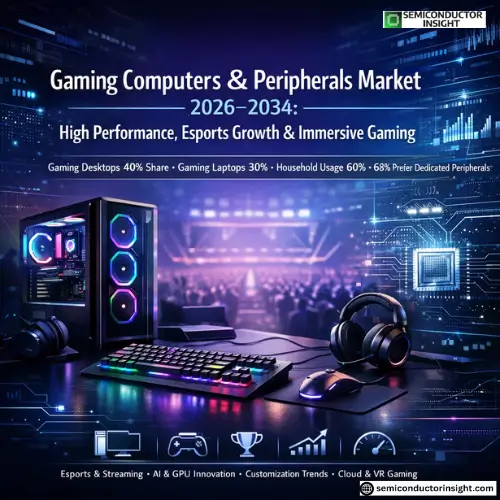
The market reflects strong consumer adoption patterns, where gaming desktops hold nearly 40% market share, followed by gaming laptops at approximately 30%, indicating a growing shift toward portable performance systems. Household gaming remains dominant, accounting for nearly 60% of total usage, while commercial applications such as gaming cafes and esports arenas and continue expanding rapidly.
This transformation is closely connected with broader technological trends discussed in related ecosystems such as Artificial Intelligence hardware market and Semiconductor Industry innovations, which continue to shape processing power, graphics capabilities, and system efficiency in gaming devices.
Technology Innovation Driving Hardware Evolution
Technological innovation remains the primary force shaping the industry, with gaming hardware increasingly incorporating advanced GPUs, high speed processors, and responsive peripherals designed to enhance precision and performance. More than 55% of gaming accessories now integrate RGB lighting and wireless functionality, while over 47% adoption of wireless gaming devices highlights the growing demand for flexibility and customization.
The demand for mechanical keyboards, high DPI sensors, ergonomic designs, and immersive audio systems continues to rise as gamers prioritize responsiveness and comfort. Studies indicate that nearly 68% of PC gamers prefer dedicated gaming peripherals, emphasizing the shift toward specialized equipment engineered for competitive gameplay.
Recent industry developments also demonstrate changing hardware preferences. For instance, processor adoption trends show increasing interest in high performance chipsets, with certain gaming processors achieving over 40% user adoption among PC gamers, reflecting evolving consumer preference toward performance optimized architectures.
Esports Culture and Streaming Economy Expanding Market Demand
The rapid growth of competitive gaming and content streaming has significantly influenced hardware demand. The global esports audience exceeded 500 million viewers, and nearly 44% of gamers upgraded at least one gaming accessory within a year, demonstrating the strong impact of competitive gaming culture on purchasing behavior.
Gaming peripherals such as headsets, controllers, and precision input devices are increasingly viewed as essential performance tools rather than optional accessories. The expansion of professional gaming tournaments and live streaming platforms has accelerated demand for high accuracy equipment, real time responsiveness, and immersive audio visual capabilities.
This evolving ecosystem also connects with emerging digital environments like the Virtual Reality Industry and Cloud Gaming Industry, where high performance computing and low latency peripherals play a critical role in delivering seamless gaming experiences.
You can freely browse our most recent updated report to learn more about it before scrolling further:
https://semiconductorinsight.com/report/global-gaming-computers-and-peripherals-market/
Consumer Behavior and Customization Trends
Modern gamers increasingly seek personalized and customizable gaming environments, influencing product design and market expansion. Industry insights reveal that over 65% of gamers prioritize device customization, while approximately 54% focus on ergonomic design features that enhance comfort during long gaming sessions.
Additionally, gaming setups are becoming more complex, with players using an average of 4 to 5 peripherals per system, including keyboards, mice, controllers, and audio devices. This indicates strong replacement cycles and continuous upgrade demand across the industry.
The shift toward immersive setups has also contributed to the popularity of mid-range gaming systems, which represent nearly 43% of market share, offering balanced performance and affordability for mainstream users.
Regional Expansion and Digital Gaming Adoption
Regional dynamics play a significant role in shaping the global market landscape. North America accounts for approximately 35% of global market share, supported by high consumer spending and strong esports infrastructure, while Asia Pacific represents the fastest growing region due to its large gaming population and expanding digital ecosystem.
The broader gaming industry context further highlights the importance of PC gaming, which contributes nearly 21% of global gaming revenue, positioning it as one of the leading gaming platforms worldwide.
Emerging economies, particularly in Asia, are witnessing increased adoption of gaming laptops and affordable hardware solutions, supported by expanding internet penetration and digital entertainment consumption.
It is anticipated that ongoing developments in AI-driven optimization, immersive display technologies, and next-generation graphics processing systems will influence the gaming computer and peripherals market in the coming years. Increasing integration of intelligent software customization, adaptive controls, and energy efficient hardware designs is likely to transform gaming experiences further.
Moreover, the convergence of gaming with advanced technologies such as cloud computing, virtual environments, and real time streaming platforms indicates that gaming hardware will continue evolving beyond entertainment devices into high performance computing ecosystems.
As consumer expectations shift toward immersive, personalized, and high speed gaming experiences, the market is positioned for sustained growth, supported by technological innovation, expanding digital infrastructure, and the rising global gaming community.

Comments (0)