

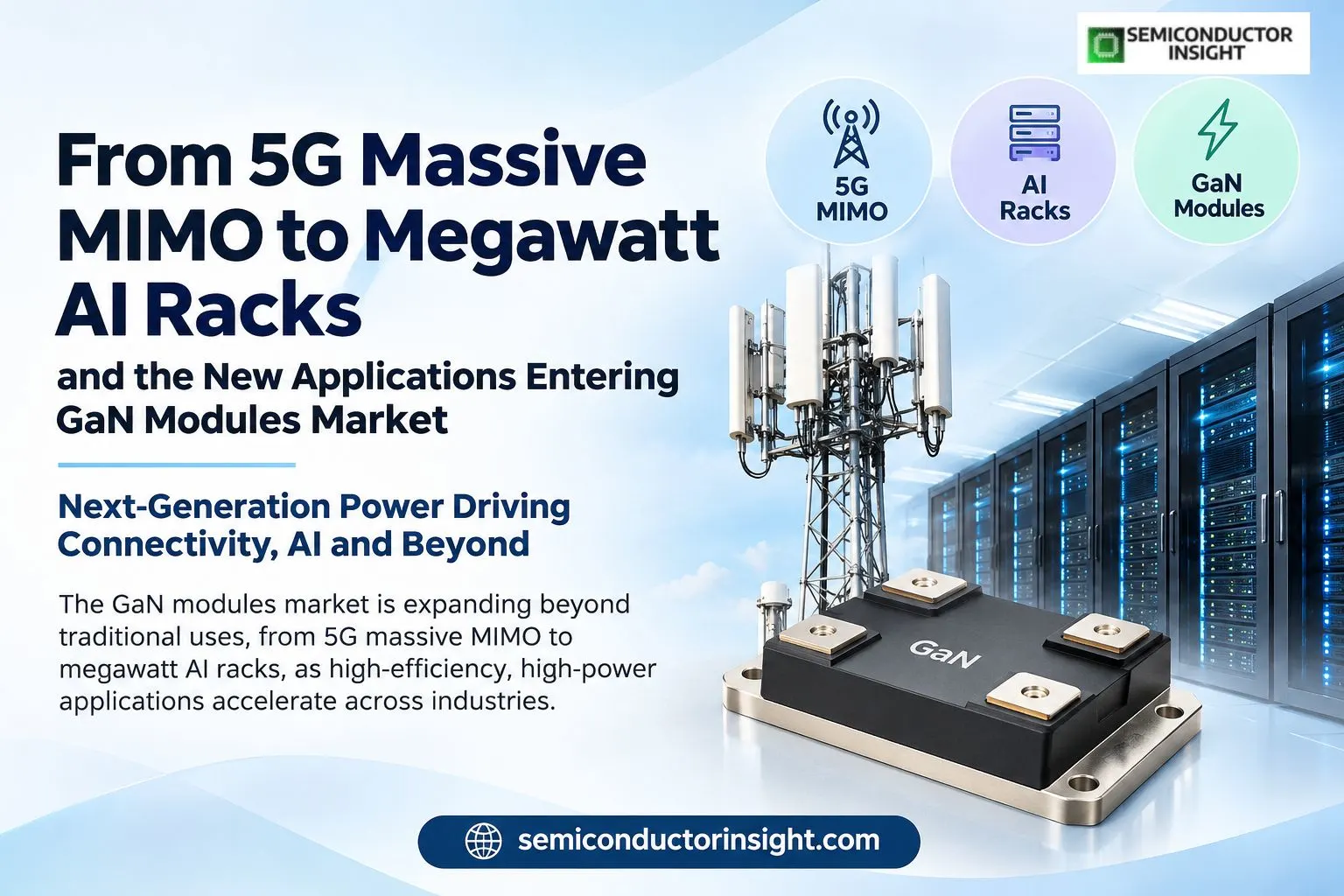
From 5G Massive MIMO to Megawatt AI Racks and the New Applications Entering GaN Modules Market
As semiconductor systems become more power-intensive and space-constrained, gallium nitride is moving into applications where conventional silicon components face limitations in switching speed, efficiency, and thermal performance. GaN modules bring together power or radio-frequency components in integrated packages, helping equipment manufacturers simplify system design while improving performance. Their relevance is expanding across AI infrastructure, telecommunications, industrial power conversion, and electric mobility.
GaN Modules Market is developing along two important technology paths: power modules for efficient energy conversion and RF modules for high-frequency wireless communication. Understanding both is essential to assessing the industry’s changing product landscape.
AI Infrastructure Is Changing the Power Module Design Brief
- The rapid expansion of AI computing is placing greater pressure on server power architectures. High-performance accelerators require substantial electrical power, while equipment designers must manage heat and maintain compact system footprints. GaN-based power stages are becoming relevant in high-frequency conversion systems where reducing switching losses and passive component size can improve overall design.
- A notable 2026 development came from Texas Instruments, which introduced an 800 VDC power architecture with NVIDIA for future AI data centres. Its reference design uses integrated GaN power stages in an 800V-to-6V converter, reporting peak efficiency of 97.6% and power density above 2,000 W/in³ for compute-tray applications. The architecture uses two conversion stages between the 800V supply and processor power.
- This shift creates opportunities for module manufacturers supplying compact, high-efficiency conversion stages, gate-drive solutions, and thermal-management-compatible packages.
650V Packaging Is Getting Smaller and More Thermally Capable
Voltage capability alone is no longer the only measure of progress in GaN design. Package footprint, heat extraction, and integration are becoming equally important as power density increases.
Renesas introduced a 650V GaN device in September 2026 featuring dual-side cooling and an 8 × 8 mm PQFN package. The device has 20 mΩ on-resistance, while its package footprint is 57% smaller than the company’s referenced 10 × 15 mm TOLT package. Renesas is targeting 800V AI data-centre architectures, including intermediate bus conversion and battery-backup power stages.
The development highlights a broader packaging direction: manufacturers are working to move more electrical power through smaller footprints without allowing thermal constraints to undermine reliability.
5G Massive MIMO Is Giving RF Modules a Different Growth Path
GaN modules also have an important role in radio-frequency infrastructure. In 5G massive MIMO base stations, power-amplifier modules must support high output power, bandwidth, linearity, and stable operation across demanding signal conditions.
- Ampleon introduced its G1M3438P70C integrated GaN Doherty power-amplifier module in June 2026. Designed for the 3.4–3.8 GHz frequency range, it delivers approximately 48 dBm peak output power, around 48% typical drain efficiency at 39 dBm average output power, and bandwidth support up to 400 MHz. The 12 × 8 mm LGA package also integrates intelligent bias control and monitoring functions.
This type of integration can reduce external circuitry and calibration effort for radio designers. It also illustrates why RF GaN modules should be considered separately from power-conversion modules when analysing product demand.
To find out more, feel free to browse our latest updated report: https://semiconductorinsight.com/report/global-gan-modules-market/
Higher Voltage Ambitions Are Expanding GaN’s Application Envelope
GaN’s established strengths in high-frequency switching are encouraging developers to explore higher-voltage applications. These include data-centre power distribution, renewable-energy conversion, electric vehicles, and high-voltage DC infrastructure.
- In August 2026, Power Integrations announced 2,200V-rated PowiGaN technology, extending its portfolio toward applications traditionally associated with silicon carbide. The company identified emerging AI data centres, photovoltaic systems, EV power systems, and HVDC infrastructure as potential application areas.
This development does not mean GaN will replace SiC in every high-voltage application. Instead, it expands the range of architectures designers can evaluate, with the final choice depending on switching frequency, voltage, thermal design, reliability, and system economics.
India’s GaN Ecosystem Is Moving Beyond Product Imports
- India is also beginning to establish a stronger commercial presence in GaN power semiconductors.
- In May 2026, Cyient Semiconductors launched its first GaN power-device family using licensed Navitas technology.
- The initial portfolio included seven devices targeting applications up to 650V, covering fast chargers, AC-DC supplies, AI data centres, telecommunications, and e-mobility.
- The company also outlined plans to work with local outsourced semiconductor assembly and test partners as its ecosystem develops.
- This is an important step for domestic availability and technical support. However, the longer-term opportunity will depend on manufacturing readiness, customer qualification, packaging capabilities, and the development of a dependable local supply chain.
Module Integration Is Becoming a Competitive Differentiator
The next stage of GaN Modules Market will not be determined by the semiconductor die alone. Buyers increasingly need solutions that combine switching devices, drivers, protection, sensing, and thermal design into dependable system-level products. Manufacturers such as Infineon are extending GaN into power-module platforms, while onsemi’s 2026 GaNEXUS portfolio spans 40V to 650V devices for computing, industrial, and energy applications.
For module suppliers, the commercial opportunity lies in matching the right GaN architecture to specific system requirements. AI power conversion, 5G radio units, industrial equipment, and e-mobility will not demand identical module designs. Their different voltage, frequency, cooling, and reliability requirements will shape product development and customer adoption.

Comments (0)