

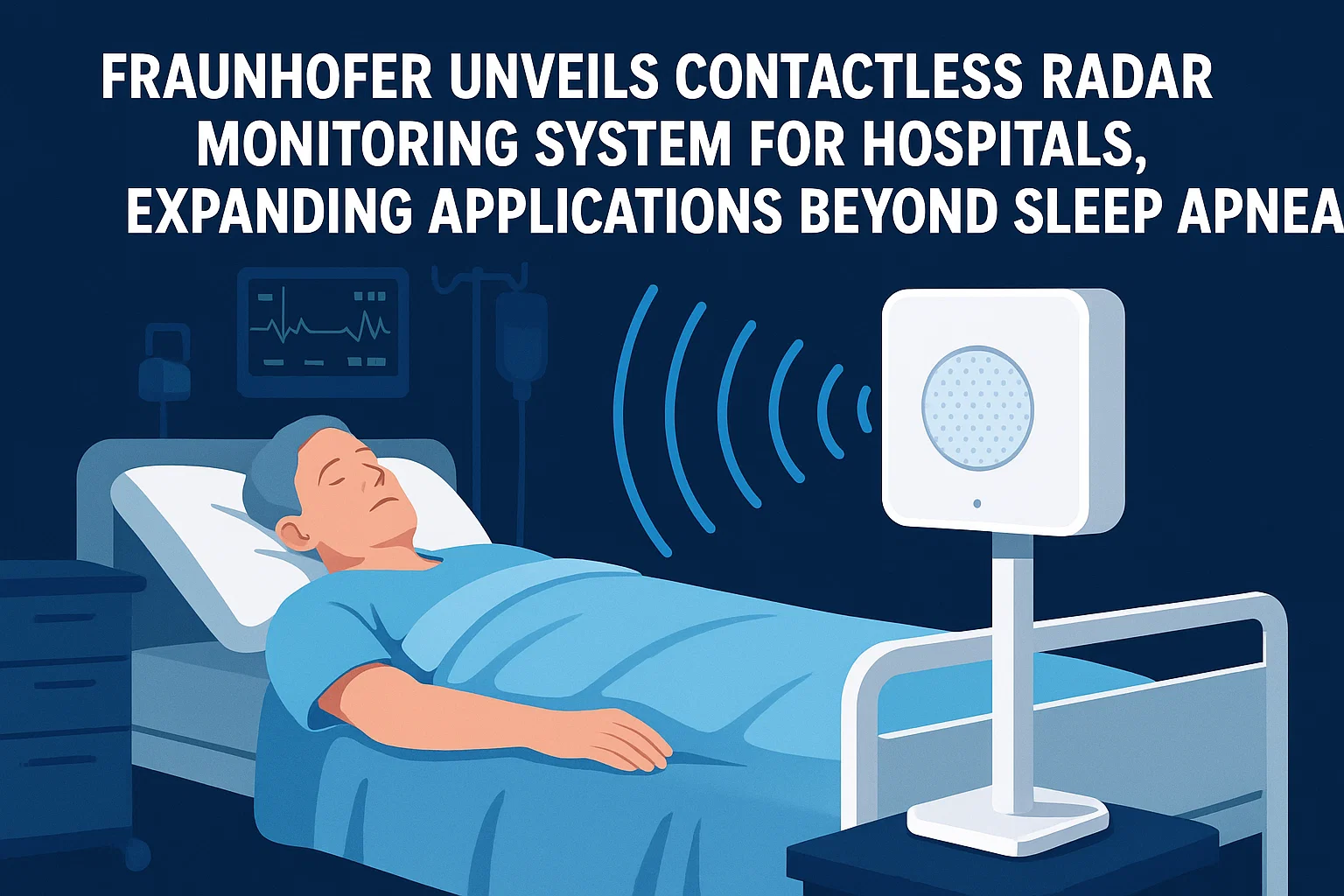
Fraunhofer Unveils Contactless Radar Monitoring System for Hospitals, Expanding Applications Beyond Sleep Apnea
The field of sleep medicine is undergoing a remarkable transformation, driven by advances in respiratory sleep radar sensors, which provide contactless, non-invasive, and highly accurate monitoring of breathing patterns during sleep. These cutting-edge devices are poised to reshape how conditions such as obstructive sleep apnea (OSA), chronic respiratory disorders, and sleep-related breathing disorders (SRBDs) are diagnosed and managed.
According to recent data, the global respiratory sleep radar sensor market was valued at USD 185 million in 2024 and is projected to grow significantly, reaching USD 680 million by 2032, expanding at a compound annual growth rate (CAGR) of 21.1% during the forecast period. This exponential growth is fueled by rising cases of sleep disorders, increasing demand for home-based healthcare solutions, advancements in AI-powered radar technology, and growing awareness about the health risks associated with untreated sleep apnea.
Access Your Free Sample Report- Respiratory Sleep Radar Sensor Market
Understanding Respiratory Sleep Radar Sensors
What Are Respiratory Sleep Radar Sensors?
Respiratory sleep radar sensors are non-contact monitoring devices that use radar waves to track minute chest movements caused by breathing during sleep. Unlike traditional methods such as polysomnography (PSG) or wearable sensors, these devices operate without direct physical contact, making them more comfortable and accessible for continuous overnight monitoring.
Key parameters they measure include:
- Respiratory rate
- Apnea and hypopnea events
- Sleep quality indicators
- Oxygen desaturation levels (when combined with auxiliary systems)
This non-invasive approach makes radar sensors particularly valuable for:
- Home-based sleep studies
- Hospital ICUs and nursing homes
- Elderly care facilities
- Telemedicine applications
Market Growth Drivers
1. Rising Prevalence of Sleep Disorders
The global burden of sleep-related breathing disorders, especially obstructive sleep apnea (OSA), is escalating. According to the World Sleep Society, nearly 936 million people worldwide suffer from some form of OSA. Untreated OSA is linked to severe health complications such as:
- Cardiovascular diseases
- Hypertension
- Type 2 diabetes
- Stroke
- Depression and cognitive impairment
This rising prevalence is creating an urgent demand for accurate, cost-effective, and accessible diagnostic solutions, boosting the adoption of radar-based respiratory monitoring systems.
2. Shift Towards Home-Based and Telehealth Monitoring
The COVID-19 pandemic accelerated the trend of remote patient monitoring (RPM) and home healthcare solutions. Traditional sleep studies require overnight stays at sleep labs, which are costly and inconvenient. Respiratory sleep radar sensors offer a hassle-free alternative, enabling clinicians to gather comprehensive data remotely while patients remain in the comfort of their homes.
Healthcare providers are increasingly integrating these sensors with telehealth platforms, creating a seamless workflow for:
- Data collection
- Cloud-based analysis
- Virtual consultations
3. Technological Advancements in Radar and AI
Modern radar sensors leverage Frequency-Modulated Continuous Wave (FMCW) technology, combined with artificial intelligence (AI) and machine learning (ML) algorithms, to deliver precise measurements. AI enhances the detection of subtle breathing anomalies and differentiates between obstructive and central sleep apnea events.
Recent research highlighted by MDPI demonstrated that certain radar frequency bands significantly improve diagnostic accuracy. For instance, AI-powered radar systems now achieve:
- 4% accuracy in classifying sleep apnea severity
- F1 scores of ~0.80 for event-level detection
These advancements are bridging the gap between radar-based monitoring and the gold-standard PSG, making radar a viable long-term alternative.
4. Increasing Awareness and Preventive Healthcare
Governments, non-profits, and health organizations are running campaigns to raise awareness about the risks of untreated sleep apnea. As patients become more informed, demand for early diagnosis and continuous monitoring tools is skyrocketing, further driving the radar sensor market.
Recent Developments in the Respiratory Sleep Radar Sensor Industry
1. Radar Frequency Bands and Diagnostic Precision
A 2025 systematic review and network meta-analysis revealed that the effectiveness of radar sensors heavily depends on the frequency band used. Certain frequency ranges demonstrated significantly higher sensitivity and specificity in detecting apnea-hypopnea events.
Implication:
Manufacturers are now investing in multi-frequency radar designs to maximize diagnostic accuracy, particularly for challenging cases such as central sleep apnea or mixed respiratory disorders.
2. Event-Level Detection with FMCW Radar
Researchers, led by H. Zhang and colleagues, introduced a contactless method that combines FMCW radar with deep learning models like U-Net and attention mechanisms. This approach not only detects apnea events but also predicts blood oxygen saturation (SpO₂) as an auxiliary task.
- Dataset: 35 clinical subjects with synchronized PSG and radar recordings
- Results:
- Event detection F1 score: 80
- Sleep apnea severity classification accuracy: 4%
Significance:
This breakthrough enhances granular event-level monitoring, offering physicians detailed insights into patient breathing patterns rather than just overall severity metrics.
Download Sample Report PDF- Respiratory Sleep Radar Sensor Market
3. SleepizOne+: Clinical Validation of Contact-Free Devices
The SleepizOne+, a contactless sleep apnea testing device, recently underwent clinical trials. Results showed strong agreement with PSG in diagnosing moderate-to-severe OSA (≥15 apnea-hypopnea events per hour). However, it faced limitations in:
- Precisely classifying disease severity
- Estimating total sleep time accurately
Future Outlook:
By integrating radar data with pulse oximetry, manufacturers can overcome these hurdles, making contactless systems more robust and reliable.
4. FDA-Cleared Wearable Pulse Oximeter Integration
At the ATS 2025 Conference, a wearable pulse oximeter ring paired with an advanced software platform was showcased. This system tracks treatment responses in OSA patients over long periods, improving compliance and care quality.
Although not radar-based, this wearable represents a complementary technology that, when integrated with radar sensors, can provide a holistic view of patient health.
5. Fraunhofer’s Contactless Vital Signs Monitoring
The Fraunhofer Institute unveiled a high-frequency radar system capable of monitoring:
- Respiratory rate
- Heart rate
- Other vital signs
The device works even through clothing, blankets, or mattresses, making it ideal for:
- ICU patients
- Burn victims
- Elderly individuals in nursing homes
This development broadens the application scope of radar technology beyond sleep studies to continuous hospital-based monitoring.
6. Depth-Sensing Cameras for Sleep Monitoring
An innovative study by Dr. Lara Brewer and colleagues demonstrated that depth-sensing cameras could generate a “touchless flow signal” closely correlated with traditional respiratory inductance plethysmography (RIP). This technology is promising for hospitals and home settings where minimal patient disturbance is crucial.
7. Multimodal Mechanoacoustic Sensors
While radar remains dominant, alternative mechanoacoustic sensors are emerging. These devices, worn on the skin, detect mechanical vibrations associated with breathing. Combining radar with mechanoacoustic data can improve diagnostic accuracy and robustness, especially in noisy environments.
Challenges Facing the Market
Despite rapid advancements, several hurdles must be addressed to unlock the full potential of respiratory sleep radar sensors:
1. Clinical Validation and Regulatory Approval
Regulatory bodies like the FDA require extensive clinical validation to ensure safety and efficacy. Many radar-based devices are still undergoing trials, delaying their commercial availability.
2. Signal Interference and Environmental Noise
Radar signals can be affected by:
- Movement artifacts
- External electronic interference
- Household obstacles like furniture or walls
Developers are working on advanced filtering algorithms to minimize these challenges.
3. Cost and Accessibility
High-end radar systems remain expensive, limiting adoption in low-income regions. However, innovations like RestAware’s low-cost FMCW radar ($35) demonstrate the potential for affordable, scalable solutions.
4. Integration with Healthcare Ecosystems
For widespread adoption, radar sensors must seamlessly integrate with:
- Electronic health records (EHRs)
- Telemedicine platforms
- Insurance reimbursement systems
Regional Insights
North America
- Dominates the market due to a high prevalence of sleep apnea, advanced healthcare infrastructure, and strong regulatory frameworks.
- The U.S. is a hub for AI-driven radar startups and FDA-approved devices.
Europe
- Rapid growth driven by initiatives from institutions like Fraunhofer.
- Emphasis on hospital-based continuous monitoring.
Asia-Pacific
- Poised for fastest growth, fueled by large patient populations in countries like China and India.
- Increasing investments in affordable, home-based solutions.
Future Outlook: Where the Industry Is Headed
The respiratory sleep radar sensor market is set to evolve dramatically over the next decade. Key future trends include:
- AI-Powered Predictive Analytics:
Predicting sleep-related breathing events before they occur, enabling preventive interventions. - Integration with Smart Home Ecosystems:
Radar sensors embedded into smart beds or home assistants for continuous, passive monitoring. - Hybrid Multimodal Systems:
Combining radar with camera-based monitoring, wearables, and cloud-based analytics for comprehensive care. - Global Expansion:
Affordable devices tailored for emerging markets will expand the global footprint.
Click Here To Download Full Sample Report- Respiratory Sleep Radar Sensor Market
Market Forecast and Economic Impact
With a projected CAGR of 21.1%, the market’s economic significance is undeniable. By 2032, revenue is expected to reach USD 680 million, creating opportunities for:
- Medical device manufacturers
- AI technology providers
- Healthcare institutions
This growth will also generate jobs in fields like data science, clinical research, and telemedicine operations. With rapid technological progress, growing awareness, and strong market momentum, these devices are set to become a cornerstone of modern healthcare. By 2032, as the market nears USD 680 million, respiratory sleep radar sensors will not only improve patient outcomes but also redefine how we understand and manage sleep health globally.

Comments (0)