
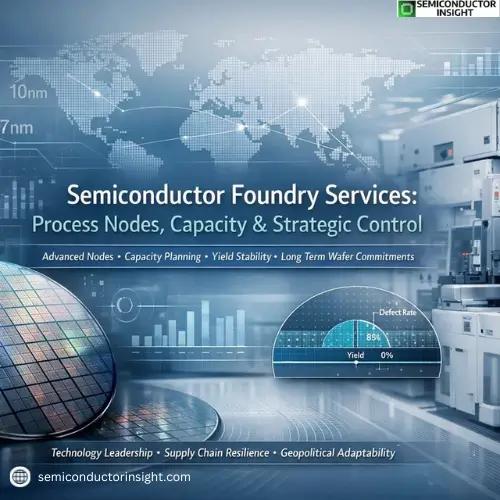
Foundry Services Evolution: From Mature Nodes to High-NA EUV Leadership
The semiconductor foundry service market refers to contract-based wafer fabrication services provided to chip designers that do not own manufacturing facilities. Foundries convert design files into physical integrated circuits using advanced process nodes, high-volume manufacturing lines, and tightly controlled yield management systems.
In an industry where fabrication costs now exceed billions of dollars per facility, foundry services have become the structural backbone of global semiconductor production, enabling innovation without capital overload.
Process Nodes as the Core Market Differentiator
Foundry competition, in contrast to commoditized manufacturing services, centres on process node maturity, defect density, and yield stability. Advanced nodes below 10nm attract the highest-value customers, while mature nodes remain critical for automotive, industrial, and power applications.
Foundries must balance capital allocation between cutting-edge nodes and stable legacy processes, ensuring utilization remains high across economic cycles. This dual-node strategy plays a key role in revenue stability and customer diversification.
To Know More about the Report, You Can Freely Browse Our Latest Updated Report:
https://semiconductorinsight.com/report/semiconductor-foundry-service-market/
Capacity Planning and Long-Term Commitments
Foundry services operate on long planning horizons. Capacity expansion decisions are made years in advance, based on projected customer roadmaps rather than short-term demand spikes.
As a result, the market increasingly relies on:
- Multi-year wafer supply agreements
- Prepaid capacity reservations
- Strategic customer partnerships
These arrangements reduce volatility for foundries while securing production access for customers in times of shortage.
Geographical Concentration and Risk Distribution
Semiconductor foundry capacity is highly concentrated in specific regions, making geography a defining market variable. Governments and enterprises now view foundry access as a matter of economic and technological security.
To address concentration risks, foundries are expanding footprints across multiple countries, supported by public funding, incentive programs, and regional manufacturing policies. This diversification reshapes investment flows within the market without immediately changing competitive leadership.
Technological Services Other Than Manufacturing
Modern foundry services extend far beyond wafer processing. Customers increasingly rely on foundries for design enablement, process development kits (PDKs), yield optimization support, and advanced packaging collaboration.
This service expansion strengthens customer lock-in and shifts foundries closer to co-development partners rather than transactional suppliers. The value proposition now includes manufacturability insight, not just production output.
Why Foundry Services Dictate the Semiconductor Value Chain?
The shift toward fabless semiconductor models has elevated foundries from backend suppliers to strategic power centres. Today, access to advanced process nodes often determines which companies can compete in AI accelerators, mobile processors, automotive electronics, and high-performance computing.
Foundry capacity is no longer just about output. It defines:
- Technology leadership
- Time-to-market advantage
- Supply chain resilience
This dynamic has transformed foundries into gatekeepers of next-generation semiconductor progress.
Import & Export Dynamics and Regulatory Influence
Foundry services are deeply impacted by export controls, technology transfer regulations, and cross-border compliance frameworks. Restrictions on advanced equipment, materials, or node access directly affect which customers can be served and at what technological level.
Foundries must navigate:
- Equipment sourcing restrictions
- Customer eligibility compliance
- Regional technology sovereignty rules
Cost Structure and Margin Discipline
Foundry economics are driven by fixed costs, making utilization rates a critical performance metric. Even small changes in demand can significantly affect profitability due to the capital-intensive nature of fabrications.
To maintain margin discipline, foundries optimize:
- Tool utilization
- Yield learning curves
- Process standardization across customers
Customer Segmentation and Demand Behavior
Demand patterns vary sharply by customer type. High-volume consumer electronics prioritize advanced nodes and rapid ramp-up, while automotive and industrial clients emphasize long-term availability and process stability.
Foundries tailor service models accordingly, aligning capacity commitments with customer lifecycle expectations rather than applying uniform manufacturing strategies.
Strategic Outlook: Foundries as Industry Anchors
Semiconductor foundry service market is no longer a supporting segment it is the anchor of the global chip ecosystem. As chip complexity increases and capital requirements escalate, reliance on foundry services will deepen across all semiconductor categories.
Future competition will centre on technology execution, capacity foresight, and geopolitical adaptability, rather than pricing alone. Foundries that align manufacturing excellence with ecosystem partnerships will continue to shape the trajectory of the semiconductor industry.
Key Takeaway Section
Semiconductor foundry service market represents the convergence of manufacturing scale, technology leadership, and strategic control, making it one of the most influential segments in the global semiconductor landscape.

Comments (0)