
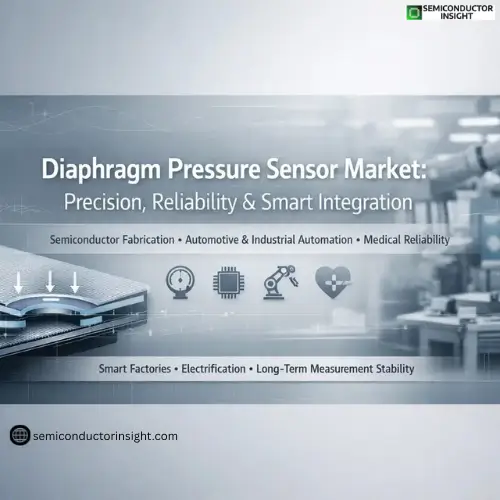
Forecast for the Diaphragm Pressure Sensor Market as Smart Manufacturing Boosts
Diaphragm pressure sensor market is no longer defined solely by traditional industrial instrumentation. It is increasingly shaped by advancements in semiconductor fabrication, materials engineering, and integrated electronics, all of which are expanding the performance envelope of these sensors.
Pressure sensing is one of the oldest measurement requirements in engineering, yet it continues to evolve as systems become smarter, smaller, and more sensitive. Within this space, diaphragm pressure sensors hold a distinctive position. Their ability to convert mechanical deformation into precise electrical signals has made them indispensable across industries that demand accuracy, stability, and long-term reliability.
Quick Glance at Industry Highlights:
- January 2025: KNF has introduced a new series of OEM liquid diaphragm pumps offering high precision and reliability for demanding applications. The FM 50 series uses cutting-edge pump drive technology for simple system integration and long-term durability, improving liquid metering precision and flexibility. With a set point precision of +/- 2%, the pumps offer a flow rate of 100-500 ml/min while maintaining a linear flow rate under a range of conditions and a back pressure of up to 1 bar.
- September 2025: ABB’s new P-300 versatile pressure transmitter series is now available in the United States, ensuring high accuracy and ease of use over a broad range of applications in the petrochemical, chemical, power, pulp and paper, and other industrial sectors. When paired with ABB’s S26 remote diaphragm seal series, the P-300 pressure transmitters come with a unique anti-abrasion Diaflex diaphragm that stands up to harsh slurry conditions found in many process industries.
The Core Principle That Keeps Gaining Relevance
At the heart of a diaphragm pressure sensor is a simple but powerful concept: a thin diaphragm flexes under pressure, and this deformation is measured using piezoresistive, capacitive, or resonant techniques. What has changed over time is not the principle itself, but the level of precision with which it can now be engineered.
Modern semiconductor processes allow diaphragms to be manufactured with extreme dimensional control, enabling sensors to detect minute pressure variations with exceptional repeatability. This precision has elevated diaphragm-based sensors from basic monitoring tools to critical components in closed-loop control systems.
Automotive and Mobility Applications Are a Major Growth Engine
The automotive sector remains one of the most influential demand drivers for diaphragm pressure sensors. Modern vehicles rely on precise pressure measurement for engine management, braking systems, transmission control, and emission monitoring.
As electrification and advanced driver-assistance systems gain traction, the number of sensing points within vehicles continues to rise. Diaphragm pressure sensors are particularly valued for their robustness under vibration, temperature fluctuations, and long operating cycles, making them suitable for both conventional and next-generation mobility platforms.
Industrial Automation Elevates Accuracy Requirements
In industrial environments, pressure measurement is closely tied to safety, efficiency, and process optimization. Diaphragm pressure sensors are widely used in hydraulics, pneumatics, fluid control, and process automation, where consistent performance under harsh conditions is essential.
The shift toward smart factories and Industry 4.0 has increased the emphasis on data accuracy and real-time monitoring. Sensors are expected not only to measure pressure but also to communicate seamlessly with control systems, analytics platforms, and predictive maintenance tools. This trend reinforces demand for advanced diaphragm sensor designs with stable long-term behavior.
Medical and Healthcare Applications Demand Reliability Over Time
In medical devices, pressure sensors often operate in environments where accuracy can directly impact patient outcomes. Diaphragm pressure sensors are used in respiratory equipment, infusion systems, and diagnostic instruments, where consistency and biocompatibility are critical.
Medical applications, in contrast to consumer electronics, place a higher priority on dependability than on quick upgrade cycles. This criteria strengthens the market position of diaphragm-based designs by favoring sensor technologies with demonstrated mechanical stability and predictable aging characteristics.
Material Innovation Is Quietly Transforming the Market
- While silicon remains the dominant material for diaphragm fabrication, ongoing research into alternative materials and surface treatments is enhancing sensor durability and performance.
- Improved coatings and packaging techniques help protect diaphragms from corrosion, moisture, and mechanical fatigue.
- These material-level innovations enable sensors to operate in more demanding environments, including chemical processing, oil and gas systems, and outdoor installations.
- As application boundaries expand, so does the relevance of diaphragm pressure sensors across industries.
Manufacturing Scale Meets Customization
The diaphragm pressure sensor market balances two seemingly opposing forces: high-volume manufacturing and application-specific customization. On one hand, automotive and industrial markets demand cost-efficient, scalable production. On the other, specialized applications require tailored pressure ranges, form factors, and interface options.
Leading manufacturers are addressing this challenge through modular designs and flexible production processes. This approach allows them to serve diverse markets without compromising quality or consistency.
You can review our most recent insights here:
https://semiconductorinsight.com/report/diaphragm-pressure-sensor-market/
Market Outlook: Steady Growth with Technological Depth
The growth trajectory of the diaphragm pressure sensor market is closely aligned with broader trends in automation, electrification, and digital transformation. Rather than experiencing sudden demand spikes, the market advances steadily as pressure sensing becomes more deeply embedded in modern systems.
Future opportunities are expected to emerge from continued miniaturization, improved integration with digital electronics, and expanding use in data-driven environments. These developments position diaphragm pressure sensors not as legacy components, but as evolving technologies supporting the next phase of industrial and electronic innovation.
Final Perspective
The diaphragm pressure sensor market illustrates how foundational engineering concepts can remain relevant through continuous refinement. By combining mechanical reliability with semiconductor-level precision, these sensors continue to meet the rising expectations of modern applications.
As industries demand greater accuracy, smarter systems, and long-term stability, diaphragm pressure sensors are set to remain a quiet but essential pillar of the global sensing ecosystem.

Comments (0)