
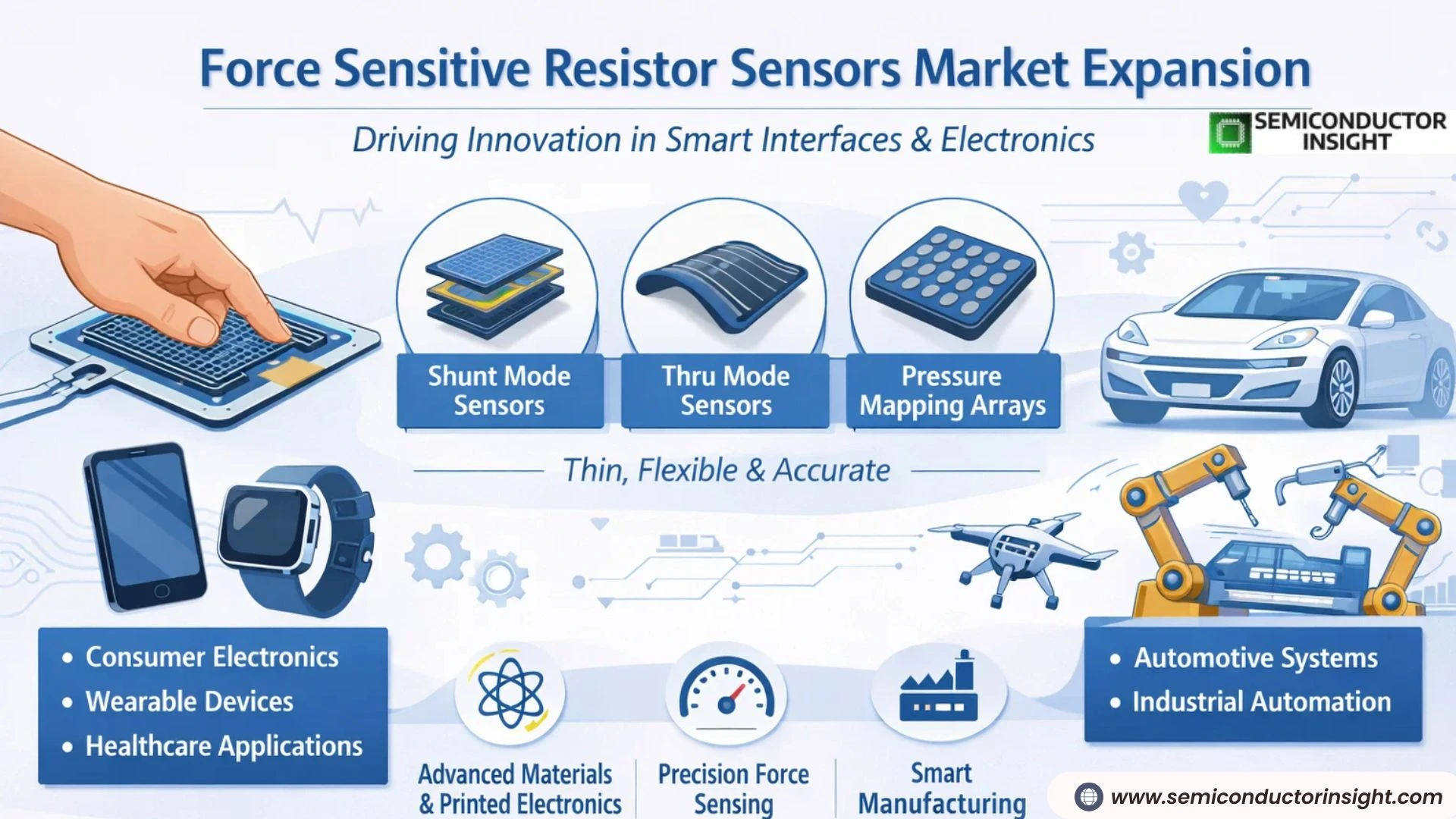
Force Sensitive Resistor Sensors Market Expansion and Smart Interface Technologies
A gentle touch, a controlled grip, a pressure-based command modern electronics are becoming more responsive to human interaction than ever before. Behind this shift lies the rapidly evolving force sensitive resistor sensors market, a crucial segment within the semiconductor ecosystem that enables devices to detect pressure, force, and tactile input with exceptional precision. These sensors are redefining how machines interact with people, transforming everyday electronics into intelligent and responsive systems.
Force sensitive resistor sensors, often referred to as FSR sensors, operate using piezoresistive sensing technology, where electrical resistance changes when force is applied. The conductive layer inside the sensor forms electrical pathways under pressure, reducing resistance and generating measurable signals. Their thin structure, flexibility, and low power consumption make them ideal for integration into modern electronic devices, driving rapid adoption across multiple industries.
The growing demand for smart devices, touch-based interfaces, and real-time sensing systems continues to position this market at the forefront of semiconductor innovation.
Sensor Design and Semiconductor Material Innovation
- The performance of force sensitive resistor sensors is closely linked to advancements in semiconductor materials and thin-film manufacturing processes. Modern FSR sensors typically use conductive polymers, carbon-based inks, and flexible substrates that respond dynamically to applied pressure.
- Recent innovation focuses on printed electronics, enabling mass production of ultra-thin sensors with improved signal response and durability. Miniaturization technologies now allow sensor profiles as thin as 0.2 mm, supporting integration into compact electronic devices and wearable technologies.
- Manufacturers are also exploring graphene-based sensing layers and hybrid material structures to improve temperature stability, sensitivity, and long-term reliability. The shift toward RoHS-compliant materials and environmentally friendly manufacturing has further influenced material engineering strategies across the industry.
- These semiconductor material innovations are enabling higher accuracy levels, faster response times, and improved mechanical durability.
Major Force Sensitive Resistor Sensor Sub Types
- Shunt mode FSR sensors represent one of the most widely adopted configurations, offering stable output and high sensitivity for consumer electronics and automotive applications. This segment accounts for a significant portion of market deployment due to its reliability and precision characteristics.
- Thru mode FSR sensors are gaining popularity because of their flexibility and ability to operate on curved surfaces. These sensors deliver fast response times and are increasingly used in robotics, industrial automation, and medical equipment.
- Flexible FSR strips and pressure mapping arrays are also emerging as advanced sensor formats, supporting applications that require distributed force detection and multi-point pressure monitoring.
Integration in Consumer Electronics and Smart Interfaces
Consumer electronics remains one of the largest application areas for force sensitive resistor sensors. Smartphones, tablets, gaming controllers, and wearable devices rely on FSR technology to enable pressure-sensitive input and tactile feedback.
These sensors allow devices to recognize varying levels of touch intensity, improving responsiveness and enhancing user experience. Pressure-based interaction technologies are becoming standard in next-generation touch interfaces, increasing demand for highly sensitive and compact sensing components.
Wearable devices such as fitness trackers and smart watches also incorporate FSR sensors to monitor motion intensity, grip force, and physical activity metrics. The expansion of wearable technology continues to create new opportunities for semiconductor sensor manufacturers.
Healthcare and Medical Device Applications
Healthcare represents one of the fastest expanding sectors for force sensitive resistor sensors. Medical devices utilize these sensors for pressure monitoring, posture detection, and patient diagnostics.
Applications include pressure mapping systems, smart hospital beds, rehabilitation equipment, and wearable monitoring devices. FSR sensors help detect pressure points, monitor movement, and prevent medical complications, improving patient care outcomes.
The growing adoption of remote healthcare and telemedicine solutions is further accelerating the integration of compact sensing technologies into medical equipment.
Advanced Manufacturing and Industrial Intelligence
The transition toward smart manufacturing and industrial automation is creating strong demand for force sensitive resistor sensors. These sensors enable precise force measurement in assembly lines, quality control processes, and robotic operations.
Industrial IoT systems use FSR sensors for real-time monitoring of pressure and mechanical stress, improving production efficiency and reducing operational risks. Their ability to provide immediate feedback supports predictive maintenance strategies and enhances equipment performance.
As manufacturing environments become increasingly automated, pressure sensing technologies are becoming essential components of intelligent industrial systems.
Lastly before we wrap up, don’t forget to look at our most recent exclusive report for in-depth insights: https://semiconductorinsight.com/report/force-sensitive-resistor-sensors-market/
Automotive and Mobility System Integration
Automotive manufacturers are integrating force sensitive resistor sensors into vehicle systems to enhance safety, comfort, and user interaction. These sensors are used in seat occupancy detection, touch-sensitive control panels, and smart airbag deployment systems.
Advanced driver assistance systems also rely on force sensing technologies to monitor driver behavior and optimize vehicle performance. The shift toward connected and autonomous vehicles continues to expand opportunities for semiconductor sensor technologies.

Comments (0)