Market Insights
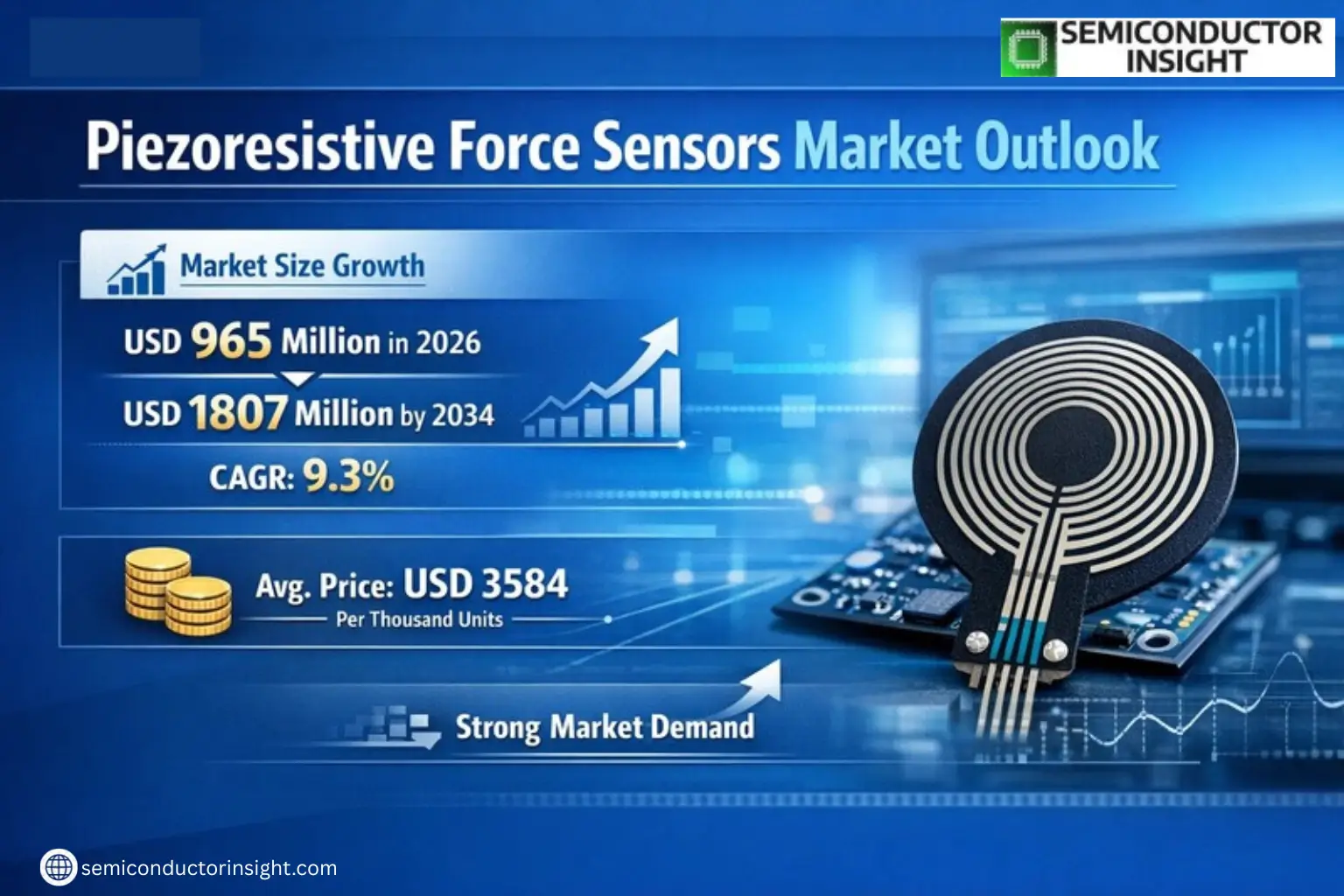
Global Piezoresistive Force Sensors Market was valued at USD 965 million in 2026 and is projected to reach USD 1807 million by 2034, exhibiting a CAGR of 9.3% during the forecast period.
In 2026, global shipments reached approximately 294.77 million units, with an average market price of around USD 3584 per thousand units.
Piezoresistive Force Sensors are compact sensing devices that convert mechanical pressure into measurable electrical signals through resistance changes. These components consist of force-sensitive resistor elements, substrate materials, and integrated signal processing circuits. Their operation leverages the piezoresistive effect – where applied force alters the conductive path’s resistance either through semiconductor lattice deformation or conductive particle realignment.
The market growth is driven by expanding applications in consumer electronics and industrial automation, where these sensors address critical needs for precise force measurement. Key manufacturers like Tekscan and Interlink Electronics are advancing miniaturization technologies, while Asian producers dominate volume manufacturing. The Asia-Pacific region accounted for over 50% of 2026 sales, reflecting concentrated production capabilities and growing adoption across automotive and robotics sectors.
MARKET DRIVERS
Growing Demand for Miniaturized Sensing Solutions
Piezoresistive Force Sensors Market is experiencing robust growth due to increasing demand for compact, high-precision force measurement in industries like medical devices, automotive, and consumer electronics. Technological advancements in MEMS-based piezoresistive sensors have enabled their adoption in space-constrained applications.
Automotive Safety and Industrial Automation Trends
Stringent safety regulations in the automotive sector drive the need for reliable force sensing in airbag deployment systems and brake pedals. Industrial automation’s reliance on tactile feedback and robotic force control further accelerates piezoresistive force sensor adoption, with the market projected to grow at 6.2% CAGR until 2028.
The proliferation of IoT-enabled devices and smart manufacturing has created new use cases for piezoresistive force sensors in predictive maintenance and real-time monitoring systems.
MARKET CHALLENGES
High Development Costs and Technical Limitations
Developing application-specific piezoresistive force sensors requires significant R&D investment, particularly for medical-grade or high-temperature resistant variants. The nonlinear response characteristics at extreme force ranges remain a technical hurdle for some industrial applications.
Other Challenges
Competition from Alternative Technologies
Capacitive and optical force sensing technologies are gaining traction in certain segments, offering higher resolution in some case-specific applications, though piezoresistive variants maintain advantages in cost-effectiveness for most commercial uses.
MARKET RESTRAINTS
Material Limitations in Harsh Environments
Standard silicon-based piezoresistive force sensors face durability challenges in extreme temperature or chemically aggressive environments, limiting adoption in oil & gas or aerospace applications without expensive protective measures.
MARKET OPPORTUNITIES
Emerging Applications in Wearable Health Tech
Global Wearable Medical Device Market expansion presents significant growth potential for ultra-thin piezoresistive force sensors capable of continuous patient monitoring. Recent advances in flexible hybrid electronics enable integration into smart bandages and rehabilitation wearables.
Piezoresistive Force Sensors Market Trends
Rapid Market Expansion with 9.3% CAGR Projection
Global Piezoresistive Force Sensors Market is growing robustly, valued at USD 965 million in 2026 with projections reaching USD 1807 million by 2034. This 9.3% CAGR reflects increasing adoption across consumer electronics, automotive, and medical sectors. Unit shipments reached 294.77 million in 2026, demonstrating widespread integration into industrial and consumer applications.
Other Trends
Miniaturization Driving Consumer Electronics Adoption
Advancements in sensor miniaturization enable thinner profiles below 0.2mm thickness while maintaining 0.5-5% measurement accuracy. This facilitates integration into smartphones, wearables, and IoT devices where space constraints previously limited adoption. Major OEMs now routinely embed these sensors in touch interfaces and health monitoring systems.
Regional Market Dynamics
Asia-Pacific dominates with over 50% market share due to concentrated electronics manufacturing. North America (22.87%) leads in R&D and high-end applications through firms like Tekscan, while Europe (18.5%) excels in automotive and industrial automation implementations. China’s domestic suppliers are rapidly catching up in semiconductor-grade sensors.
Manufacturing and Supply Chain Evolution
Leading producers achieve gross margins of 30-40% with automated lines producing up to 100k units monthly. The supply chain is consolidating around key material suppliers like DuPont for polyimide substrates and Toray for conductive films. Vertical integration is increasing among top Chinese manufacturers to secure raw material supplies.
Technology Advancements
Next-generation sensors now achieve 0.1N resolution with ±2% nonlinearity through improved conductive particle formulations. Hybrid designs combining piezoresistive and capacitive elements are emerging for automotive safety systems requiring redundancy. Smart sensors with embedded ASICs reduce external component counts by 60%.
COMPETITIVE LANDSCAPE
Key Industry Players
Global Piezoresistive Force Sensors Market Dynamics
Global Piezoresistive Force Sensors Market is dominated by established players like Nissha, Tekscan, and Interlink Electronics, which collectively hold over 60% market share. These companies lead through technological innovation, extensive patent portfolios, and strategic partnerships with major electronics OEMs. The competitive landscape shows high concentration in North America and Asia-Pacific regions, with Japanese and US firms commanding premium positioning in high-performance applications.
Specialized manufacturers like Memtronik and Butler Technologies focus on niche segments such as medical devices and automotive electronics. Chinese companies including Hanwei Electronics Group and Nanjing Momao Electronic Technology are gaining market share through competitive pricing and government-supported R&D initiatives. Emerging players like NextInput (acquired by Qorvo) are disrupting the market with MEMS-based force sensing solutions for consumer electronics applications.
List of Key Piezoresistive Force Sensors Companies Profiled
- Nissha Co., Ltd.
- Tekscan, Inc.
- Interlink Electronics
- Memtronik
- Butler Technologies
- Hanwei Electronics Group
- Nanjing Momao Electronic Technology
- NextInput (Qorvo)
- Ohmite Manufacturing Company
- Techprint
- Taiwan Alpha Electronic Co., Ltd.
- Sensitronics LLC
- LEGACT (Guangzhou Lijing Photoelectric Technology)
- Ceradex Corporation
- Shanghai Smith Adhesive New Material Co., Ltd.
Segment Analysis:
| Segment Category | Sub-Segments | Key Insights |
| By Type |
|
Thru Mode dominates due to superior linearity in force measurement and better integration capabilities in compact electronic devices.
|
| By Application |
|
Consumer Electronics represents the largest application segment with expanding integration in smart devices.
|
| By End User |
|
OEMs drive the majority of demand through large-scale integration in finished products.
|
| By Sensitivity Range |
|
50N Below sensors see widest adoption due to their versatility in consumer applications.
|
| By Shape |
|
Rectangle shapes dominate industrial applications due to mounting advantages.
|
Regional Analysis: Global Piezoresistive Force Sensors Market
Automotive manufacturers in North America increasingly integrate piezoresistive force sensors for advanced driver assistance systems and battery management in electric vehicles. The technology enables precise pressure monitoring across critical vehicle components.
The region’s healthcare industry utilizes piezoresistive sensors in surgical robots, prosthetics, and patient monitoring equipment. FDA-approved medical devices incorporate these sensors for their reliability and precision in delicate medical procedures.
Smart factories across North America deploy piezoresistive sensors for quality control and robotic assembly lines. The technology enables real-time force feedback for precision manufacturing processes in aerospace and electronics sectors.
Leading research institutions collaborate with sensor manufacturers to develop next-generation piezoresistive solutions. Government funding supports advancements in nanomaterials and miniaturization techniques for specialized applications.
Europe
Europe represents the second-largest market for piezoresistive force sensors, driven by strong industrial automation and automotive sectors. The region benefits from stringent safety regulations requiring advanced sensing technologies across multiple industries. Germany leads in manufacturing applications, while Scandinavian countries focus on medical and robotics implementations. Collaborative research programs between universities and corporations accelerate innovation in smart sensor technologies for industrial IoT applications.
Asia-Pacific
Asia-Pacific emerges as the fastest-growing region for piezoresistive force sensors, fueled by expanding electronics manufacturing and automotive production. China dominates regional demand with massive electronics assembly operations, while Japan leads in precision instrument applications. Increasing investments in robotics and automation across Southeast Asia create new opportunities for compact, high-performance force sensing solutions in consumer electronics manufacturing.
South America
South America shows moderate growth in piezoresistive force sensor adoption, primarily concentrated in Brazil’s automotive sector and Argentina’s industrial applications. The region benefits from increasing automation in mining and agricultural equipment manufacturing. Infrastructure development projects drive demand for structural monitoring systems incorporating advanced force measurement technologies.
Middle East & Africa
The Middle East & Africa region exhibits niche demand for piezoresistive force sensors, mainly in oil & gas applications and infrastructure projects. Gulf countries invest in smart city technologies incorporating force sensing for security and automation systems. South Africa leads in mining equipment applications requiring robust sensor solutions for harsh operating environments.
Report Scope
This market research report provides a comprehensive analysis of the Piezoresistive Force Sensors Market, covering the forecast period 2026–2034. It offers detailed insights into market dynamics, technological advancements, competitive landscape, and key trends shaping the industry.
Key focus areas of the report include:
- Market Overview: The report begins with an overview outlining its current market scenario, key growth indicators, and industry transformation drivers. It discusses macroeconomic factors, demand–supply balance, regulatory landscape, and the strategic role of semiconductors in powering advancements across industries such as automotive, telecommunications, consumer electronics, and industrial automation.
- Market Size & Forecast: Historical data and future projections for revenue, unit shipments, and market value across major regions and segments.
- Segmentation Analysis: Detailed breakdown by product type, technology, application, and end-user industry to identify high-growth segments and investment opportunities.
- Regional Insights: Insights into market performance across North America, Europe, Asia-Pacific, Latin America, and the Middle East & Africa, including country-level analysis where relevant.
- Competitive Landscape: Profiles of leading market participants, including their product offerings, R&D focus, manufacturing capacity, pricing strategies, and recent developments such as mergers, acquisitions, and partnerships.
- Technology Trends & Innovation: Assessment of emerging technologies, integration of AI/IoT, semiconductor design trends, fabrication techniques, and evolving industry standards.
- Market Drivers & Restraints: Evaluation of factors driving market growth along with challenges, supply chain constraints, regulatory issues, and market-entry barriers.
- Stakeholder Insights: Insights for component suppliers, OEMs, system integrators, investors, and policymakers regarding the evolving ecosystem and strategic opportunities.
Primary and secondary research methods are employed, including interviews with industry experts, data from verified sources, and real-time market intelligence to ensure the accuracy and reliability of the insights presented.
FREQUENTLY ASKED QUESTIONS:
What is the current market size of Piezoresistive Force Sensors Market?
-> Piezoresistive Force Sensors Market was valued at USD 965 million in 2026 and is projected to reach USD 1807 million by 2034, exhibiting a CAGR of 9.3% during the forecast period.
Which key companies operate in Piezoresistive Force Sensors Market?
-> Key players include Nissha, Shenzhen New Degree Technology, Memtronik, Tekscan, Butler Technologies, Hanwei Electronics Group, Nanjing Momao Electronic Technology, NextInput (Qorvo), Interlink, and Ohmite, among others. The top 5 companies held over 60% market share in 2026.
What are the key growth drivers?
-> Key growth drivers include increasing demand for industrial automation, rising adoption in consumer electronics, technological advancements in force sensing, and expanding applications in medical devices and robotics.
Which region dominates the market?
-> Asia-Pacific dominated the market with over 50% share in 2026, followed by North America (22.87%) and Europe (18.50%). The region benefits from its strong manufacturing base in consumer electronics and industrial automation.
What are the emerging trends?
-> Emerging trends include miniaturization of sensors, development of flexible piezoresistive sensors, integration with IoT platforms, and increasing adoption in automotive safety systems.
Get Sample Report PDF for Exclusive Insights
Report Sample Includes
- Table of Contents
- List of Tables & Figures
- Charts, Research Methodology, and more...
 Download Sample Report PDF