

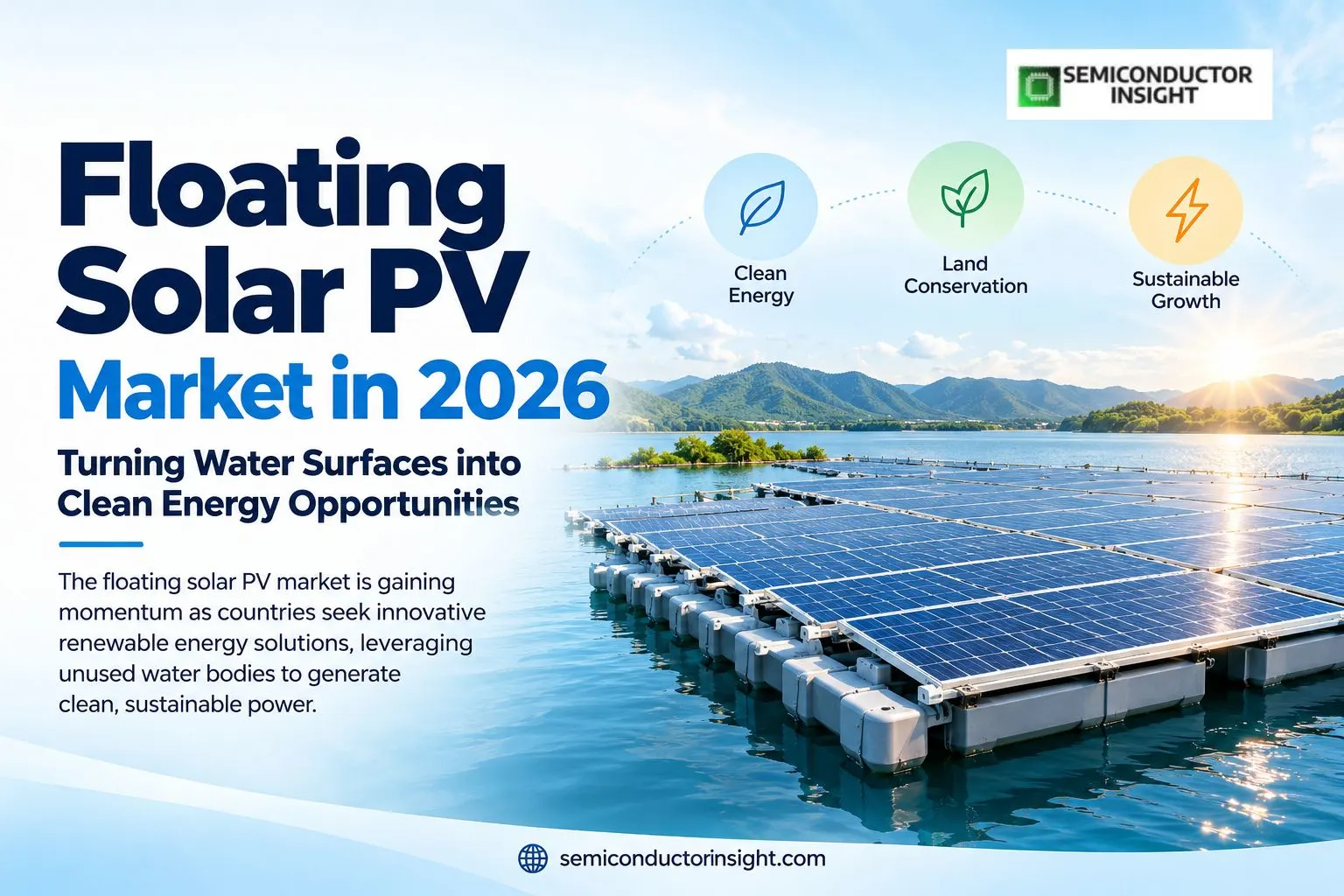
Floating Solar PV Market in 2026 as Reservoir Innovation, Battery Storage and Water-Energy Integration Redefine Renewable Power
Floating solar photovoltaic technology is changing the way developers think about renewable energy sites. Instead of competing for agricultural land or building space, photovoltaic modules are installed on engineered floating platforms across reservoirs, industrial ponds and selected inland water bodies. The concept becomes particularly relevant where electricity demand is rising but available land is limited.
Floating Solar PV Market is also evolving beyond panel installation. Project developers must coordinate anchoring systems, electrical connections, water operations, environmental monitoring and, increasingly, energy storage. These requirements make floating solar a distinct infrastructure category rather than simply a variation of conventional ground-mounted solar.
India’s 2026 Policy Move Puts Reservoirs under the Spotlight
India made a significant policy announcement on 31 July 2026, when the Union Cabinet approved the Pradhan Mantri Surya Sarovar Yojana. According to the Ministry of New and Renewable Energy, the programme provides an outlay of ₹5,070 crore and targets 5,000 MW of floating solar projects with co-located energy storage. The planned storage requirement is at least two hours, equivalent to 10,000 MWh across the programme’s targeted capacity.
The scale of the opportunity is also notable. An assessment released by the ministry in June 2026 estimated India’s floating solar potential at approximately 102.18 GWp across suitable inland water bodies. Yet a February 2026 government consultation reported that only around 700 MW of floating solar had been commissioned nationally at that point.
The difference between assessed potential and commissioned capacity highlights the importance of identifying viable sites, preparing project designs and establishing clear implementation procedures.
Singapore Shows How Solar Generation Can Support Water Infrastructure
Singapore offers a practical example of floating solar integrated with water management. Its Tengeh Reservoir installation, commissioned in 2021, has a capacity of 60 MWp and occupies approximately 45 hectares. The system comprises more than 122,000 solar panels distributed across 10 floating islands. Singapore’s national water agency estimates that the installation can generate enough electricity to power around 16,000 four-room public housing flats.
- In August 2026, Singapore’s Ministry of Sustainability and the Environment confirmed 63 MWp of floating solar deployment across its reservoirs and plans for another 350 MWp across Lower Seletar, Pandan and Kranji reservoirs by 2030. The government also reported that Tengeh produces approximately 7–10% more solar energy than a comparable land-based system, although actual performance depends on installation conditions.
This example demonstrates how floating solar can support electricity generation while making use of existing infrastructure, provided water quality, reservoir operations and environmental considerations are adequately managed.
Why the Float, Anchor and Electrical Design Matters?
Floating solar installations depend on a connected set of engineering systems. Floats must support the module array, mooring systems must accommodate water-level changes and wind loads, and electrical components must operate reliably in a humid environment.
Project design therefore needs to account for:
- Water-level variation, wave action and extreme weather.
- Corrosion resistance, cable protection and long-term access for maintenance.
- Reservoir ecology, water quality and competing uses of the water body.
- Safe electrical isolation and inspection procedures.
The World Bank’s floating solar research identifies anchoring, electrical maintenance, water rights and environmental assessment as important considerations in project development.
You can freely browse our most recent updated report to learn more about it before scrolling further: https://semiconductorinsight.com/report/floating-solar-pv-market/
Battery Storage Is Changing the Project Design Conversation
Pairing floating solar with battery storage can help shift some electricity generation towards periods of higher demand. India’s 2026 scheme explicitly links the two technologies, specifying a minimum two-hour storage duration for supported projects. This design approach recognises that generating electricity during daylight hours does not automatically guarantee that it will be available when required.
When installed alongside hydropower, floating solar may also complement existing grid connections and generation infrastructure. The World Bank has highlighted the potential for coordinated solar and hydropower operation, although the benefits depend on reservoir conditions, grid constraints and operational planning.
The Next Project Milestone Is Reliable Operation, Not Just Installed Capacity
- Floating Solar PV Market is moving into a phase where deployment figures must be considered alongside operational performance.
- Developers and utilities need to establish how installations behave across seasonal water levels, changing weather and long maintenance cycles.
India’s new programme and Singapore’s expansion plans demonstrate two different routes towards greater adoption: policy-backed project development and carefully managed integration with existing water infrastructure. Their long-term significance will depend on whether projects can combine dependable electricity generation, sound environmental management and practical maintenance over their operating lives.

Comments (0)