
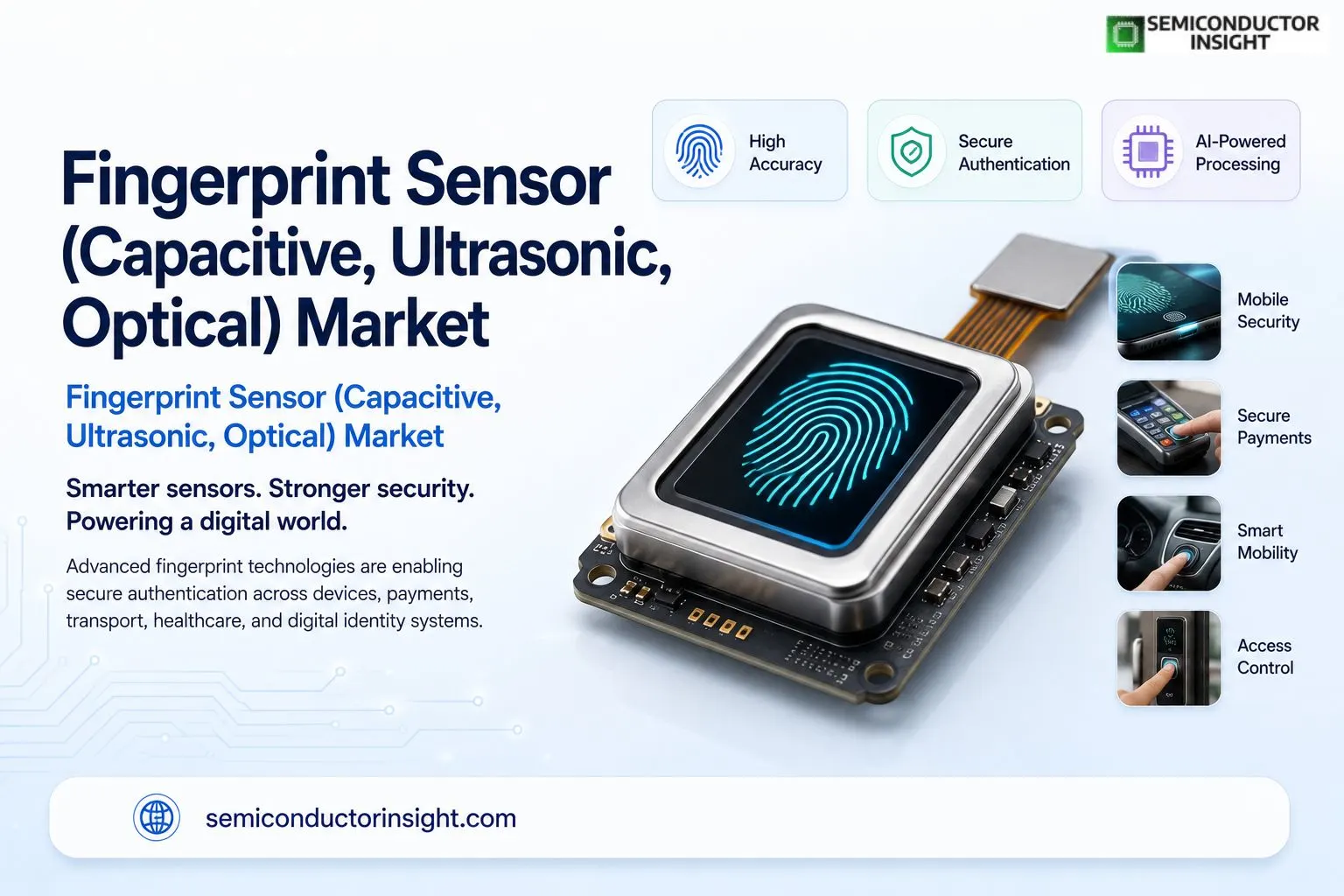
Fingerprint Sensor Market Innovations Reshaping Smartphones, Cars and Smart Homes
The semiconductor industry is entering a new phase where biometric authentication is no longer limited to unlocking smartphones. Fingerprint sensor market has become one of the most active technology segments supporting secure payments, industrial automation, healthcare systems, connected vehicles, and government-backed identity programs. Capacitive, ultrasonic, and optical fingerprint technologies are now deeply integrated into daily digital infrastructure, creating a new layer of trust in devices that continuously exchange sensitive data.
Fingerprint authentication demand accelerated after global digital banking adoption surged and remote identity verification became a requirement across online platforms. Smartphone manufacturers are embedding larger and faster sensors directly beneath displays, while semiconductor companies are investing in AI-assisted biometric processing to improve accuracy under difficult conditions such as wet fingers, low lighting, or damaged skin surfaces.
Please take a Look at Our Updated Report before continuing: https://semiconductorinsight.com/report/fingerprint-sensor-capacitive-ultrasonic-optical-market/
Semiconductor Engineering Behind Next Generation Sensors
- Capacitive fingerprint sensors continue to dominate mobile devices because of their compact structure and low energy consumption. These sensors detect electrical differences between fingerprint ridges and valleys, making them highly effective for smartphones, tablets, and payment cards.
Several Android flagship devices launched during 2025 integrated ultra-thin capacitive modules directly into foldable displays, reducing hardware thickness while improving response time.
- Ultrasonic fingerprint sensors are gaining strong momentum in premium electronics because they create detailed 3D fingerprint maps using sound waves instead of light. This technology performs effectively even with moisture or oily surfaces, making it useful for automotive dashboards and industrial control systems.
Samsung’s Galaxy Ultra series and multiple Chinese flagship smartphones expanded ultrasonic sensor integration to improve secure mobile payments and enterprise authentication.
- Optical fingerprint sensors are also evolving rapidly due to improvements in high-resolution imaging and AI-powered pattern recognition. Optical systems are now widely used in smart door locks, retail kiosks, and airport verification terminals because they support larger scanning areas and lower manufacturing costs.
Digital Identity Programs Expanding Biometric Infrastructure
Governments across Asia, Europe, and the Middle East are increasing investments in biometric identification systems linked to public services and financial access. India’s Aadhaar ecosystem remains one of the world’s largest biometric databases, supporting identity verification for banking, telecom services, and welfare distribution. According to UIDAI operational records, the platform processes billions of authentication requests annually across digital service networks.
- In airports, biometric boarding systems are becoming standard operational infrastructure.
- Singapore Changi Airport and several European transit hubs expanded fingerprint and facial recognition systems to reduce manual identity checks and improve passenger flow.
- The integration of semiconductor-based biometric chips into travel systems is reducing verification time from minutes to seconds.
The banking sector is also reshaping the fingerprint sensor market. Mastercard introduced biometric payment cards with embedded fingerprint authentication, allowing cardholders to authorise transactions without PIN entry. These cards integrate miniature semiconductor sensor modules directly inside the card body while maintaining standard payment dimensions.
Device Makers Pushing Fingerprint Sensors beyond Smartphones
- The growing connected device ecosystem is creating fresh opportunities for semiconductor manufacturers.
- Smart home companies are embedding fingerprint sensors into security locks, garage systems, and private access panels.
- Several luxury residential projects in Dubai and Singapore now use biometric access systems connected to centralised IoT platforms.
- Automotive companies are also entering the biometric authentication race. In 2025, multiple electric vehicle manufacturers introduced fingerprint-enabled driver profiles that automatically adjust seating, climate settings, and infotainment preferences.
- Fingerprint verification is increasingly being tested as an anti-theft solution for connected vehicles where software-defined access is replacing traditional keys.
- Healthcare systems are another major growth area. Hospitals in Japan and South Korea expanded biometric authentication for patient data access and medicine storage cabinets.
- Fingerprint-based verification helps reduce unauthorised access to medical records while supporting secure digital workflows in high-pressure healthcare environments.
Biometric Security Becoming Part of Everyday Infrastructure
Fingerprint sensor market is no longer operating as a standalone consumer electronics segment. It is becoming part of a broader semiconductor movement where digital identity, connected infrastructure, and AI-assisted authentication work together across industries. From financial services and healthcare to transportation and smart homes, fingerprint sensors are evolving into silent security layers embedded inside everyday systems.

Comments (0)