
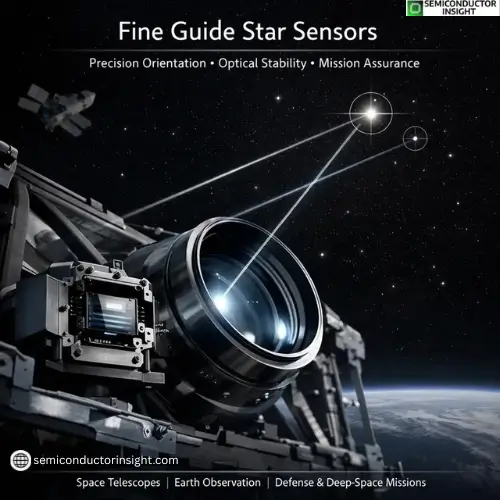
Fine Guide Star Sensor Market Trends, Accuracy Demand, and Growth Outlook
In life science research, neuronal markers act as reference signals that allow scientists to locate, track, and understand complex biological systems with precision. In a remarkably similar way, fine guide star sensors function as the neuronal markers of space-based optical systems, enabling spacecraft and telescopes to orient themselves with extraordinary accuracy in an otherwise chaotic orbital environment.
Just as neuronal markers are essential for mapping neural pathways, fine guide star sensors are indispensable for maintaining stable line-of-sight alignment in advanced space missions. This parallel highlights why the Fine Guide Star Sensor Market has moved from being a niche aerospace component segment to a strategically critical part of modern semiconductor-driven space infrastructure.
You Can Freely Surf Our Latest Updated Report Here:
https://semiconductorinsight.com/report/fine-guide-star-sensor-market/
What Fine Guide Star Sensors Really Do?
Fine guide star sensors are high-precision optical sensing systems used to detect reference stars and provide real-time positional feedback for spacecraft attitude control. These sensors allow telescopes and imaging payloads to lock onto celestial reference points, ensuring stable observation even when subjected to micro-vibrations, thermal shifts, and orbital disturbances.
From a market perspective, this segment sits at the intersection of advanced semiconductor imaging, precision optics, and space-grade electronics, making it both technically demanding and highly specialized.
Semiconductor Innovation as the Core Enabler
- At the heart of fine guide star sensors lies semiconductor innovation.
- Advanced image sensors, radiation-hardened processing units, and low-noise signal amplification technologies are central to achieving the sensitivity required for star tracking.
- The target market places more emphasis on signal integrity, thermal stability, and long-term operational consistency than consumer imaging markets, which place more emphasis on pixel count.
- These priorities influence material selection, fabrication processes, and quality validation standards across the supply chain.
Why Demand Is Rising Beyond Traditional Space Programs?
Historically, fine guide star sensors were limited to flagship scientific missions and large government-funded observatories. Today, the demand landscape has expanded significantly. The rise of commercial space exploration, earth observation satellites, and defence reconnaissance platforms has increased the need for compact, reliable, and ultra-precise guidance systems.
What makes this growth distinctive is that it is driven less by volume and more by performance reliability and mission assurance, which directly elevates the value of each deployed sensor system.
A Simplified Operational Flow where the sequence illustrates why even marginal improvements in sensor accuracy can dramatically enhance overall mission performance.
Star Detection → Signal Processing → Attitude Correction → Image Stabilization
Key Characteristics Defining Market Competition
Competition in the fine guide star sensor market is shaped by factors that differ significantly from mainstream semiconductor segments. Success depends on:
- Demonstrated performance in space-qualified missions, rather than laboratory benchmarks
- Long-term reliability under radiation and temperature extremes
These attributes create high entry barriers, reinforcing the dominance of experienced suppliers with proven flight heritage.
Application Landscape: Where These Sensors Are Deployed
Scientific space telescopes remain the most visible application, but they are no longer the only growth engine. Earth observation platforms rely on fine guide star sensors to support high-resolution imaging for climate monitoring, resource mapping, and disaster response.
Defence and security missions also represent a steady demand stream, particularly where persistent surveillance and precise target tracking are required. In each case, the sensor’s role is foundational rather than auxiliary.
Regional Market Dynamics without Overgeneralization
North America and Europe continue to lead in terms of research-driven deployments and institutional funding. However, emerging space programs in Asia-Pacific regions are increasingly investing in precision guidance technologies as part of their satellite and deep-space ambitions.
Growth is not evenly distributed, but it is strategically aligned with national space roadmaps, making policy direction an indirect yet influential market factor.
Challenges That Shape Development Cycles
The development processes for fine guide star sensors are lengthy and require a lot of validation, in contrast to high-volume semiconductor industries. Components must undergo rigorous testing for radiation tolerance, mechanical stress, and optical accuracy. These requirements extend time-to-market but also reinforce the premium nature of the segment.
As a result, partnerships between sensor manufacturers, space agencies, and system integrators play a critical role in sustaining innovation momentum.
Long-Term Market Outlook
Fine Guide Star Sensor Market is positioned for steady, high-value growth rather than rapid expansion. As space missions become more complex and observation accuracy thresholds continue to tighten, demand for reliable guidance sensors will deepen.
Future progress will be defined by incremental gains in sensitivity, miniaturization, and integration with next-generation on board processing architectures. The market’s resilience lies in its indispensability to mission success.
Key Takeaway
Much like neuronal markers provide clarity in complex biological systems, fine guide star sensors bring stability and precision to the vast uncertainty of space. Their role is quiet but critical, making this market one of the most technically respected and strategically important segments within the semiconductor-enabled aerospace ecosystem.

Comments (0)