MARKET INSIGHTS
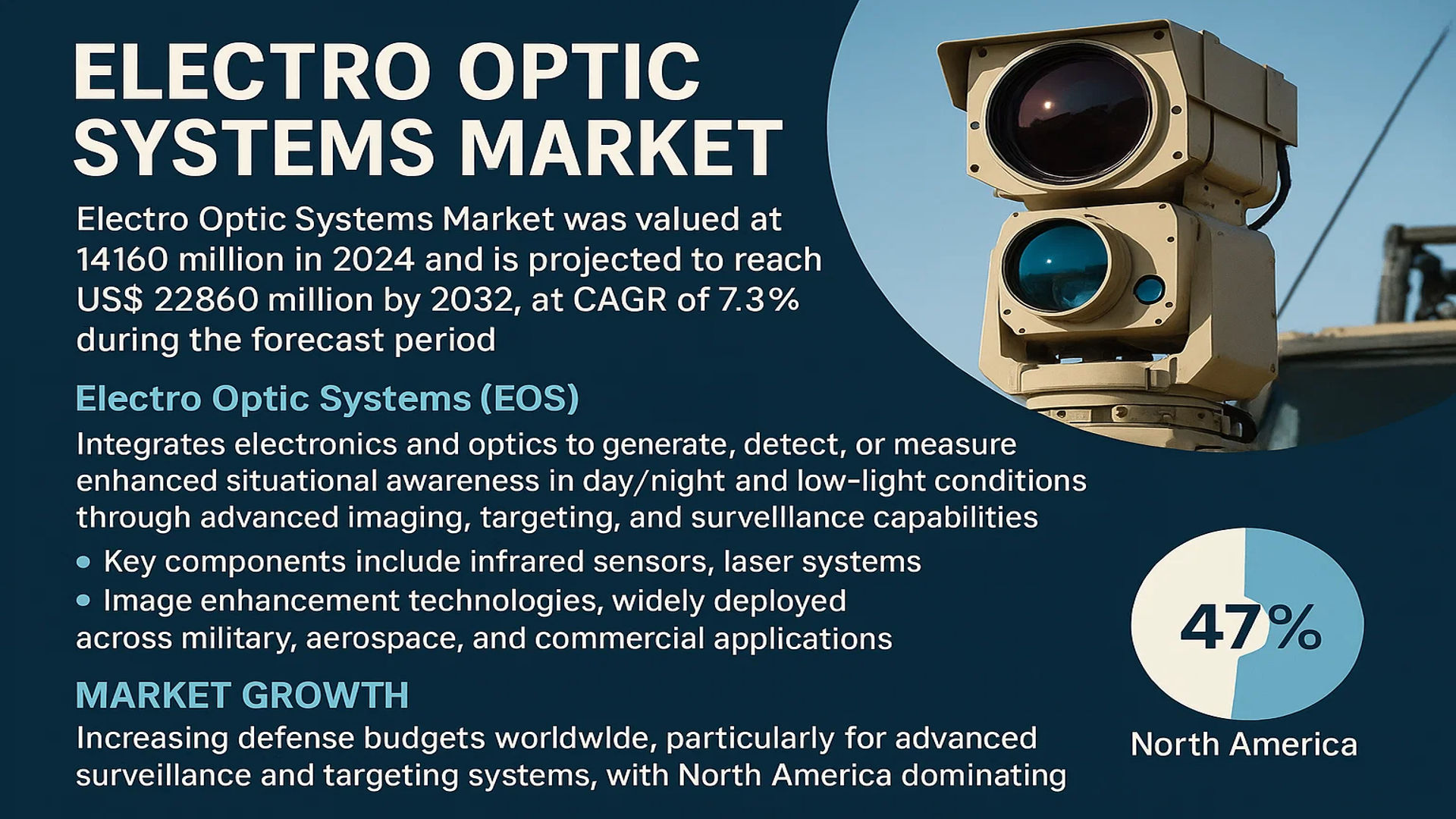
The global Electro Optic Systems Market was valued at 14160 million in 2024 and is projected to reach US$ 22860 million by 2032, at a CAGR of 7.3% during the forecast period.
Electro Optic Systems (EOS) integrate electronics and optics to generate, detect, or measure electromagnetic radiation across the spectrum. These systems enable enhanced situational awareness in day/night and low-light conditions through advanced imaging, targeting, and surveillance capabilities. Key components include infrared sensors, laser systems, and image enhancement technologies, widely deployed across military, aerospace, and commercial applications.
The market growth is driven by increasing defense budgets worldwide, particularly for advanced surveillance and targeting systems, with North America dominating 47% of global demand. Technological advancements in AI-powered image processing and miniaturization of EO components further accelerate adoption. Major players like Lockheed Martin and Raytheon Technologies collectively hold 49% market share, with recent investments focusing on counter-drone systems and space-based EO applications.
MARKET DYNAMICS
MARKET DRIVERS
Military Modernization Programs Fueling Global Electro-Optic Systems Demand
The global defense sector’s ongoing modernization initiatives serve as a primary catalyst for electro-optic system adoption. Armed forces worldwide are prioritizing enhanced surveillance, targeting, and reconnaissance capabilities, with electro-optic sensors becoming critical components across all military platforms. Currently, over 45% of modern defense budgets in major economies allocate funds specifically for electro-optical technologies. The technology’s dual-use capabilities in both defensive and offensive operations make it particularly valuable in contemporary warfare scenarios where precision engagement and situational awareness determine mission success.
Expanding UAV Applications Creating New Growth Vectors
The unmanned aerial vehicle (UAV) sector has emerged as a significant growth driver for electro-optic systems, with the market for military drones projected to maintain double-digit annual growth through 2030. Modern UAV platforms increasingly integrate advanced EO/IR sensor payloads for intelligence gathering, border surveillance, and target acquisition missions. These systems account for approximately 30-40% of total UAV platform costs, reflecting their critical role in mission effectiveness. The transition towards autonomous systems and artificial intelligence-enabled processing further amplifies demand for high-performance electro-optic solutions with smaller SWaP (size, weight, and power) profiles.
Commercial Sector Adoption Expanding Beyond Defense
While defense applications continue dominating electro-optic system usage, commercial sectors demonstrate accelerating adoption rates. Industrial automation, autonomous vehicles, and smart city infrastructure projects increasingly incorporate electro-optical components for machine vision and sensing applications. The commercial segment currently represents about 15% of total market revenue but is growing nearly twice as fast as military applications. This diversification reduces industry reliance on defense spending cycles while opening new opportunities in sectors requiring precision optical measurements and non-contact sensing solutions.
MARKET CHALLENGES
Stringent Export Controls Limiting Market Expansion
The electro-optic systems market faces substantial trade barriers due to national security concerns surrounding advanced optical and sensor technologies. Many components fall under strict export control regimes, creating complex compliance requirements for manufacturers operating in global markets. These restrictions particularly impact sales to emerging economies seeking to develop indigenous defense capabilities, as approximately 60% of advanced electro-optic technologies remain subject to international arms trafficking regulations. Compliance costs and licensing delays add significant overhead to international business operations while creating entry barriers for new market participants.
Other Challenges
Technological Obsolescence Risks
The rapid pace of innovation creates substantial product lifecycle challenges. Military platforms often have service lives exceeding 30 years, while their electro-optic subsystems typically require upgrades every 5-7 years to maintain operational relevance. This disparity creates compatibility issues and significant retrofit costs that strain defense procurement budgets.
Supply Chain Fragility
Specialized optical components and sensor materials face recurring supply constraints. The market experienced critical shortages during recent global supply chain disruptions, with lead times for certain infrared detectors extending beyond 18 months. This volatility complicates production planning and inventory management across the industry.
MARKET RESTRAINTS
High Development Costs Constraining Market Entry
Electro-optic system development requires substantial capital investments in specialized manufacturing facilities and testing equipment. Establishing production capacity for military-grade infrared sensors alone can exceed $50 million in initial capital expenditure, creating significant barriers for new entrants. This capital intensity contributes to market consolidation, with the top five manufacturers controlling nearly half of global revenue. The long development cycles and stringent qualification processes further amplify financial risks, as programs often take 5-8 years from initial design to full-scale production.
Technical Performance Limitations in Extreme Conditions
While electro-optic systems provide unparalleled capabilities in optimal conditions, performance degradation in adverse environments remains a key restraint. Infrared sensors face reduced effectiveness in high-humidity conditions, losing up to 30% of their detection range in tropical climates. Similarly, laser systems experience scattering and bloom effects in dust storms or heavy precipitation. These limitations require additional system redundancies and environmental hardening that increase complexity and cost, particularly for platforms operating in diverse climates and terrains.
MARKET OPPORTUNITIES
Emerging Multi-Spectral Sensor Fusion Technologies
The integration of multi-spectral imaging capabilities presents a transformative opportunity for the electro-optics sector. Advanced systems combining visible light, infrared, and ultraviolet sensors with AI-driven data fusion algorithms can achieve detection probabilities exceeding 90% in complex environments. These technologies show particular promise for perimeter security applications, where they’ve demonstrated false alarm reduction rates approaching 75% compared to single-band systems.
Expanding Counter-UAS Defense Requirements
The proliferation of commercial drone technology has generated urgent demand for electro-optic based counter-UAS solutions. Modern systems combine thermal imagers, laser rangefinders, and high-sensitivity daylight cameras to detect and track small, low-flying drones. The counter-UAS market for electro-optic components is projected to grow at 28% annually through 2030, representing one of the industry’s fastest-growing segments.
ELECTRO OPTIC SYSTEMS MARKET TRENDS
Military Modernization and Advanced Defense Systems Driving Market Growth
The global electro-optic systems market is experiencing significant growth due to increasing military modernization programs and the integration of advanced defense technologies. Military applications account for over 65% of the total market demand, with electro-optic systems being widely deployed in surveillance, targeting, and reconnaissance operations. The growing defense budgets of major economies, such as the U.S., China, and European nations, are accelerating investments in electro-optic sensors and laser-based weapon systems. For instance, the U.S. Department of Defense allocated $7.6 billion for directed energy and electro-optics research in 2024, underscoring the critical role of these technologies in modern warfare.
Other Trends
Shift Toward Autonomous and AI-Enabled Electro-Optic Systems
Advances in artificial intelligence (AI) and machine learning (ML) are revolutionizing electro-optic systems by enhancing their targeting precision and autonomous decision-making capabilities. AI-integrated sensors can rapidly detect and classify threats, allowing for faster response times in combat scenarios. Furthermore, the development of multi-spectral imaging systems capable of operating in diverse environmental conditions is expanding the applicability of electro-optic technologies in both defense and civilian sectors. The incorporation of edge computing in electro-optic systems is also improving real-time data processing, reducing latency, and enhancing situational awareness for military personnel.
Growing Demand for Surveillance and Border Security Solutions
The increasing need for surveillance and border security is propelling the adoption of electro-optic systems in both government and commercial applications. These systems are being widely deployed for perimeter security, maritime monitoring, and counter-drone operations. The rising geopolitical tensions and asymmetric warfare threats have further driven investments in high-resolution imaging and infrared-based surveillance systems. For example, the global market for drone detection electro-optic systems is projected to grow at a CAGR of 12.8% from 2024 to 2032, reflecting the heightened focus on neutralizing aerial threats. In parallel, advancements in thermal imaging and long-range detection technologies are improving border security measures, particularly in conflict-prone regions.
COMPETITIVE LANDSCAPE
Key Industry Players
Defense and Aerospace Giants Lead Innovation in Electro Optic Systems Market
The global Electro Optic Systems (EOS) market features a semi-consolidated structure dominated by established defense contractors and specialized optoelectronics manufacturers. Lockheed Martin and Raytheon Technologies collectively command over 30% market share through their cutting-edge military electro-optics solutions, particularly in infrared and laser-based systems. Their dominance stems from long-term defense contracts and continuous R&D investments exceeding $2 billion annually in sensor technologies.
L3Harris Technologies has emerged as a formidable competitor through strategic acquisitions, notably its 2019 merger with Harris Corporation that significantly strengthened its electro-optical/infrared (EO/IR) capabilities. The company has since captured approximately 12% of the global market, with particular strength in maritime and airborne surveillance systems. Meanwhile, European players like Safran and Leonardo maintain strong positions through specialized offerings in targeting systems and stabilized imaging platforms.
Beyond traditional defense leaders, mid-sized innovators are gaining traction through niche technological advances. Elbit Systems and Israel Aerospace Industries have made significant inroads with compact, AI-powered electro-optic systems, capturing nearly 8% combined market share. Their solutions demonstrate particular effectiveness in urban combat scenarios and counter-drone applications.
The competitive dynamics are intensifying as companies pursue three key strategies: modular system architectures allowing platform flexibility, development of multi-spectral imaging capabilities, and integration of machine learning for automated target recognition. Recent product launches emphasize reduced size, weight, and power (SWaP) characteristics while maintaining or improving performance parameters.
List of Key Electro Optic Systems Companies Profiled
- Lockheed Martin Corporation (U.S.)
- Raytheon Technologies Corporation (U.S.)
- L3Harris Technologies, Inc. (U.S.)
- Safran S.A. (France)
- Leonardo S.p.A. (Italy)
- Thales Group (France)
- BAE Systems plc (U.K.)
- Teledyne FLIR LLC (U.S.)
- Northrop Grumman Corporation (U.S.)
- Elbit Systems Ltd. (Israel)
- Israel Aerospace Industries Ltd. (Israel)
- Hensoldt AG (Germany)
- AVIC Optronics Co., Ltd. (China)
- Wuhan Guide Infrared Co., Ltd. (China)
- Aselsan A.Ş. (Turkey)
- Rafael Advanced Defense Systems Ltd. (Israel)
- Electro Optic Systems Holdings Limited (Australia)
- Transvaro (South Africa)
- Dalian Danning Co., Ltd. (China)
Segment Analysis:
By Technology
Laser Technology Dominates Due to Rising Demand for Precision Military Systems
The market is segmented based on technology into:
- Infrared
- Laser
- Image Enhancement Technology
By Application
Military & Defense Segment Leads Due to Increasing Defense Budgets Globally
The market is segmented based on application into:
- Military & Defense
- Homeland Security
- Commercial
By Platform
Airborne Systems Lead Due to Advancements in UAV and Fighter Jet Technologies
The market is segmented based on platform into:
- Airborne
- Ground
- Maritime
By Component
Sensors Segment Dominates with Growing Need for Surveillance Applications
The market is segmented based on component into:
- Sensors
- Cameras
- Displays
- Others
Regional Analysis: Electro Optic Systems Market
North America
North America dominates the Electro Optic Systems (EOS) market, accounting for 47% of global revenue share in 2024. This leadership stems from substantial defense spending, particularly in the U.S., where advanced military technologies like infrared sensors, laser targeting systems, and drone surveillance platforms receive priority funding. The U.S. Department of Defense allocated $842 billion for fiscal year 2024, with significant portions directed toward modernizing electro-optic capabilities for airborne and maritime applications. Canada and Mexico are also investing in border security systems, further boosting demand for long-range surveillance EOS.
Europe
Europe holds a 25% market share, driven by NATO defense modernization programs and homeland security initiatives. Countries like Germany, France, and the UK are focusing on counter-drone technologies and next-generation optronic sighting systems for armored vehicles. The European Defence Fund has earmarked substantial budgets for dual-use (military and commercial) EOS development. However, stringent export controls and fragmented procurement policies across EU nations pose challenges for manufacturers. Collaborative projects like the Eurofighter Typhoon’s PIRATE infrared tracking system demonstrate regional technological capabilities.
Asia-Pacific
The fastest-growing region, Asia-Pacific is witnessing 12% annual growth in EOS adoption, propelled by territorial security concerns and indigenous defense programs. China leads with substantial investments in hypersonic weapon guidance systems and space-based EO/IR satellites. India’s Make in India initiative has spurred local production of thermal imaging systems, while Japan and South Korea focus on naval EO systems for maritime domain awareness. Commercial applications in autonomous vehicles and industrial automation are emerging growth drivers, though military spending remains the primary market catalyst.
South America
Limited defense budgets constrain the South American EOS market, but border surveillance and narcotics interdiction requirements create steady demand. Brazil’s SISFRON border monitoring system incorporates advanced electro-optical sensors, while Chile invests in coastal monitoring EOS. The region shows potential for growth in civil applications like forest fire detection, though economic volatility and reliance on imports hinder market expansion. Local assembly partnerships with global EOS manufacturers are gradually increasing.
Middle East & Africa
The region presents a high-growth niche for EOS, particularly in counter-rocket, artillery, and mortar (C-RAM) systems. Israel leads in EO innovation with companies like Elbit Systems and Rafael exporting advanced targeting pods and missile warning systems. GCC nations are investing heavily in air defense EOS, while African countries prioritize border surveillance. Geopolitical tensions and asymmetric warfare threats sustain demand, though budget limitations outside oil-rich nations slow adoption rates. Partnerships with Western and Israeli suppliers shape the competitive landscape.
Report Scope
This market research report provides a comprehensive analysis of the global and regional Electro Optic Systems markets, covering the forecast period 2025–2032. It offers detailed insights into market dynamics, technological advancements, competitive landscape, and key trends shaping the industry.
Key focus areas of the report include:
- Market Size & Forecast: Historical data and future projections for revenue, unit shipments, and market value across major regions and segments. The global Electro Optic Systems market was valued at USD 14,160 million in 2024 and is projected to reach USD 22,860 million by 2032, at a CAGR of 7.3%.
- Segmentation Analysis: Detailed breakdown by technology (Infrared, Laser, Image Enhancement), application (Airborne, Ground, Maritime), and end-user industries to identify high-growth segments and investment opportunities.
- Regional Outlook: Insights into market performance across North America (47% share), Europe (25%), Asia-Pacific, Latin America, and Middle East & Africa, including country-level analysis where relevant.
- Competitive Landscape: Profiles of leading market participants like Lockheed Martin, Raytheon Technologies, L3Harris Technologies, Safran, and Leonardo (collectively holding 49% market share), including their product portfolios and strategic developments.
- Technology Trends & Innovation: Assessment of emerging technologies including AI integration, laser weapon systems, advanced imaging solutions, and next-generation electro-optical sensors.
- Market Drivers & Restraints: Evaluation of defense modernization programs, increasing UAV adoption, and counter-drone technologies as growth drivers, along with regulatory challenges and high R&D costs as potential restraints.
- Stakeholder Analysis: Strategic insights for defense contractors, system integrators, component suppliers, and investors regarding market opportunities and technology roadmaps.
The report employs rigorous primary and secondary research methodologies, including interviews with industry leaders and analysis of verified market data, to ensure the highest accuracy and reliability of findings.
FREQUENTLY ASKED QUESTIONS:
What is the current market size of Global Electro Optic Systems Market?
-> Electro Optic Systems Market was valued at 14160 million in 2024 and is projected to reach US$ 22860 million by 2032, at a CAGR of 7.3% during the forecast period..
Which key companies operate in Global Electro Optic Systems Market?
-> Key players include Lockheed Martin, Raytheon Technologies, L3Harris Technologies, Safran, Leonardo, Thales, and BAE Systems, among others. The top five companies hold about 49% market share.
What are the key growth drivers?
-> Key growth drivers include increasing defense budgets worldwide, modernization of military systems, rising demand for UAVs, and advancements in laser weapon technologies.
Which region dominates the market?
-> North America dominates with 47% market share, followed by Europe (25%) and Asia-Pacific. The US accounts for the largest national market.
What are the emerging trends?
-> Emerging trends include AI-powered electro-optical systems, directed energy weapons, multi-spectral imaging, and miniaturization of EO components for portable applications.

Get Sample Report PDF for Exclusive Insights
Report Sample Includes
- Table of Contents
- List of Tables & Figures
- Charts, Research Methodology, and more...