

FDA Clearance Pathway 2026 Update: Medical-Grade Requirements for Sleep Intervention Chipsets
The global smart pillows market is on track to reach at highest with this explosive growth that represents more than just a consumer wellness trend, where it signals a fundamental shift in how semiconductor companies approach the healthcare interface. Anti-snoring smart pillows with position adjustment and sound analysis have emerged as the proving ground for a new generation of MEMS sensors, low-power AI processors, and edge-computing architectures that must operate flawlessly in the intimate, challenging environment of the bedroom.
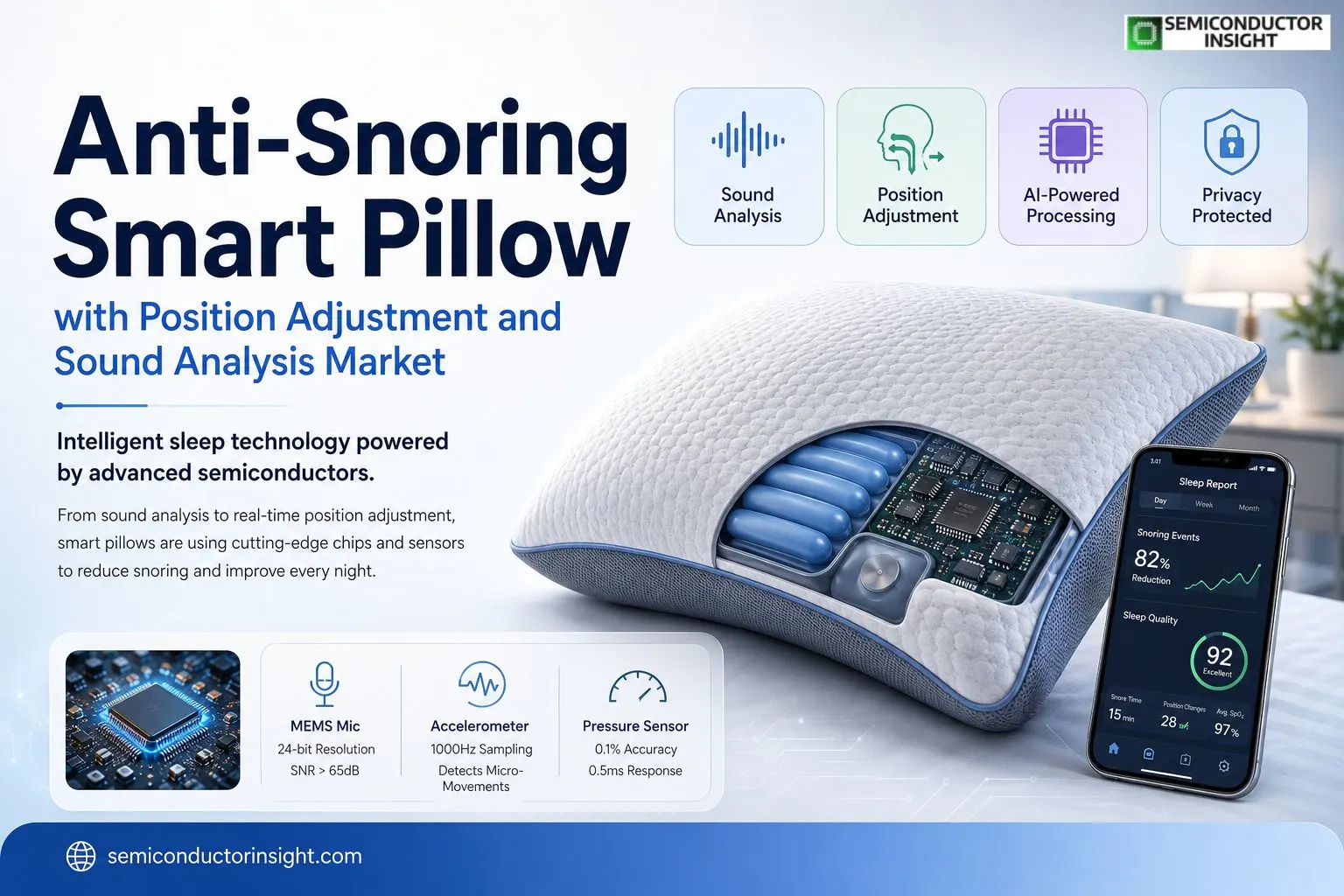
The semiconductor content in these devices tells the real story. Each advanced anti-snoring pillow contains a sophisticated sensor fusion array: MEMS microphones with 24-bit resolution for snore pattern analysis, accelerometers capable of detecting micro-movements at 1000Hz sampling rates, and pressure sensors with 0.1% accuracy for real-time inflation control. This system-on-chip architecture must process data locally to ensure privacy, operate on ultra-low power budgets to avoid heat generation, and deliver sub-50ms latency for responsive haptic feedback.
From CPAP Compliance Crisis to Semiconductor Opportunity
- Nearly 45% of adults snore occasionally, while approximately 25% snore regularly, with an estimated 30 million Americans experiencing chronic snoring symptoms related to obstructive sleep apnea.
- The CPAP (Continuous Positive Airway Pressure) market, valued at USD 12.5 billion in 2023, has long dominated sleep disorder treatment, but compliance rates remain below 50% due to discomfort and inconvenience.
- This compliance gap has created a USD 3.8 billion opportunity for semiconductor-enabled alternatives, with smart pillows positioned as the first-line intervention.
- Amazon’s recent patent filing for an ‘automated sleep assistant’ smart pillow has validated the semiconductor opportunity, describing a system where audio input devices capture sounds and utterances, sensors detect movement, and inflatable air bladders provide haptic feedback based on machine learning analysis.
- The patent specifically details how external haptic forces can help a user’s head lift or tip to a specific angle that opens their airway, representing a significant advancement in real-time biomechanical intervention.
For a more thorough report, please contact us using our most recent report: http://semiconductorinsight.com/report/anti-snoring-smart-pillow-with-position-adjustment-and-sound-analysis-market/
Sound Analysis at the Edge: The Audio Semiconductor Imperative
The sound analysis component presents unique challenges for semiconductor design. Snore detection requires distinguishing between snoring sounds, breathing patterns, and ambient environmental noise at 2 AM when the bedroom is otherwise silent. Modern smart pillows integrate MEMS microphones with signal-to-noise ratios exceeding 65dB, voice activity detection algorithms running on dedicated DSP cores, and machine learning models optimized for edge deployment. Current devices can detect and respond to snoring events within 2-3 seconds, a latency requirement that necessitates local processing rather than cloud-based analysis.
The global smart sensor anti-snore pillow segment alone was valued at USD 655 million in 2023 and is projected to reach USD 2.1 billion by 2030, growing at 21.3% CAGR. This growth is driven by enhanced health awareness among middle-aged and elderly populations and increasing understanding of non-invasive anti-snoring equipment. Major semiconductor players are responding with specialized sleep health chipsets integrating low-power MCUs with dedicated analog front-ends for biosignal processing.
Positioning Precision: The Mechanical Engineering-Semiconductor Interface
- Position adjustment in anti-snoring smart pillows relies on an intricate interplay between semiconductor control systems and mechanical actuation.
- When a snoring event is detected, air chambers within the pillow must inflate in a targeted sequence to change the sleeper’s head position, opening airways without fully awakening the user.
- This requires pressure sensors with 0.5ms response time, motor drivers capable of precise inflation control, and closed-loop feedback systems operating at refresh rates above 100Hz.
- The semiconductor content extends to the control algorithms themselves.
- Machine learning models trained on snoring patterns analyze historical data to predict events before they occur, enabling proactive rather than reactive positioning.
- Some premium devices now incorporate heart rate variability monitoring and respiratory rate detection, adding additional semiconductor requirements for photoplethysmography (PPG) sensors and specialized biosignal processing units.
Sleep Health Awareness Drives Semiconductor Innovation
The pandemic era accelerated global awareness of sleep health’s importance to immune function and overall wellbeing. Studies indicate that sleep-related breathing disorder awareness campaigns have contributed to rising demand for snoring-monitoring technologies since 2024. This awareness has fueled investment in sleep health semiconductor R&D, with patent filings in the space increasing by 34% between 2022 and 2025.
Smart pillows are increasingly integrating with broader smart home ecosystems, synchronizing with IoT devices to adjust room temperature, lighting, and air quality based on real-time sleep metrics. This connectivity demands additional semiconductor components: Bluetooth Low Energy 5.3 transceivers for seamless data transmission, secure elements for biometric data protection, and power management ICs supporting multiple operating modes. The smart pillow is becoming a node in the connected bedroom, generating 2-3GB of sleep data annually per user.
The Path to FDA Clearance and Medical-Grade Semiconductor Requirements
- Amazon’s smart pillow patent filing acknowledges the importance of regulatory pathways, with FDA approval for sleep apnea detection remaining a critical milestone.
- Medical-grade certification imposes stringent requirements on semiconductor components: extended temperature ranges (0°C to 70°C), reliability standards exceeding 10,000 operating hours, and electromagnetic compatibility ensuring no interference with other medical devices.
- The neurological devices market, which includes sleep disorder interventions, is projected to grow from USD 12.5 billion in 2023 to USD 20.9 billion by 2033 , creating significant opportunities for semiconductor suppliers who can meet these quality standards.
- The semiconductor industry’s response has been swift. Foundries are developing specialized sleep health fabrication processes optimized for low-power biosignal processing, while packaging innovations enable the integration of microphones, sensors, and processing units in form factors suitable for fabric-embedded applications.
Implementation in Practical Settings and the 2026 Projection
Based on current market trends, the smart pillow segment specifically targeting anti-snoring applications is expected to account for 38% of total smart pillow revenues by 2026, driven by the clear value proposition of snore reduction. The multifunctional segment (combining snore reduction with sleep tracking, temperature regulation, and smart alarms) will capture 44% of the market, reflecting growing consumer demand for comprehensive sleep solutions.
The average smart pillow currently contains semiconductor components valued at USD 28-42 per unit, representing a significant content opportunity compared to USD 3-5 for conventional consumer electronics. This premium semiconductor content reflects the demanding requirements for sensor fusion, AI processing, and real-time actuation. The market is projected to ship 4.2 million units globally in 2026, translating to a semiconductor addressable market of USD 147 million specifically for smart pillow applications.
Privacy, Ethics, and the Semiconductor Data Challenge
The bedroom represents the most intimate environment in the consumer technology landscape, making data privacy a paramount concern. Smart pillows collect continuous biometric data including respiratory patterns, heart rate, and acoustic recordings during vulnerable sleep states. Semiconductor firms must incorporate hardware-level security features to earn consumer trust secure enclaves for encryption key storage, physically unclonable functions for device identity, and tamper detection circuits to prevent unauthorized access.
Regulatory demands are evolving alongside technology. The smart pillow market is expected to see deeper integration with predictive health and personalized wellness platforms, with anticipated innovations including biometric sensors capable of early detection of sleep apnea, bruxism, and cardiac irregularities. This medicalization of consumer sleep technology imposes additional semiconductor requirements for accuracy, reliability, and cybersecurity.

Comments (0)