

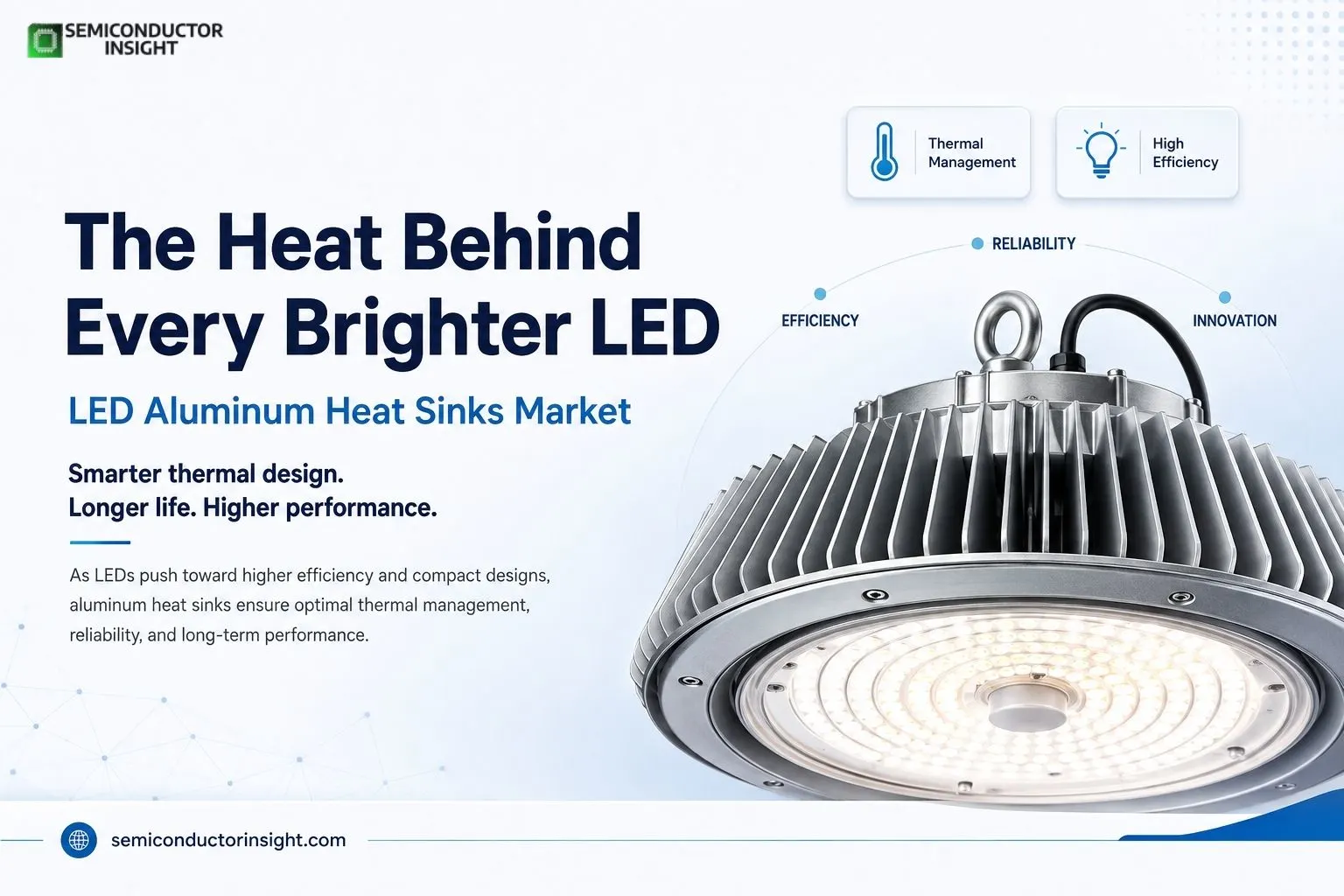
Extruded vs. Die-Cast Aluminum Heat Sinks in 2026: Which Architecture Fits High-Power LEDs?
LED technology has spent years becoming more efficient, smaller and more controllable. The less visible consequence is that thermal engineering has become increasingly important. Every watt entering an LED system does not become visible light; part of the electrical energy ultimately becomes heat, and that heat has to travel away from the semiconductor junction before it damages performance or accelerates degradation.
The U.S. Department of Energy notes that LED junction temperature depends on drive current, the thermal path and ambient temperature. The heat sink therefore is not simply a metal component attached to a lamp. It forms part of the complete path connecting the LED die to the surrounding environment.
For additional report info, feel free to view our most recent edition: https://semiconductorinsight.com/report/led-aluminum-heat-sinks-market/
The hidden engineering behind brighter LEDs
- The progression in LED efficacy illustrates why this thermal pathway matters.
- DOE states that specialized LED products can reach 150 lumens per watt or more, while its long-term research objectives have targeted 250-325 lm/W for warm-white LED packages and 250-275 lm/W for integrated lighting products.
- At the luminaire level, performance requirements are already demanding. DOE procurement guidance specifies minimum efficacy levels of 143 lm/W for industrial low-bay luminaires and 175 lm/W for industrial high-bay products.
- This creates an unusual design equation: the lighting system must deliver more optical output while controlling temperature within an increasingly compact physical package.
Why aluminum keeps its place in the thermal path?
Aluminum occupies a particularly useful position because it combines relatively low density with strong thermal-management characteristics and manufacturing flexibility. Heat sinks can be produced through extrusion, die casting, stamping, machining and other forming techniques, allowing designers to create fins and channels around the LED package without turning the thermal solution into an excessively heavy component.
For lighting manufacturers, that combination is important. A street-lighting fixture, industrial high bay or architectural luminaire may need to dissipate heat continuously while remaining lightweight enough for installation, mounting and structural integration.
The design focus is therefore moving from “How much aluminum is required?” toward “How efficiently can the available aluminum move heat?”
Fin geometry becomes a performance variable
The most interesting innovation is often hidden in the geometry.
A heat sink with a larger apparent surface area is not automatically better. Fin spacing, thickness, height, airflow, mounting orientation, contact resistance and the interface between the LED module and heat sink all influence the actual thermal pathway.
LED junction → package → thermal interface → aluminum base → fins → surrounding air
Changing any one of these stages can alter the final junction temperature.
That is why modern heat-sink development increasingly involves thermal simulation before physical prototypes are manufactured.
The 60,000-hour benchmark changes the design conversation
- LEDs are often selected partly because of their long operating life. A DOE-supported lighting project, for example, targeted a lifetime exceeding 60,000 hours together with efficiency above 120 lm/W and full dimmability.
- At 60,000 hours, a lighting product operating continuously would accumulate almost 6.85 years of operating time. In applications such as warehouses, roadway infrastructure, industrial facilities and commercial buildings, thermal reliability can therefore influence years of maintenance exposure.
- This makes the heat sink part of the reliability strategy rather than merely a component-cost decision.
High-bay lighting reveals the thermal challenge
Industrial high-bay lighting provides a useful example of where thermal engineering becomes particularly demanding. DOE’s procurement specifications identify high-bay LED luminaires producing at least 10,000 lumens and requiring at least 175 lm/W efficacy.
A high-bay fixture may operate for long periods at substantial electrical power while being installed many meters above the floor. Replacing a failed thermal component or complete luminaire can involve lifts, production interruptions and maintenance labor.
The heat sink consequently has to balance thermal capacity, airflow, weight, manufacturability and long-term reliability.
Smarter lighting is creating smarter thermal designs
LED systems are no longer limited to simple on-off operation. Modern installations increasingly incorporate dimming, occupancy sensing, daylight response and networked controls. DOE’s research into 23 commercially available LED streetlights with claimed 0-10 V dimming capability demonstrated measurable variation in driver performance and highlighted the importance of consistent control behavior.
Controls can reduce operating power, but they also create changing thermal conditions. A luminaire may transition repeatedly between high-output and reduced-output states rather than operating at one fixed thermal load.
That makes thermal design increasingly intertwined with electronics, firmware, sensors and control architecture.
The next heat sink may be designed around the whole luminaire
A significant shift is underway from treating the heat sink as a standalone metal part to designing the entire luminaire as a thermal system.
LED package → PCB → thermal interface → aluminum heat spreader → fin architecture → housing → airflow
This integrated approach allows manufacturers to examine thermal resistance alongside optical performance, mechanical packaging and electronics.
It also opens the door to thinner profiles, application-specific fin patterns and integrated housings that perform structural and thermal functions simultaneously.
A number worth watching is 200 lm/W
- DOE research projections have placed LED lamp and luminaire efficacy around the 200 lm/W range in the 2020s, with projected values above that level in subsequent development scenarios.
- As efficacy rises, the objective is not simply to add more LEDs. Manufacturers are increasingly looking for ways to extract maximum useful light from smaller packages while keeping temperature under control.
- That is where LED Aluminum Heat Sinks Market becomes closely connected with semiconductor packaging, thermal interface materials, PCB design and intelligent lighting electronics.
The competitive question is gradually changing from how to make an LED brighter to how to sustain high output, compact packaging and long operating life without allowing thermal performance to become the limiting factor.

Comments (0)