
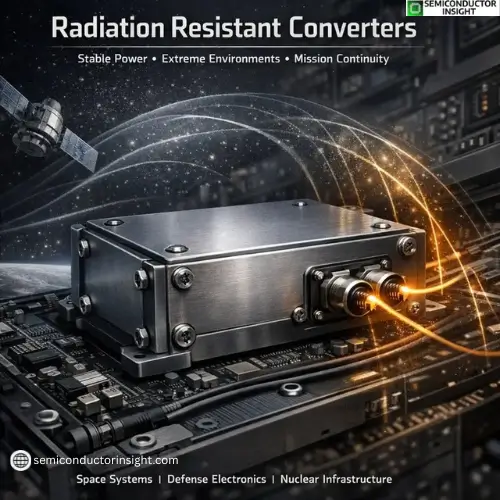
Extreme-Environment Power Requirements Shape the Growth of the Radiation-Resistant Converter Market
In environments where conventional electronics fail within seconds, radiation resistant converters operate as silent enablers of continuity. These components are engineered to deliver stable power under constant exposure to ionizing radiation, temperature extremes, and long operational lifetimes. As space missions extend in duration and defence electronics move closer to radiation-intense zones, Radiation Resistant Converter Market has transitioned from a niche requirement to a strategic necessity.
This market serves applications where system failure is not an option satellites, deep-space probes, nuclear facilities, and high-altitude aerospace platforms all rely on converters designed to endure conditions far beyond terrestrial standards.
What Defines a Radiation Resistant Converter?
Radiation resistant converters are specialized power conversion devices built to withstand cumulative radiation exposure without performance degradation. These systems, in contrast to commercial converters, are built with materials chosen for long-term dependability, fault-tolerant structures, and radiation-hardened components.
Their purpose extends beyond power delivery; they protect downstream electronics by ensuring voltage consistency even during radiation events, making them foundational to mission-critical semiconductor ecosystems.
Latest Market Updates:
- For instance, in June 2025, Traditional space applications have long required space-grade components to help ensure the success of missions. The SA15-28 off-the-shelf radiation-hardened DC-DC 15W power converter and its companion SF100-28 EMI filter, which are made to fulfill MIL-STD-461 criteria, are the latest addition to Microchip Technology’s space portfolio, which has more than 60 years of space heritage. Operating from a 28V satellite bus in challenging conditions, this space-grade power device is a typical, non-hybrid DC-DC isolated power converter with a matching electromagnetic interference (EMI) filter.
- For instance, in June 2025, STMicroelectronics launches radiation-hardened point-of-load converters for LEO applications. The LEOPOL1 point-of-load step-down converter for Low Earth Orbit (LEO) deployments from STMicroelectronics satisfies the requirements of equipment manufacturers aiming to enter the New Space market, which is now growing in North America, Asia, and Europe.
Why Demand Is Structurally Increasing?
The rise in satellite constellations, space exploration programs, and defense modernization has significantly reshaped demand patterns. Governments and private entities are deploying electronics into environments previously considered unreachable, increasing reliance on power systems that can operate autonomously for years.
Another contributing factor is the growing emphasis on system miniaturization. As payload sizes shrink, converters must deliver high efficiency within compact footprints while maintaining radiation tolerance, raising the technical threshold for suppliers.
Application Landscape without Conventional Boundaries
Radiation resistant converters are not confined to a single industry vertical. Their adoption spans multiple mission profiles where exposure risk varies but reliability expectations remain absolute.
Key usage environments include:
- Orbital and deep-space platforms requiring uninterrupted power cycles
- Defence electronics exposed to high-energy radiation fields
- Nuclear monitoring and control systems operating in regulated zones
Engineering Philosophy behind Market Products
This area develops through validation rather than speed, in contrast to commercial semiconductor markets that are propelled by fast iteration. Product development cycles are longer, focusing on qualification standards, environmental testing, and mission certification.
Manufacturers invest heavily in redundant circuit designs, shielding techniques, and advanced semiconductor processes that minimize radiation-induced charge buildup. These engineering choices shape not only product pricing but also supplier credibility in long-term contracts.
Supply Chain Characteristics and Vendor Positioning
Radiation resistant converter market operates with a limited supplier base due to high entry barriers. Vendors often maintain close collaboration with aerospace agencies, defence contractors, and system integrators throughout development phases.
Rather than volume manufacturing, suppliers focus on precision production, traceability, and compliance documentation. This structure favors established players with proven deployment histories.
Take a Quick Glance at Our In-Depth Analysis Report:
https://semiconductorinsight.com/report/radiation-resistant-converter-market/
Regional Market Dynamics
North America remains a central demand hub due to its concentration of aerospace programs, defence budgets, and private space enterprises. Europe follows closely, driven by collaborative space missions and nuclear research initiatives. Select Asia-Pacific regions are emerging as contributors, particularly where satellite manufacturing capabilities are expanding.
Regional growth is less about consumer adoption and more about institutional investment cycles and national technology strategies.
Competitive Differentiation Factors
Competition within this market is shaped by performance reliability rather than price positioning. Buyers prioritize qualification heritage, radiation tolerance thresholds, and documented in-orbit or field performance.
Two decisive evaluation parameters include:
- Demonstrated resistance to cumulative radiation exposure
- Stability across extended operational lifetimes
These factors often outweigh aggressive cost reduction strategies.
Upcoming Market Outlook
Radiation Resistant Converter Market is positioned for sustained, long-cycle growth as electronic systems continue to migrate into high-risk environments. Advancements in space exploration, nuclear monitoring, and defence electronics will steadily expand application boundaries.
Future developments are expected to focus on improving efficiency, reducing form factor, and extending operational endurance without compromising radiation resilience.
Strategic Takeaway
This market is defined by engineering depth, qualification trust, and mission longevity. Radiation resistant converters do not follow commercial semiconductor trends; instead, they set their own pace based on reliability, validation, and long-term deployment confidence.
For stakeholders, this segment represents stability built on technical excellence rather than rapid volume expansion.

Comments (0)