
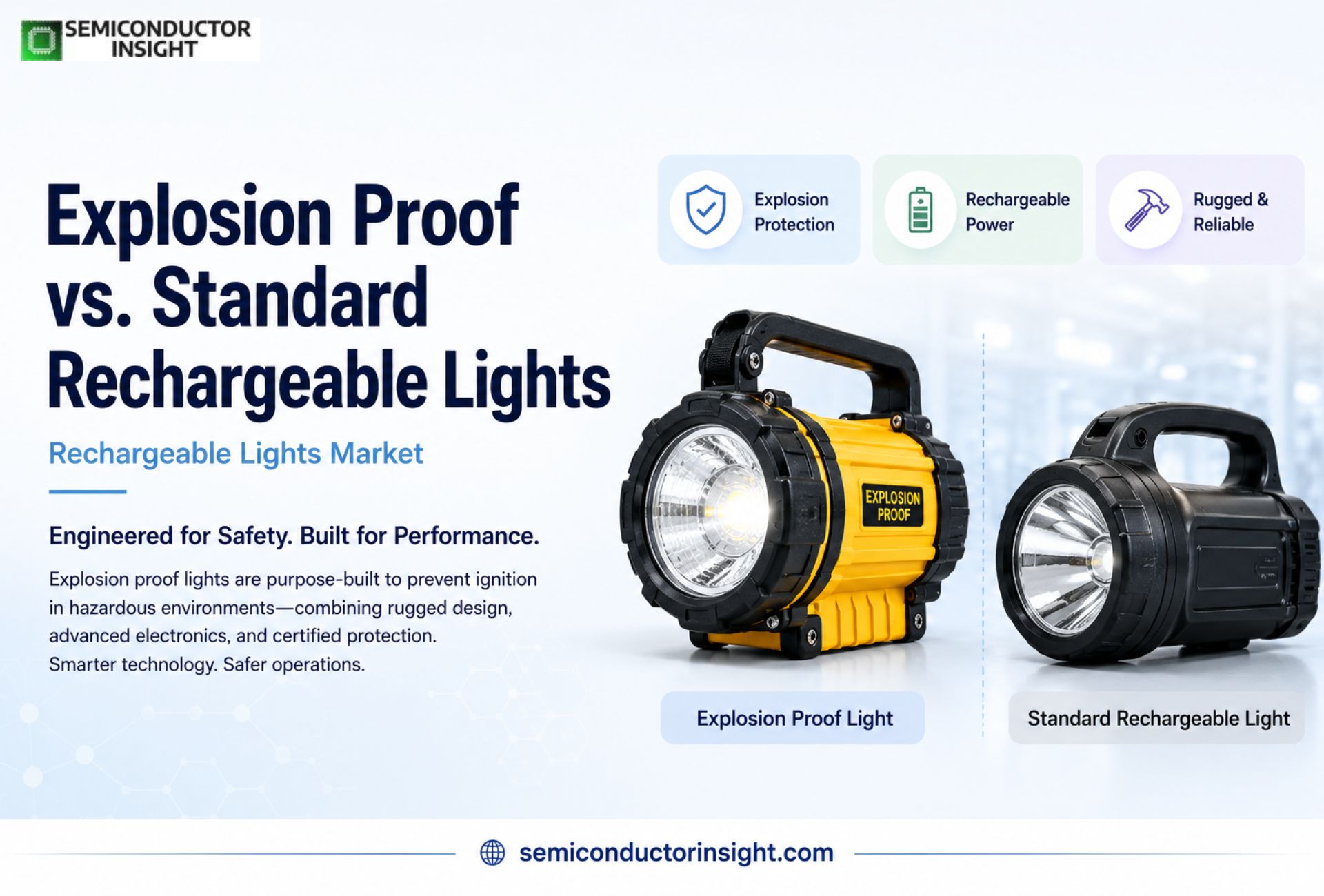
Explosion Proof vs. Standard Rechargeable Lights 2026: What Changes in Hazardous Environments?
The modern hazardous-location light is no longer just a brighter flashlight. It combines LED emitters, regulated power electronics, rechargeable battery systems, thermal management, impact-resistant materials and explosion-protection engineering inside a compact enclosure.
That distinction matters in locations where methane, vapors, gases or combustible dust can turn an ordinary electrical device into an ignition source. IECEx standards specifically cover equipment used where explosive atmospheres may exist, including requirements for intrinsic safety, flameproof construction and protection against dust ignition.
For the semiconductor industry, this creates a specialized application for high-efficiency LEDs and tightly controlled electronic architectures.
The Safety Threshold Starts Before the LED Turns On
- The most important specification is not brightness. It is whether the complete lighting system can operate without becoming an ignition source.
- OSHA’s maritime requirements provide a useful example. Where an atmosphere reaches 10% of the lower explosive limit, employers must provide explosion-proof, self-contained temporary or portable lights approved for hazardous conditions.
- This changes the design equation. The LED, battery, switch, charging interface and internal electronics all have to be considered as part of the safety system rather than independent components.
2026 Brings a Fresh Product Signal
A notable 2026 development came from Streamlight, which introduced its Dualie Rechargeable ATEX in June. The intrinsically safe light is approved for ATEX-certified Zone 0 locations and combines a forward spot beam with a side flood beam.
The significance goes beyond a new flashlight launch. Zone 0 represents an environment where an explosive gas atmosphere can be present continuously or for long periods, making certification and ignition-control engineering central to product design.
The shift toward dual-purpose illumination also reflects how workers actually use portable lighting: one beam for distance and another for close-range task visibility.
The Numbers Are Moving in the Right Direction
Current commercial products show how far portable hazardous lighting has progressed.
Streamlight’s rechargeable Vulcan 180 HAZ-LO ATEX delivers 450 lumens on high mode, a 316-meter beam, and up to 14 hours of runtime. Its low mode extends operation to 30 hours. The unit uses three white LEDs and a rechargeable lithium-ion battery.
Another Streamlight hazardous-location platform, the Survivor Pivot ATEX, reaches 325 lumens in combined spot/flood operation and uses a 2.6-Ah lithium-ion battery pack rated for up to 1,000 recharge cycles.
These specifications illustrate an important trend: the value proposition is increasingly measured through a combination of lumens, beam distance, operating hours, recharge cycles and hands-free functionality.
You Can Freely Surf Our Latest Updated Report Here: https://semiconductorinsight.com/report/explosion-proof-rechargeable-light-market/
Mining Remains a High-Discipline Test Environment
- Underground mining provides one of the clearest examples of why semiconductor and battery design must be treated as a safety issue.
- MSHA requires portable electric cap lamps used underground to be maintained in permissible condition. Its guidance also highlights intrinsic-safety principles designed to prevent electrical equipment from producing a spark or reaching a temperature capable of igniting an explosive atmosphere.
- IECEx separately identifies IEC 60079-35-1 and IEC 60079-35-2 for caplights used in mines susceptible to firedamp.
- The result is a demanding design environment in which illumination performance cannot be separated from electrical safety.
Rechargeability Is Changing the Operating Model
Rechargeable architecture is becoming increasingly attractive where equipment is used repeatedly across long shifts. Eliminating routine disposable-battery replacement can simplify fleet management, while regulated LED output helps maintain more consistent illumination as battery voltage changes.
Current products demonstrate the variety of approaches. Streamlight’s PolyStinger LED HAZ-LO, for example, provides 260 lumens, a 253-meter beam, 5 hours of high-mode runtime and a NiMH battery designed for up to 1,000 recharge cycles.
The opportunity for semiconductor suppliers lies in improving power conversion efficiency, thermal control, battery monitoring and LED drive regulation without compromising certification requirements.
The Next Design Battle Is Inside the Housing
The competitive edge is increasingly moving from raw LED brightness toward the electronics surrounding the emitter.
Smaller power-management components can help designers reduce system size. More efficient LED drivers can extend runtime. Better battery-management circuitry can monitor charging and operating conditions. Meanwhile, ruggedized switches, sealed housings and thermal controls have to coexist with these electronics.
That is why explosion-proof rechargeable lighting is becoming an interesting niche application for LED semiconductor technology, power ICs, sensors and battery-management electronics.
From Illumination Tool to Connected Safety Device
The longer-term product direction is likely to involve more than simply increasing lumen output. Workers in refineries, chemical plants, mines, utilities, firefighting and confined-space operations increasingly need lighting that combines hands-free positioning, multiple beam patterns, signaling, battery-status visibility and rugged environmental protection.
The market’s evolution is therefore being shaped by a convergence of three technologies: efficient semiconductor lighting, safer rechargeable power and certified hazardous-area engineering.
The defining question for the next generation will not be how bright can the light become? It will be how much useful illumination can be delivered for how long, in how hazardous an environment, without introducing a new risk.

Comments (0)