
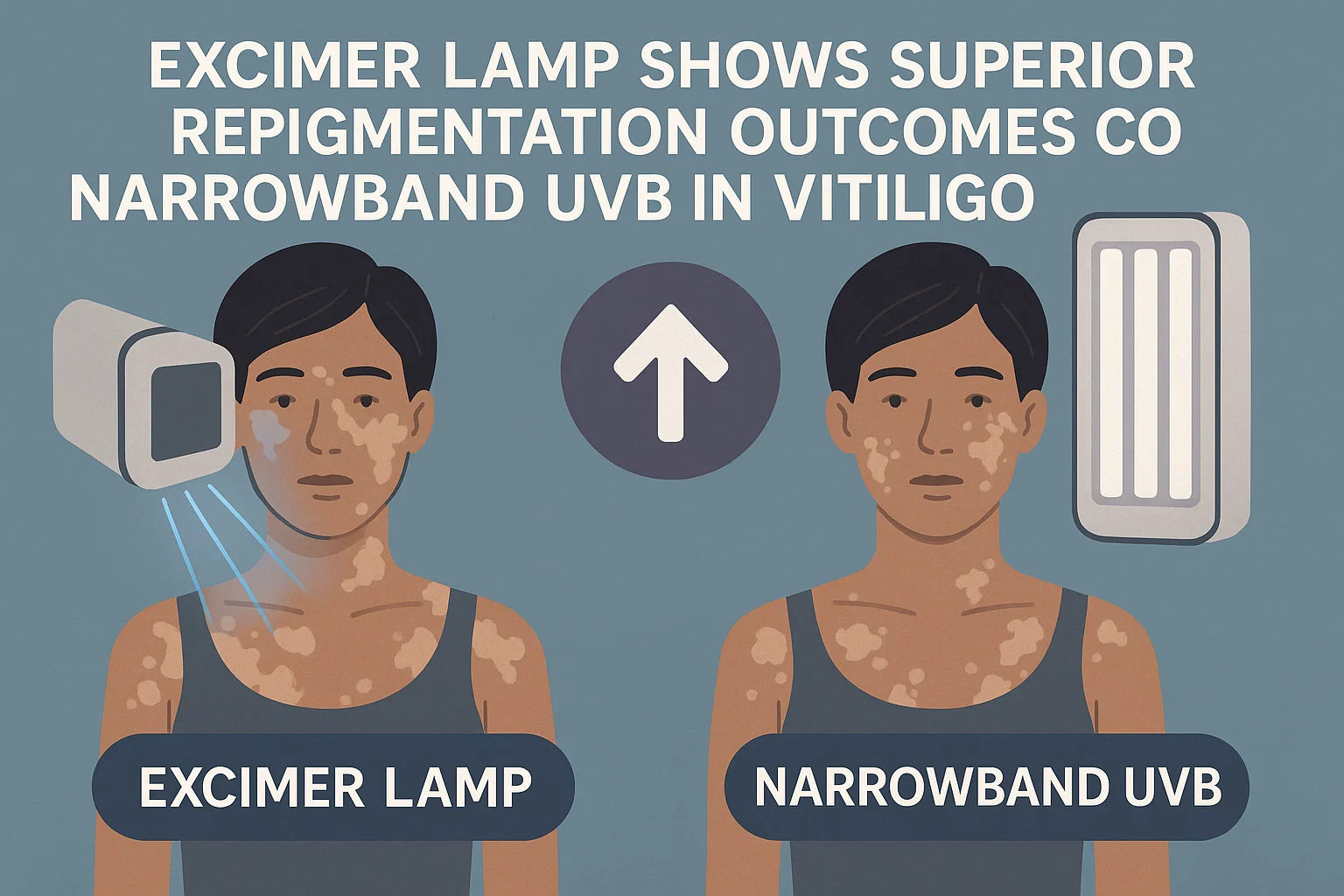
Excimer Lamp Shows Superior Repigmentation Outcomes Compared to Narrowband UVB in Vitiligo
For millions of people living with chronic skin conditions such as psoriasis, vitiligo, and eczema, effective treatment can feel like an endless search. Creams, ointments, and systemic drugs often come with side effects, limited efficacy, or high costs. Against this backdrop, UVB narrowband (NB-UVB) phototherapy has emerged as a trusted, scientifically proven therapy that harnesses the power of a specific wavelength of ultraviolet light (311–313 nm) to reduce inflammation, stimulate pigment production, and restore healthier skin.
What was once confined to hospital dermatology departments has now spread into home-based devices, handheld lamps, and even combined regimens with systemic therapies. In 2024, the UVB narrowband lamp industry reached an estimated US$ 345 million in market size, and forecasts suggest a strong rise to US$ 523 million by 2032, growing at a CAGR of 5.4% between 2025 and 2032.
Access Your Free Sample Report- UVB Narrowband Lamp Market
The Science Behind UVB Narrowband Phototherapy
NB-UVB works by delivering a carefully tuned wavelength of ultraviolet light, shorter than visible light but less harmful than broadband UV. Unlike older broadband UV lamps, narrowband focuses on the therapeutic sweet spot of 311–313 nm, which:
- Slows abnormal skin cell growth (beneficial in psoriasis).
- Stimulates melanocyte activity (helpful in vitiligo repigmentation).
- Modulates immune responses, reducing overactive inflammation (useful in eczema and other inflammatory dermatoses).
This simple yet powerful mechanism has made NB-UVB the gold standard of phototherapy worldwide.
Market Overview: A Growing Industry
The UVB narrowband lamp industry is expanding due to:
- Rising prevalence of skin disorders
- Psoriasis affects about 125 million people worldwide.
- Vitiligo prevalence is estimated at 0.5–2% of the global population.
- Eczema and atopic dermatitis continue to rise, especially in urban populations.
- Shift toward home-based treatments
Patients increasingly prefer home phototherapy due to convenience and reduced clinic visits. Handheld devices are driving consumer adoption. - Advancements in device design
Portable lamps, excimer devices, and smart dosing systems are making phototherapy safer and more precise. - Cost advantages
Compared to biologics or systemic immunomodulators, NB-UVB remains affordable and relatively free from serious systemic side effects.
With US$ 345 million market value in 2024 and projected US$ 523 million by 2032, the industry is riding a wave of clinical validation and consumer demand.
Recent Developments and Breakthroughs in NB-UVB
1. The UPDATE Trial: Combining NB-UVB with Topical Therapy for Atopic Eczema
The UPDATE trial (NCT05704205), launched in Europe, is one of the most important studies in recent years. Its goal is to evaluate NB-UVB phototherapy plus optimal topical therapy (OTT) versus topical therapy alone in patients with moderate-to-severe atopic eczema.
- Why it matters: While NB-UVB is a standard therapy for psoriasis and vitiligo, its role in eczema is less clear. Many insurers question whether reimbursement is justified due to “low certainty evidence.” The UPDATE trial is designed to settle this debate by delivering robust data on clinical outcomes, safety, cost-effectiveness, and patient-reported quality of life.
- Impact: If positive, the trial could influence global reimbursement policies and expand NB-UVB’s role in eczema management.
2. Handheld NB-UVB Devices: Safe and Effective for Home Use
A recent systematic review in the Indian Journal of Dermatology, Venereology & Leprology confirmed what many patients and dermatologists have been advocating: handheld NB-UVB lamps are safe and effective for vitiligo treatment.
- They deliver targeted therapy to small areas, ideal for localized vitiligo patches.
- Unlike full-body cabinets, handheld devices are affordable and suitable for home use.
- Importantly, the review found that the treatment remained safe even when patients did not calculate a “minimal erythema dose” (MED) for every session a step that often intimidates new users.
Takeaway: Home-based phototherapy is no longer a fringe option but a mainstream solution, increasing accessibility and adherence to treatment.
3. Excimer Lamp (308 nm) vs Narrowband UVB
A 2025 systematic review in Dermato (MDPI) compared the 308 nm excimer lamp with traditional NB-UVB.
- The excimer lamp, delivering monochromatic light, showed superior repigmentation outcomes in vitiligo compared to NB-UVB.
- Its results were comparable to the more expensive excimer laser but at a lower cost.
- However, NB-UVB still holds the advantage for widespread disease because excimer lamps are better suited for targeted patches.
This suggests a future of complementary use: excimer lamps for localized lesions, NB-UVB for generalized involvement.
Download Sample Report PDF- UVB Narrowband Lamp Market
4. Afamelanotide + NB-UVB: A Synergistic Combination
Afamelanotide, an analogue of the natural hormone α-MSH, stimulates melanogenesis (pigment production). When combined with NB-UVB, it appears to accelerate repigmentation in vitiligo patients.
- Clinical trial NCT01430195 is evaluating whether the combination allows faster, more complete results with fewer NB-UVB sessions.
- This could reduce cumulative UV exposure and improve patient satisfaction.
If successful, this therapy could reshape vitiligo management, blending phototherapy with systemic innovation.
Emerging Trends in the NB-UVB Industry
Rise of Home and Portable Devices
Patients are increasingly empowered to manage chronic skin diseases at home. Companies are launching:
- Portable handheld devices with precise dosing.
- Smart lamps that connect with apps to track treatment schedules.
- Foldable panels for larger body areas.
Safety Protocol Innovations
Instead of relying on complex MED tests, research suggests standardized dosing regimens may be safe enough for most patients. This lowers barriers to home adoption.
Integration with Other Therapies
- Combination regimens (e.g., NB-UVB + topical corticosteroids, NB-UVB + calcineurin inhibitors, NB-UVB + biologics) are gaining ground.
- Research shows these combinations often produce faster or more durable results than monotherapy.
Regulatory and Access Issues
While NB-UVB is safe, healthcare policy lags behind science in some countries. For example, Dutch insurers debated discontinuing coverage for eczema phototherapy due to uncertain evidence. Positive trial outcomes (like UPDATE) will be key in maintaining or expanding reimbursement globally.
Patient Perspective: Why NB-UVB Matters
NB-UVB is more than a clinical tool it changes lives. Patients often report:
- Fewer side effects than systemic drugs.
- Long-lasting benefits when combined with maintenance therapy.
- Improved mental health as visible skin changes improve confidence.
In interviews, dermatologists stress that phototherapy is often underutilized, even though it is one of the safest long-term treatments available.
Market Outlook 2025–2032
With a 5.4% CAGR, the UVB narrowband lamp market is set for steady growth. Key drivers include:
- Technological innovation → more portable, affordable, smart devices.
- Growing patient awareness → increased demand for non-drug therapies.
- Clinical validation → trials proving efficacy in eczema, vitiligo, psoriasis.
- Expanding home-use approvals → regulators allowing patients to manage therapy independently.
- Emerging economies → higher adoption in Asia, Latin America, and Africa where biologics remain prohibitively expensive.
By 2032, the industry could surpass US$ 523 million, with handheld and home-use devices representing the fastest-growing segment.
Challenges Ahead
- Evidence gaps remain, particularly in long-term safety and cost-effectiveness.
- Competition from biologics, excimer devices, and novel drugs could limit adoption in some regions.
- Insurance coverage varies widely, making access inconsistent.
- Patient adherence is critical; without regular use, outcomes decline.
Click Here To Download Full Sample Report- UVB Narrowband Lamp Market
The Future Looks Bright
The UVB narrowband lamp industry is at a turning point. Once considered a “traditional” therapy, NB-UVB is now evolving through innovation, scientific validation, and consumer empowerment.
- Trials like UPDATE may unlock wider insurance coverage.
- Handheld and home-use devices are democratizing access.
- Excimer lamps and combination regimens are refining how we apply phototherapy.
- The industry’s steady 4% growth trajectory reflects not just a financial story but also a human one millions of patients gaining new hope for clear, healthy skin.
As we move toward 2032, the challenge will be ensuring that this safe, effective, and affordable therapy is available to everyone who needs it. With innovation lighting the way, NB-UVB phototherapy is set to remain a cornerstone of dermatology for decades to come.

Comments (0)