MARKET INSIGHTS
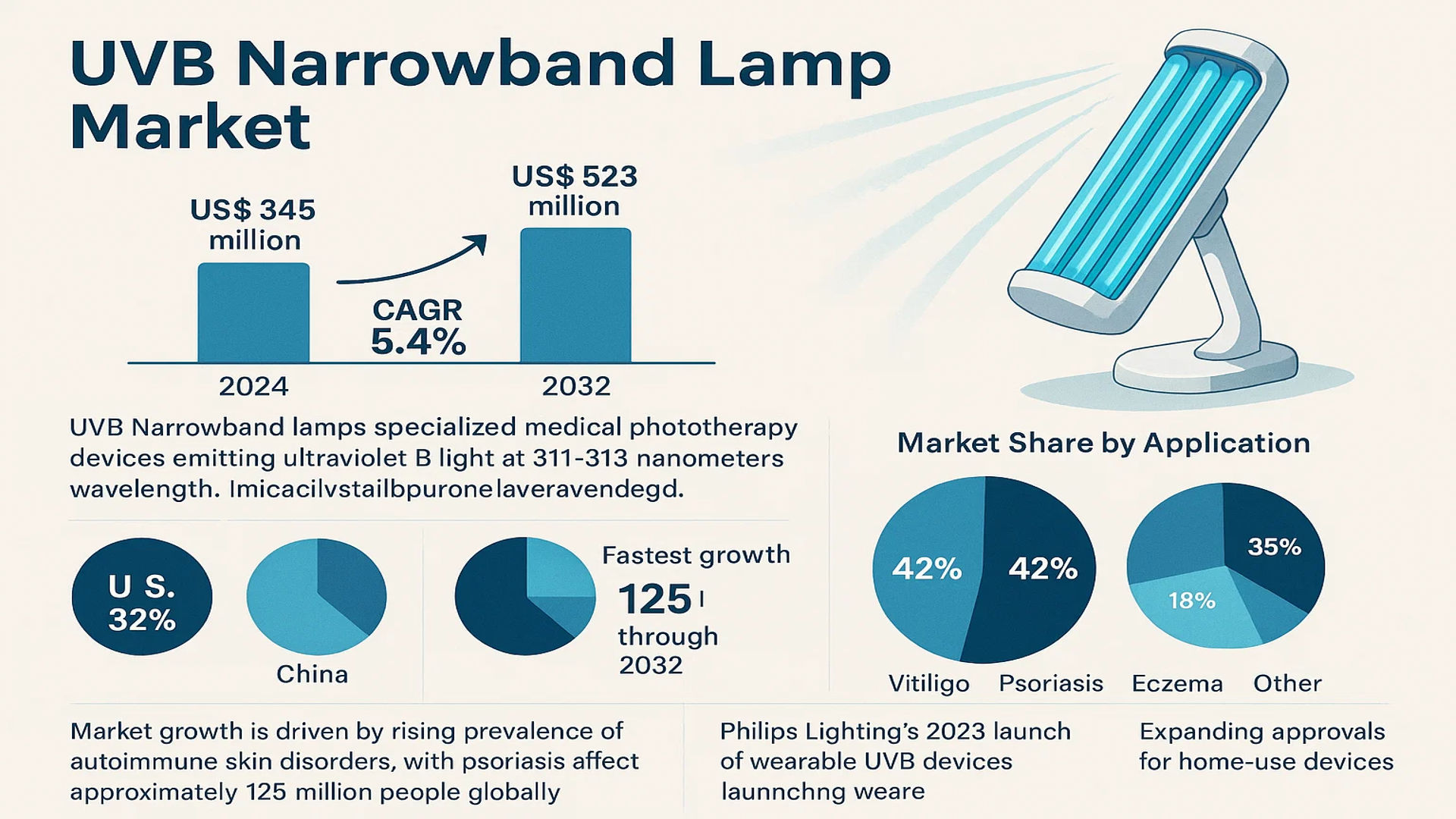
The global UVB Narrowband Lamp Market size was valued at US$ 345 million in 2024 and is projected to reach US$ 523 million by 2032, at a CAGR of 5.4% during the forecast period 2025-2032. The U.S. market accounted for 32% of global revenue in 2024, while China is expected to witness the fastest growth with a projected CAGR of 7.2% through 2032.
UVB Narrowband lamps are specialized medical phototherapy devices emitting ultraviolet B light at 311-313 nanometers wavelength. These lamps are clinically proven for treating chronic skin conditions by stimulating melanocyte activity and suppressing hyperactive immune responses. The technology primarily includes handheld and desktop form factors, with applications across vitiligo (42% market share), psoriasis (35%), eczema (18%) and other dermatological conditions.
The market growth is driven by rising prevalence of autoimmune skin disorders, with psoriasis affecting approximately 125 million people globally. Recent advancements include Philips Lighting’s 2023 launch of wearable UVB devices, while regulatory approvals for home-use devices are expanding access. LightSources Group and National Biological dominate the competitive landscape, collectively holding 48% market share through patented lamp technologies and clinical partnerships.
MARKET DYNAMICS
MARKET DRIVERS
Rising Prevalence of Skin Disorders to Accelerate UVB Narrowband Lamp Adoption
The global burden of chronic skin conditions like psoriasis, vitiligo, and eczema has shown a significant upward trajectory in recent years. With psoriasis alone affecting over 125 million people worldwide, dermatologists increasingly recommend phototherapy as a first-line treatment. UVB narrowband lamps have become the gold standard in phototherapy due to their superior safety profile and efficacy compared to broadband UVB. Clinical studies demonstrate that narrowband UVB achieves clearance rates exceeding 70% for moderate psoriasis cases. As healthcare systems prioritize cost-effective treatments with minimal side effects, the demand for UVB narrowband solutions continues rising sharply across both clinical and homecare settings.
Technological Advancements Enhance Treatment Accessibility
Recent innovations in UVB lamp technology have significantly improved patient accessibility to phototherapy treatment. Manufacturers have introduced compact, user-friendly handheld devices that maintain therapeutic efficacy while reducing treatment duration. These portable solutions address a critical market need, particularly for patients in remote areas or those with mobility challenges. The latest generation of lamps feature smart connectivity, enabling remote monitoring by healthcare providers and personalized dosage adjustments based on treatment response. Such technological integration not only improves patient compliance but also expands the addressable market by making phototherapy viable for home use under medical supervision.
➤ For instance, recent product launches incorporate Bluetooth-enabled dose tracking and mobile app integration, allowing dermatologists to monitor treatment progress remotely.
Furthermore, improvements in lamp longevity and energy efficiency have reduced the total cost of ownership, making UVB narrowband therapy more economically sustainable for healthcare providers and patients alike.
MARKET RESTRAINTS
High Treatment Costs and Limited Insurance Coverage Constrain Market Penetration
Despite the proven therapeutic benefits of UVB narrowband phototherapy, significant cost barriers hinder widespread adoption. A complete treatment course typically requires 20-30 sessions, with clinic-based therapies costing several thousand dollars annually. While some healthcare systems provide coverage, many insurance providers classify phototherapy as an elective treatment, placing the financial burden directly on patients. This economic constraint disproportionately affects middle-income demographics, creating accessibility challenges in price-sensitive markets. Additionally, the initial capital investment required for medical-grade UVB equipment limits adoption among smaller dermatology practices, further concentrating market access in urban healthcare centers.
Other Constraints
Safety Concerns Regarding Improper Use
Improper usage of UVB narrowband lamps without medical supervision can lead to adverse effects including burns, premature skin aging, and increased cancer risk. These safety concerns make both patients and physicians cautious about home-based treatment options, despite technological safeguards. Regulatory bodies in several regions have implemented strict guidelines for UVB device operation, requiring specialized training that creates additional barriers to market expansion.
Patient Compliance Challenges
The need for frequent clinic visits (typically 2-3 times weekly) presents significant compliance challenges, particularly for working adults and elderly patients. While home-use devices offer a potential solution, concerns about proper usage and monitoring continue to limit their adoption rates in many markets.
MARKET OPPORTUNITIES
Emerging Markets Present Significant Growth Potential
Developing economies in Asia Pacific and Latin America represent substantial untapped potential for UVB narrowband lamp manufacturers. Rising healthcare expenditures, increasing dermatological awareness, and growing middle-class populations in these regions are creating favorable market conditions. Countries like China and India, where vitiligo prevalence rates exceed global averages, show particularly strong demand for affordable phototherapy solutions. Localized product development focusing on cost-effective yet clinically validated devices could enable manufacturers to capitalize on these high-growth markets while addressing critical unmet medical needs.
Integration with Digital Health Platforms Opens New Possibilities
The convergence of phototherapy with digital health technologies presents transformative opportunities for the UVB narrowband market. Emerging telehealth models allow dermatologists to remotely supervise home-based treatments, combining the convenience of self-administration with professional oversight. Smart lamp systems that integrate with electronic health records can optimize treatment protocols based on patient response data, potentially improving outcomes while reducing adverse effects. As healthcare systems worldwide shift toward value-based care models, these connected solutions position UVB narrowband therapy as a cost-effective alternative to systemic medications for chronic dermatological conditions.
MARKET CHALLENGES
Intense Competition from Biologics and Alternative Therapies
The UVB narrowband lamp market faces growing competition from biologic drugs and novel systemic therapies for skin disorders. While phototherapy remains a first-line treatment for many conditions, newer biologic medications offer targeted mechanisms of action with convenient dosing schedules. These alternatives, though significantly more expensive, appeal to patients seeking minimal time commitment and potentially faster results. The market must demonstrate the cost-effectiveness and safety advantages of UVB therapy, particularly for maintenance treatment following initial biologic intervention. Without clear differentiation, phototherapy risks losing market share to pharmaceutical alternatives in certain patient segments.
Regulatory and Reimbursement Landscape Complexity
Navigating diverse regulatory requirements across global markets presents ongoing challenges for UVB device manufacturers. Classification of phototherapy equipment varies significantly by region, with some countries treating devices as medical equipment while others categorize them as consumer health products. This regulatory fragmentation increases compliance costs and slows time-to-market for innovative solutions. Simultaneously, inconsistent reimbursement policies create market access barriers, as phototherapy’s position in treatment guidelines continues evolving alongside new therapeutic options.
UVB NARROWBAND LAMP MARKET TRENDS
Expanding Applications in Dermatological Treatments to Drive Market Growth
The UVB narrowband lamp market is witnessing substantial growth, primarily due to its increasing adoption in treating chronic skin conditions such as psoriasis, vitiligo, and eczema. According to validated research, psoriasis affects approximately 125 million people worldwide, with UVB phototherapy being a cornerstone treatment due to its efficacy and non-invasive nature. The market is expanding as medical professionals increasingly favor narrowband UVB (311-313 nm) over broadband UVB for its superior safety profile and targeted therapeutic effects. Technological advancements, such as portable and handheld UVB devices, are further enabling home-based treatments, improving accessibility and patient compliance.
Other Trends
Rising Preference for At-Home Phototherapy Devices
The demand for at-home UVB narrowband lamps is surging, driven by patient preference for convenience and the reduction of hospital visits. Manufacturers are capitalizing on this shift by introducing compact, user-friendly devices with enhanced safety features like automatic shut-off mechanisms and skin sensors. This segment is projected to exhibit a robust CAGR in the coming years as consumers prioritize cost-effective, long-term management of chronic skin conditions.
Increasing Investments in Dermatological Infrastructure
Healthcare systems worldwide are ramping up investments in advanced dermatological treatments, particularly in regions with high UVB therapy adoption rates such as North America and Europe. Governments and private entities are funding specialized clinics equipped with cutting-edge phototherapy solutions, further fueling market expansion. Additionally, rising awareness about non-invasive treatment alternatives is encouraging dermatologists to integrate UVB narrowband lamps into routine clinical practice, reinforcing long-term market stability.
COMPETITIVE LANDSCAPE
Key Industry Players
Leading Brands Innovate to Capture Market Share in UVB Therapy Segment
The global UVB Narrowband Lamp market features a moderately fragmented competitive landscape where established medical technology firms coexist with specialized phototherapy manufacturers. Philips Lighting (now operating as Signify) dominates the market with approximately 22% revenue share, leveraging its advanced lamp technologies and global distribution network. The company has recently expanded its UVB narrowband product line to target both clinical and home-use segments.
National Biological (NatBio) and LightSources Group represent significant secondary players, collectively holding about 31% market share. These companies differentiate themselves through specialized offerings – NatBio through FDA-cleared medical devices and LightSources through customizable lamp solutions for dermatology clinics.
The competitive intensity has increased as manufacturers focus on three key strategies: product miniaturization for home use, energy efficiency improvements, and smart connectivity features that allow patients to monitor treatment sessions via mobile apps. This technological evolution is particularly evident in handheld devices, which are projected to grow at 8.2% CAGR through 2032.
Emerging competitors like Dermfix are gaining traction by targeting niche applications such as pediatric psoriasis treatment, while established players strengthen their positions through strategic acquisitions. For example, International Light Technologies recently acquired a smaller UV specialty firm to enhance its dermatology-focused product development capabilities.
List of Key UVB Narrowband Lamp Manufacturers Profiled
- Signify (Netherlands)
- Dermfix (UK)
- LightSources Group (U.S.)
- International Light Technologies (U.S.)
- National Biological (NatBio) (U.S.)
- Daavlin Company (U.S.)
- Waldmann GmbH (Germany)
- TheraLight Inc. (U.S.)
- UVBioTek (U.S.)
Segment Analysis:
By Type
Handheld Segment Leads Due to Portability and Growing Demand for Home-Based Treatments
The market is segmented based on type into:
- Handheld
- Desktop
By Application
Psoriasis Segment Dominates with High Adoption in Clinical and Homecare Settings
The market is segmented based on application into:
- Vitiligo
- Psoriasis
- Eczema
- Other dermatological conditions
By End User
Hospitals and Clinics Hold Significant Market Share Due to Increasing Skin Disease Prevalence
The market is segmented based on end user into:
- Hospitals and clinics
- Homecare settings
- Dermatology centers
- Aesthetic clinics
Regional Analysis: UVB Narrowband Lamp Market
North America
The North American UVB Narrowband Lamp market is driven by rising dermatological disorders and increasing adoption of phototherapy treatments. With a well-established healthcare infrastructure and high patient awareness, the U.S. dominates regional demand, accounting for over 85% of the market share in 2024. Strict FDA regulations ensure product safety and efficacy, encouraging innovation among local manufacturers like International Light Technologies and National Biological (NatBio). The handheld UVB lamp segment is witnessing accelerated growth due to home-use convenience, particularly for psoriasis treatments. However, high product costs and reimbursement challenges in certain cases remain market barriers.
Europe
Europe’s market is characterized by stringent CE certification requirements and a strong focus on clinical validation. Germany and the U.K. lead regional adoption, supported by rising cases of eczema and vitiligo. The EU’s emphasis on non-invasive treatment alternatives has boosted demand for phototherapy devices, with companies like Philips Lighting and Signify launching advanced UVB narrowband solutions. Portable devices are gaining traction, particularly in dermatology clinics, though price sensitivity in Southern Europe slightly restrains market expansion. Sustainability initiatives are also pushing manufacturers to develop energy-efficient lamps with longer lifespans.
Asia-Pacific
Asia-Pacific is the fastest-growing market, propelled by China’s booming medical device sector and India’s increasing healthcare expenditure. Rising skin disease prevalence, coupled with urbanization and pollution-related dermatological conditions, fuels demand. Local players compete aggressively on pricing, though international brands maintain dominance in premium segments. Regulatory frameworks are still evolving, creating both opportunities and challenges for market entrants. Japan and South Korea contribute significantly due to advanced healthcare systems, while Southeast Asia shows promising growth potential with expanding medical tourism.
South America
Market growth in South America is steady but constrained by economic volatility and limited healthcare budgets. Brazil accounts for the largest share, owing to its relatively developed private healthcare sector. Demand is concentrated in urban centers, with dermatology clinics being primary end-users. Import dependency raises product costs, though localized manufacturing initiatives are emerging. Public awareness campaigns about phototherapy benefits are gradually improving adoption rates, but infrastructure limitations in rural areas hinder widespread market penetration.
Middle East & Africa
This region presents a mixed landscape, with GCC countries driving demand through high disposable incomes and premium healthcare services. The UAE and Saudi Arabia are key markets, supported by medical tourism and increasing dermatology investments. However, affordability issues persist in other parts of the region, restricting adoption to elite healthcare facilities. Local distributors are collaborating with global manufacturers to improve accessibility, but regulatory inconsistencies and low awareness in some countries slow market maturation. Long-term growth potential remains intact as healthcare infrastructure develops further.
Report Scope
This market research report provides a comprehensive analysis of the Global UVB Narrowband Lamp Market, covering the forecast period 2024–2032. It offers detailed insights into market dynamics, technological advancements, competitive landscape, and key trends shaping the industry.
Key focus areas of the report include:
- Market Size & Forecast: Historical data and future projections for revenue, unit shipments, and market value across major regions and segments. The global market was valued at US$ 345 million in 2024 and is projected to reach US$ 523 million by 2032.
- Segmentation Analysis: Detailed breakdown by product type (Handheld, Desktop) and application (Vitiligo, Psoriasis, Eczema, Others) to identify high-growth segments and investment opportunities.
- Regional Outlook: Insights into market performance across North America, Europe, Asia-Pacific, Latin America, and the Middle East & Africa, including country-level analysis where relevant. The U.S. market size is estimated at USD million in 2024, while China is projected to reach USD million by 2032.
- Competitive Landscape: Profiles of leading market participants, including their product offerings, R&D focus, manufacturing capacity, pricing strategies, and recent developments such as mergers, acquisitions, and partnerships. Key players include Philips Lighting, Dermfix, LightSources Group, International Light Technologies, Signify, and National Biological (NatBio).
- Technology Trends & Innovation: Assessment of emerging technologies, product innovations, and evolving industry standards in UVB narrowband phototherapy.
- Market Drivers & Restraints: Evaluation of factors driving market growth along with challenges, supply chain constraints, regulatory issues, and market-entry barriers.
- Stakeholder Analysis: Insights for manufacturers, suppliers, healthcare providers, investors, and policymakers regarding the evolving ecosystem and strategic opportunities.
Primary and secondary research methods are employed, including interviews with industry experts, data from verified sources, and real-time market intelligence to ensure the accuracy and reliability of the insights presented.
FREQUENTLY ASKED QUESTIONS:
What is the current market size of Global UVB Narrowband Lamp Market?
-> UVB Narrowband Lamp Market size was valued at US$ 345 million in 2024 and is projected to reach US$ 523 million by 2032, at a CAGR of 5.4% during the forecast period 2025-2032.
Which key companies operate in Global UVB Narrowband Lamp Market?
-> Key players include Philips Lighting, Dermfix, LightSources Group, International Light Technologies, Signify, and National Biological (NatBio), among others.
What are the key growth drivers?
-> Key growth drivers include rising prevalence of skin disorders, increasing adoption of phototherapy treatments, and technological advancements in UVB lamp technology.
Which region dominates the market?
-> North America currently holds the largest market share, while Asia-Pacific is expected to witness the fastest growth during the forecast period.
What are the emerging trends?
-> Emerging trends include development of portable UVB devices, integration of smart features, and increasing focus on home-use phototherapy solutions.

Get Sample Report PDF for Exclusive Insights
Report Sample Includes
- Table of Contents
- List of Tables & Figures
- Charts, Research Methodology, and more...
 Download Sample Report PDF