
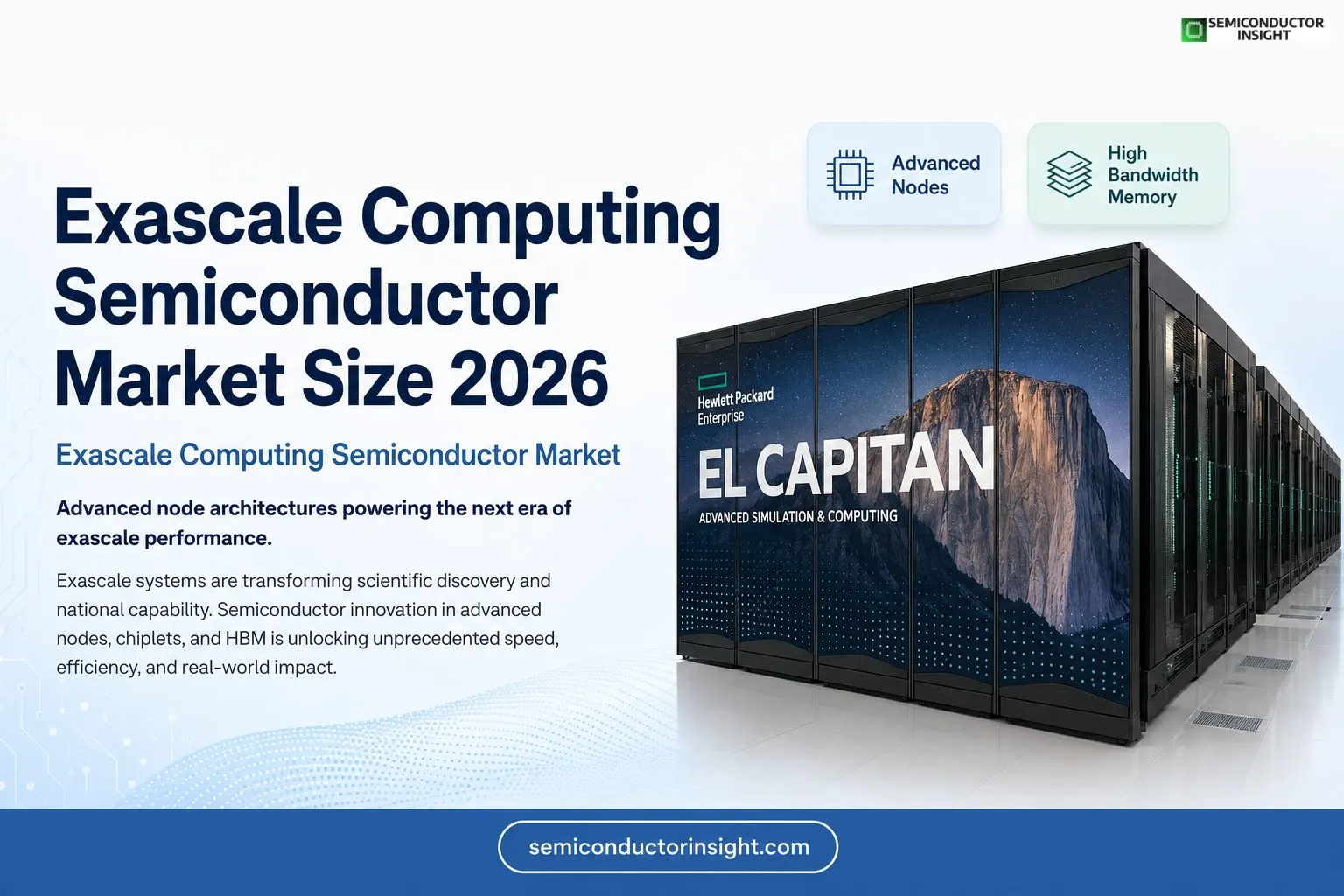
Exascale Computing Semiconductor Market Size 2026: USD 6.5 Billion Expanding Through Advanced Node Architectures
Exascale computing marks a pivotal shift in how nations tackle the most complex scientific and security challenges. These systems deliver at least one exaflop of performance one quintillion floating-point operations per second unlocking simulations and data analysis once considered impossible.
Semiconductors sit at the heart of this capability, powering everything from heterogeneous processors to high-bandwidth memory stacks that keep data flowing without bottlenecks.
Pioneering Systems Reshaping Global Capabilities
- The United States leads with several landmark installations. Frontier at Oak Ridge National Laboratory achieved over 1.3 exaflops on recent benchmarks, relying on AMD EPYC CPUs paired with Instinct MI250X GPUs across thousands of nodes.
- El Capitan at Lawrence Livermore National Laboratory, which topped global rankings in late 2024, delivers around 1.74 exaflops using AMD MI300A accelerated processing units that integrate CPU and GPU elements in single packages with substantial HBM3 memory.
- Aurora at Argonne brings Intel Xeon and Data Center GPU Max technologies into the mix, hitting roughly 1 exaflop while supporting diverse scientific workloads.
- These machines demonstrate how semiconductor innovations in chiplet designs, advanced packaging, and integrated accelerators turn raw theoretical power into practical results.
- For instance, El Capitan’s architecture supports high-resolution nuclear stockpile modelling that previously required far longer runtimes, compressing complex 3D simulations from days into hours.
Semiconductor Innovations Driving Exascale Performance
Modern exascale systems depend on tight integration of processing elements. AMD’s MI300A APU combines Zen 4 CPU cores with CDNA3 GPU compute units on one package, reducing data movement overhead and improving energy efficiency.
Memory technology plays an equally critical role. High Bandwidth Memory (HBM) stacks provide the massive throughput needed to feed these processors without starving them. Systems now incorporate thousands of such modules, paired with high-speed interconnects like Cray Slingshot 11, which ensures low-latency communication across the massive node counts often exceeding 40,000 combined CPU-GPU cores per machine.
Power efficiency remains a constant focus. El Capitan achieves strong performance per watt figures around 58 Gflops/watt, reflecting years of DOE-backed research into cooling, voltage scaling, and heterogeneous designs that balance compute density with thermal limits.
Smart Implementations Creating Market Value
- Beyond national labs, exascale semiconductor capabilities support breakthroughs across sectors.
- Climate modelling benefits from higher-resolution simulations that capture regional weather patterns and long-term trends with greater accuracy.
- Materials science teams use these systems to screen thousands of potential compounds for next-generation batteries or fusion reactor components in days rather than years.
- In healthcare, researchers run detailed molecular dynamics simulations to explore protein interactions or drug candidates.
- Defence applications include advanced cryptography analysis and predictive maintenance for complex systems. The semiconductor foundation enables these diverse uses by providing the raw speed and efficiency required for sustained exaflop-level operation.
To find out more, feel free to browse our latest updated report: https://semiconductorinsight.com/report/exascale-computing-semiconductor-market/
Global Momentum and Collaborative Efforts
While the U.S. Department of Energy’s Exascale Computing Project delivered foundational software and hardware advances through 2024, other regions pursue similar paths. European initiatives under EuroHPC and Asian programs emphasize domestic semiconductor development to reduce dependencies. These parallel efforts create a vibrant ecosystem where innovations in one area such as chiplet standardization or open interconnect protocols quickly influence others.
Universities and industry partners increasingly access fractional exascale resources through cloud integrations, broadening participation beyond traditional supercomputing centers. This democratization accelerates discovery cycles in fields ranging from astrophysics to precision agriculture.
Overcoming Technical Barriers with Next-Generation Designs
Scaling to exascale required addressing fundamental limits in traditional architectures. Designers moved away from simply increasing clock speeds toward massive parallelism, specialized accelerators, and software-hardware co-design. The result appears in systems that handle mixed-precision calculations efficiently, crucial for both scientific accuracy and AI workloads.
Ongoing work focuses on even tighter integration, such as advanced 3D stacking and new memory hierarchies, to maintain performance gains while controlling power draw systems like Frontier and El Capitan consume tens of megawatts, underscoring the need for continued semiconductor efficiency improvements.
The Path Forward for Semiconductor Leadership
- Exascale computing highlights the strategic importance of semiconductor technology in maintaining competitive edges in science and security.
- As more systems come online globally, the underlying chips and architectures will continue evolving, influencing everything from consumer devices to large-scale infrastructure.
- The journey shows how sustained investment in research, combined with practical deployments, drives meaningful progress.
From Frontier’s early exascale milestone to El Capitan’s record-setting performance, these achievements rest on semiconductor advancements that balance power, performance, and scalability for the most demanding applications ahead.

Comments (0)