
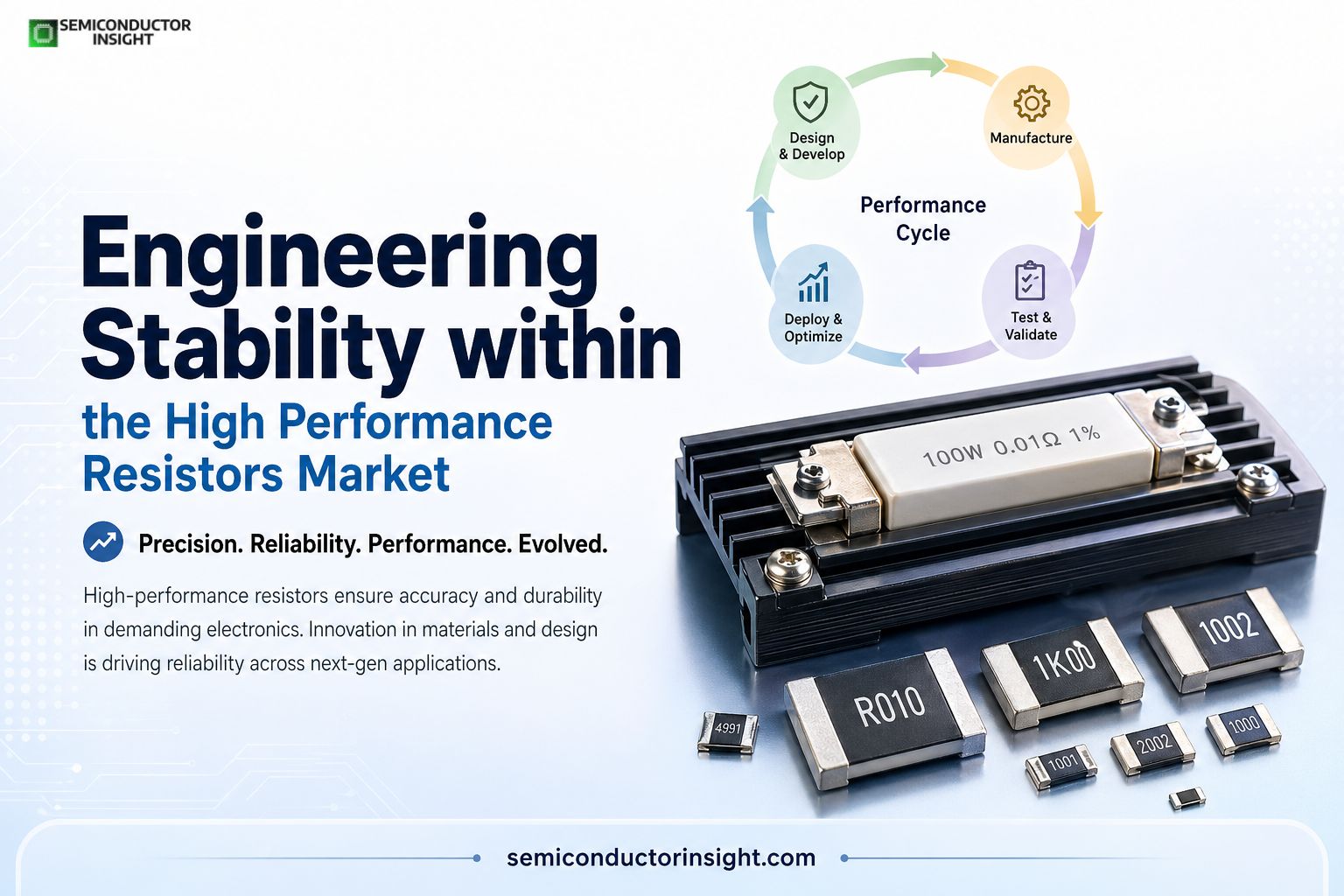
Engineering Stability within the High Performance Resistors Market
As semiconductor devices get smaller and smaller, the expectations for passive components have changed a lot. High-Performance Resistors Market is no longer only about resistance values. It’s also about how these parts work when they are put under a lot of electrical, thermal, and environmental stress.
Resistors must keep tight tolerances even when the current and temperature change quickly, like in high-speed processors, vehicle control units, and power electronics.
Globally, resistor production surpasses 200 billion units annually, with high-performance variants accounting for roughly 8-10% of total volume but contributing disproportionately to value due to their specialized applications. Thin-film resistors, known for precision, dominate segments requiring tolerance levels as low as ±0.01%, particularly in instrumentation and aerospace electronics.
Open the latest report to explore key opportunities and developments: https://semiconductorinsight.com/report/high-performance-resistors-market/
Material Science beyond Conventional Carbon Films
- The progress of materials science has a lot to do with the progress of resistor technology.
- Metal film, metal oxide, and wire-wound designs have mostly taken the place of traditional carbon composition resistors in high-performance situations.
- Thin-film resistors, which are frequently made from sputtered nickel-chromium alloys, with temperature coefficients as low as ±5 ppm/°C. This makes them perfect for precise analog circuits.
- At the same time, bulk metal foil resistors are gaining traction in ultra-sensitive applications. These components can achieve stability levels where resistance drift remains below 0.005% over 2,000 hours of operation. Such performance is critical in medical imaging systems and satellite communication modules, where even minor deviations can disrupt signal accuracy.
- Recent semiconductor fabrication facilities are also integrating resistive elements directly onto silicon substrates.
- On-chip resistors, typically formed using polysilicon layers, are now engineered to handle power densities exceeding 0.5 watts per square millimeter, supporting compact and energy-efficient chip designs.
Thermal Management as a Design Constraint
Heat dissipation has become a major problem for modern devices. Resistors that work well must be able to handle a constant load without breaking down. Power resistors in electric cars, for example, often have to deal with energy levels over 100 watts per unit, which means they need improved ceramic substrates and heat sink integration.
Important thermal factors that affect how resistors are made are:
- Temperature coefficient of resistance (TCR) stability while the load is cycled
- Ability to tolerate surge energy pulses exceeding 10 joules in industrial circuits
- Long-term stability of resistance in humid conditions with relative humidity over 85%
In renewable energy systems like solar inverters, resistors have to deal with temperature changes that range from -40°C to 125°C. This means that they need strong encapsulation and coating technologies.
Frequency Response and Signal Integrity Challenges
As high-frequency communication systems like 5G and satellite networks become more common, resistors need to keep their performance across a wide range of frequencies. Parasitic inductance and capacitance, which were once unimportant, are now very important to how circuits work. Resistors with high performance are designed with optimal shapes to reduce these effects, making sure that the performance stays steady even at frequencies above 10 GHz.
A lot of small devices use surface-mount resistors, especially those that come in 0201 and 01005 package sizes. Even though they are small (usually less than 0.4 mm long), they must be able to handle voltages up to 50 volts and keep their resistance stable when the current changes quickly.
Reliability Standards and Industrial Benchmarks
Testing for reliability has gotten stricter, notably for applications in the aerospace and automobile industries. Standards like AEC-Q200 set rules for stress testing, such as thermal shock, vibration, and load life testing. To fulfill these strict standards, high-performance resistors must have failure rates of less than 1 part per million (ppm).
Manufacturers are also paying more attention to how well their products resist electromigration, especially in thin-film designs. Modern resistors can handle current densities more than 10⁶ amperes per square centimeter without substantial damage by improving the structure of the grains and the coatings that protect them.
Emerging Use Cases in Power Electronics and AI Hardware
- The growth of artificial intelligence hardware and power electronics is creating new opportunities for high-performance resistors.
- Resistors are utilized in voltage regulation modules in AI accelerators, where accuracy has a direct effect on the stability of the computation.
- In the same way, resistors in electric vehicle battery management systems keep an eye on the flow of current with an accuracy level of better than ±0.1%, making sure that everything runs safely and efficiently.
Wide bandgap semiconductors like silicon carbide (SiC) and gallium nitride (GaN) are also changing what kind of resistors are needed. These materials let resistors work at higher voltages and switching frequencies than they could before, which means they can work in situations where traditional designs would fail. Because of this, new resistor designs are being made to match the speed and efficiency of these new semiconductor devices.

Comments (0)