
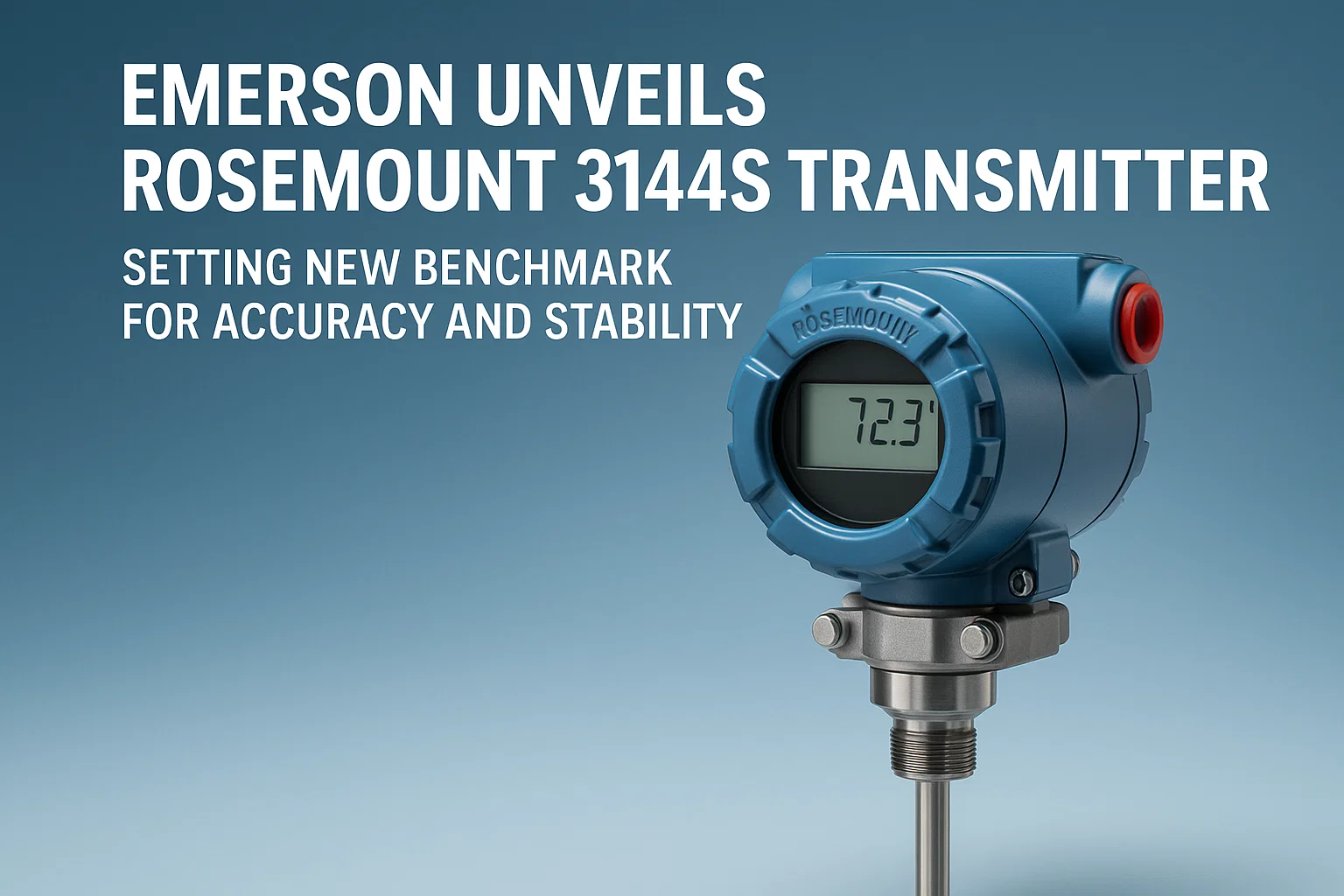
Emerson Unveils Rosemount 3144S Transmitter, Setting New Benchmark for Accuracy and Stability
In the evolving world of industrial automation, precision measurement and control are no longer optional luxuries they are mission-critical capabilities. Whether in oil refineries, renewable energy plants, automotive assembly lines, or cutting-edge robotics, reliable signal transmission from rotating equipment to stationary monitoring systems plays a pivotal role in safety, efficiency, and sustainability.
This is the role of rotary transmitters specialized devices designed to capture, process, and transmit measurement data from rotating components to stationary systems. While this technology has been around for decades, recent breakthroughs, product launches, and market dynamics are pushing rotary transmitters into an exciting new growth phase.
In 2024, the global rotary transmitters market was valued at US$ 423 million, and analysts project it will climb to US$ 634 million by 2032, reflecting a compound annual growth rate (CAGR) of 5.2% between 2025 and 2032. Behind these numbers lies a story of innovation, sectoral demand, and the increasing integration of digital intelligence into industrial measurement systems.
Access Your Free Sample Report- Rotary Transmitters Market
Understanding Rotary Transmitters
Before diving into the latest innovations, let’s establish what rotary transmitters actually do.
At their core, rotary transmitters enable the transmission of data temperature, pressure, torque, speed, or other parameters from a rotating part of a machine to a stationary receiver. Traditional slip rings, rotary unions, and similar systems made this possible mechanically. However, today’s rotary transmitters integrate wireless, digital, and IoT-enabled solutions for more accurate, reliable, and low-maintenance data transfer.
Applications include:
- Wind turbines: Monitoring torque, vibration, and temperature of rotating blades.
- Industrial motors and pumps: Capturing data from shafts, bearings, and seals.
- Automotive testing: Measuring torque and strain in rotating axles.
- Medical devices: Rotating diagnostic machines that require precise, interference-free data transfer.
- Robotics and automation: Rotary joints and arms transmitting data in real time.
This combination of breadth and specialization makes rotary transmitters essential across industries, driving demand in both established and emerging markets.
Emerson’s Rosemount 3144S: Redefining Temperature Measurement
One of the most significant recent developments comes from Emerson, a global leader in industrial automation. In August 2025, Emerson announced the launch of the Rosemount 3144S Temperature Transmitter, a device that sets new benchmarks for accuracy, stability, and usability.
Key Features
- Ultra-High Accuracy: The 3144S delivers laboratory-grade accuracy of ±0.05 °C, crucial in industries where even the smallest deviations can impact product quality or safety.
- 20-Year Stability Guarantee: Few industrial transmitters promise this level of long-term reliability, making it particularly attractive for capital-intensive sectors like oil & gas or power generation.
- ReadyConnect™ Technology: A plug-and-play setup feature reduces commissioning times, minimizing downtime during installation or system upgrades.
- Bluetooth® Remote Access: Engineers can configure, monitor, and troubleshoot transmitters without needing to be physically next to the equipment a valuable feature in hazardous or hard-to-reach environments.
- Advanced Diagnostics: Functions like Loop Integrity checks and RTD Measurement Protection enhance system reliability, reducing the likelihood of undetected faults.
- Harsh-Environment Capability: Operates at temperatures up to 650 °C, broadening its applicability across extreme process conditions.
Why This Matters
The Rosemount 3144S illustrates how manufacturers are responding to industry needs for smarter, safer, and more resilient transmitters. By integrating remote access, diagnostics, and ultra-long stability, Emerson is not just improving efficiency it is redefining expectations for what a transmitter should deliver in 2025 and beyond.
This launch has also sent ripples across the rotary transmitters sector, as many rotary applications such as turbines, rotating reactors, or large-scale compressors demand precisely these capabilities.
Specialized Innovation: Binsfeld Engineering’s Rotary Temperature Transmitters
While global giants like Emerson focus on versatile industrial transmitters, Binsfeld Engineering has carved out a niche specializing exclusively in rotary temperature transmitters.
Binsfeld’s Differentiation
- Exclusive Focus on Rotating Systems: Unlike many competitors, Binsfeld designs products specifically for rotating-to-stationary signal transmission.
- Reliability and Warranty: Their transmitters are backed by warranties of up to five years, signaling confidence in long-term durability.
- Tailored Solutions: Serving industries ranging from plastics extrusion to heavy machinery, Binsfeld emphasizes adaptability to unique customer requirements.
The Niche Advantage
While Binsfeld may not match Emerson’s scale, its laser-focused expertise allows it to dominate a highly specialized segment of the market. For customers needing absolute confidence in rotating measurement systems say, for turbines in renewable energy plants Binsfeld remains a go-to name.
Download Sample Report PDF- Rotary Transmitters Market
Market Outlook: 2025–2032
The growth trajectory of rotary transmitters underscores their rising strategic importance across industries.
- Market Size (2024): US$ 423 million
- Projected Market Size (2032): US$ 634 million
- CAGR (2025–2032):2%
Drivers of Growth
- Industrial Automation: As factories adopt Industry 4.0 standards, demand for real-time monitoring of rotating machinery is increasing.
- Energy Transition: Wind and hydroelectric turbines rely on rotary transmitters for monitoring performance and ensuring safety.
- Electric Vehicles (EVs): Testing and validating drivetrain systems requires precise torque and strain measurement.
- Robotics and Healthcare: Advanced robotics and imaging devices often require rotating signal transmission solutions.
- Operational Efficiency: Minimizing downtime through predictive maintenance drives adoption of diagnostic-capable transmitters.
Regional Insights
- North America & Europe: Leading adoption due to strong presence of industrial automation and renewable energy sectors.
- Asia-Pacific: Fastest growth, driven by manufacturing hubs in China, India, and Southeast Asia, alongside expanding EV production.
- Middle East: Rising demand from oil & gas and petrochemical sectors, where reliability in extreme conditions is paramount.
Broader Trends Shaping the Industry
1. IoT and Wireless Integration
Future rotary transmitters will increasingly feature wireless communication protocols, enabling seamless data flow into IIoT ecosystems.
2. Predictive Maintenance
Advanced diagnostics and analytics built into transmitters reduce downtime by predicting failures before they occur.
3. Sustainability and Energy Efficiency
Accurate monitoring reduces waste, optimizes energy use, and supports sustainability goals especially critical in energy-intensive industries.
4. Miniaturization and Customization
With sectors like medical devices and robotics requiring compact systems, manufacturers are investing in smaller, lighter, and application-specific designs.
5. Safety and Regulatory Compliance
In industries such as chemicals, oil & gas, and food processing, transmitters that enhance process safety are essential for regulatory compliance.
Competitive Landscape
The rotary transmitters industry is characterized by a mix of multinational corporations and specialized innovators:
- Emerson – Broad portfolio across industrial transmitters, recently pushing boundaries with Rosemount 3144S.
- Binsfeld Engineering – Specialized focus on rotary temperature transmitters.
- TE Connectivity & Rotork – Significant players in industrial measurement and automation.
- Meridian Laboratory – Known for precision slip rings and rotary unions.
This diversity fosters both cutting-edge innovation and application-specific expertise, ensuring the market remains dynamic.
Challenges Ahead
Despite promising growth, the rotary transmitters industry faces hurdles:
- High Initial Costs: Advanced transmitters can be costly, especially for SMEs.
- Integration Complexity: Aligning transmitters with existing legacy systems can be challenging.
- Environmental Stress: Devices in harsh environments must endure extreme temperatures, moisture, and vibration.
- Competition from Alternatives: Non-contact technologies, like laser-based measurement systems, may substitute in certain applications.
Click Here To Download Full Sample Report- Rotary Transmitters Market
Future Outlook
Looking forward, rotary transmitters are expected to evolve into smart, connected devices that do far more than transmit data. The next decade may see:
- AI-Enhanced Transmitters: Embedding artificial intelligence to analyze data at the edge.
- Energy-Harvesting Designs: Self-powered transmitters that draw energy from rotation.
- Hybrid Systems: Combining mechanical, wireless, and optical transmission for redundancy and resilience.
By 2032, rotary transmitters will likely be indispensable enablers of intelligent industrial systems, bridging the gap between moving machinery and digital decision-making platforms.
From Emerson’s groundbreaking Rosemount 3144S to Binsfeld’s specialized rotary temperature solutions, the rotary transmitters industry is entering a new phase of growth and transformation. With a market projected to expand from US$ 423 million in 2024 to US$ 634 million by 2032, this sector reflects the increasing importance of precision, reliability, and digital integration in industrial operations.

Comments (0)