
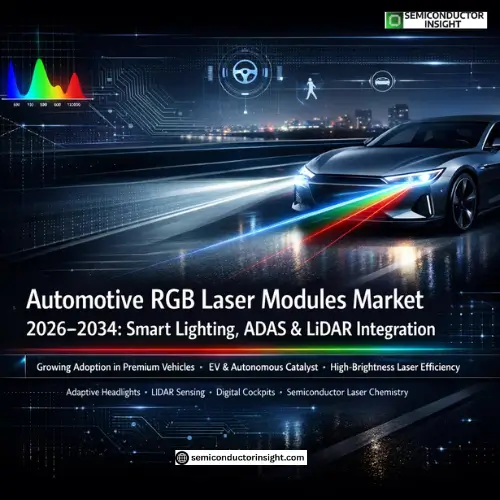
Emerging Trends in Automotive RGB Laser Modules Market and Industry Shifts
Automotive RGB Laser Modules Market is rapidly evolving as vehicles become smarter, safer, and visually more dynamic. Once limited to military or aerospace applications due to cost and complexity, RGB laser modules are now penetrating mainstream automotive segments especially advanced driver-assistance systems (ADAS), in-vehicle displays, high-resolution lighting, and LiDAR integration. In 2025, automakers reported that over 30 % of new premium models incorporated laser-based lighting or sensor systems, emphasizing their growing relevance.
Economically, the push for electric and autonomous vehicles is a core catalyst. Laser modules offer compact, high-efficiency solutions that traditional LEDs and projectors cannot match at high brightness levels. Automotive designers are increasingly choosing RGB laser modules for adaptive headlights and interactive interior displays that require precise color blending and intense illumination without excessive power draw a critical factor for EV range optimization.
Inside the Light Chemistry of RGB Lasers and Automotive Safety
- At the heart of every Automotive RGB laser module are semiconductor laser diodes, often built on compound semiconductor substrates such as GaAs (Gallium Arsenide) and InP (Indium Phosphide). These materials enable efficient red, green, and blue wavelength generation, which in turn allows for full-spectrum color control perfect for next-generation automotive lighting that doubles as communication signals in ADAS environments.
- Chemically, semiconductor lasers depend on precise dopant levels controlled quantities of atoms like phosphorus or aluminum to define electron flow and wavelength stability. This chemical engineering directly impacts reliability and lifespan, especially in vehicles where temperature swings range from sub-zero to more than 70 °C under sunlight.
- This chemical precision also enables lasers to support LiDAR performance.
- Vibrations, heat cycling, and environmental contaminants demand stable emission properties, ensuring that RGB lasers can reliably work in sensor arrays that detect obstacles at distances exceeding 200 meters a critical enhancement for pedestrian detection and collision avoidance.
Next-Level Automotive Lighting Built on RGB Laser Brilliance
Lighting in automobiles has transitioned from simple visibility aids to communication and safety tools. Traditional halogen and LED systems are being outpaced by laser-assisted headlights that can project further, consume less energy, and allow intelligent beam shaping. For example, in select luxury vehicles launched in late 2025, laser headlights projected light up to 600 meters nearly double that of conventional LED systems improving night-time pedestrian detection rates significantly.
RGB laser modules are now being embedded in customizable LED matrices that support animated turn signals and adaptive beam patterns. Beyond lighting for visibility, these systems communicate directional intent particularly useful for autonomous driving scenarios where vehicles broadcast signals to nearby pedestrians or vehicles through dynamic light patterns.
Automakers are also integrating RGB lasers within digital cockpits, delivering ultra-high-resolution displays with exceptionally rich color fidelity outpacing traditional LCD or OLED units. This shift answers consumer demand for brighter, more vivid interfaces, especially in direct sunlight conditions where contrast and color accuracy are paramount.
Take a Quick Glance at Our In-Depth Analysis Report:
https://semiconductorinsight.com/report/automotive-rgb-laser-modules-market/
Government Support and Policy Boosts for Laser-Enabled Automotive Tech
Government regulations are directly influencing how fast RGB laser technology finds adoption. Recent policies in the European Union and the United States have strengthened night-time visibility standards and pedestrian safety requirements. For instance, updated safety mandates in the EU require adaptive beam systems capable of reducing glare for oncoming vehicles a directive that only laser-based modules can satisfy in their current form due to their precise optical control.
In addition, several national research programs particularly in Japan and South Korea are subsidizing semiconductor laser research as part of broader automotive electrification initiatives. These funding efforts aim to reduce production costs, ensuring that RGB laser systems can be incorporated into mid-tier vehicles by the early 2030s. Government support is accelerating supply-chain investments and strategic partnerships between semiconductor manufacturers and automotive OEMs.
Real-World Implementations and Consumer Acceptance Trends
Major global OEMs have begun rolling out RGB laser innovations. Premium brands announced in 2025 that more than 40 % of their 2026 model lineups will include some form of laser-enhanced feature be it adaptive lighting, advanced LiDAR sensing, or immersive head-up displays (HUD). Public perception is also improving, with surveys indicating that 67 % of new car buyers see advanced lighting as a desirable safety and luxury feature rather than a mere aesthetic add-on.
Commercial fleets and autonomous vehicle programs are piloting RGB laser modules for both safety and operational efficiency. For example, delivery vehicle trials in North America integrated RGB laser sensors into urban navigation systems, reducing collision incidents by numbers that industry analysts described as “statistically meaningful.”
Laser Module Chemistry Driving Reliability and Performance
The resilience of RGB lasers in automotive environments owes much too chemical stability engineered into these modules. Unlike incandescent bulbs or standard LEDs, RGB lasers depend on compound semiconductor junction integrity. These junctions must withstand thermal stress without significant wavelength drift a chemical challenge addressed through innovations in quantum well engineering and heat-tolerant substrate layers.
Manufacturers are now applying advanced passivation layers to safeguard semiconductor surfaces from oxidation and moisture. Chemical treatments during production also minimize defect sites that can lead to premature laser degradation. These improvements extend module lifespans an essential factor when considering the 10-year operational windows expected for vehicle safety systems.
Bridging Sensor Intelligence and Light Innovation
Apart from lighting, RGB lasers are exploding in importance for LiDAR sensors embedded in cars targeting higher levels of autonomy. LiDAR units rely on controlled laser pulses to map environments with centimeter-level precision. When paired with RGB capabilities, systems not only map distance but also improve detection of color-coded signals such as road signage and hazard indicators a step closer to human-like visual interpretation.
These integrated perception systems support advanced functions such as lane detection, adaptive cruise control, and automated parking. As a result, sensor fusion strategies where RGB lasers combine with radar and cameras are becoming industry standards for next-gen vehicles.
Automotive RGB Laser Modules Market is charting an exciting course. As electric and autonomous vehicles push boundaries of what is technologically possible, RGB modules are no longer accessories they are foundational components in safety, performance, and human-machine interfaces. Recent industry collaborations between semiconductor specialists and auto manufacturers reflect a shared recognition: RGB lasers will help define the next era of smart, connected, and highly efficient vehicles.
From lighting that intelligently communicates with road users to sensor systems that deliver near-human perception, automotive RGB laser modules are set to influence how vehicles are designed and experienced in the decade ahead.

Comments (0)