MARKET INSIGHTS
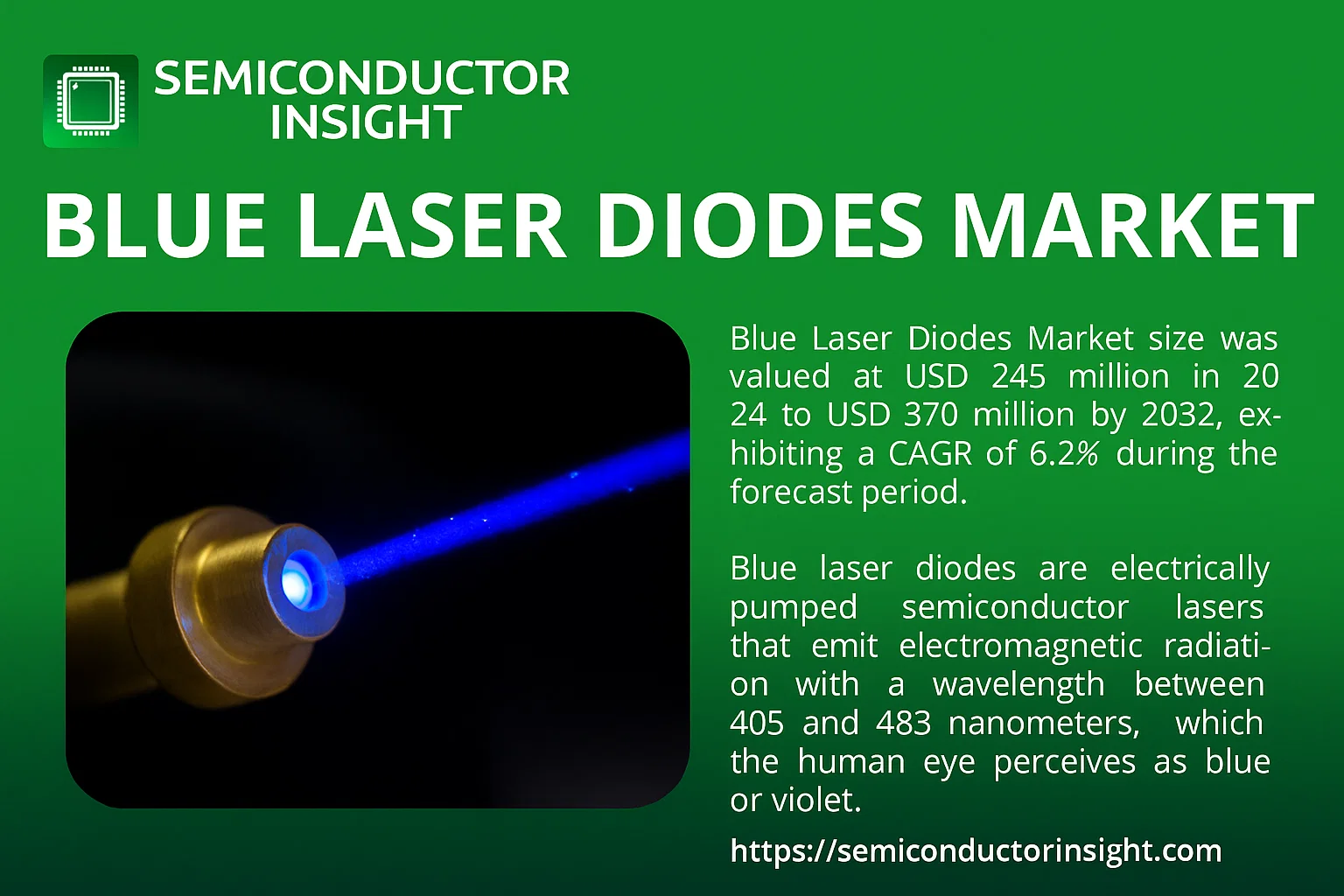
Global Blue Laser Diodes Market size was valued at USD 245 million in 2024 to USD 370 million by 2032, exhibiting a CAGR of 6.2% during the forecast period.
Blue laser diodes are electrically pumped semiconductor lasers that emit electromagnetic radiation with a wavelength between 405 and 483 nanometres, which the human eye perceives as blue or violet. These devices operate on the principle of stimulated emission within a p-n junction or p-i-n structure, where the recombination of electrons and holes generates coherent light. This report specifically covers discrete blue laser diode components within this wavelength range and excludes integrated modules or systems.
The market is experiencing steady growth driven by increasing demand across several key applications. The expansion of high-brightness laser projectors for entertainment and business, along with the critical role these diodes play in bio-medical instrumentation and material processing, are primary growth drivers. Furthermore, the industry is highly concentrated, with key players such as Sony, Nichia, Sharp, and Osram Opto Semiconductors collectively accounting for a significant majority of the market share. Geographically, North America represents the largest consumption region, holding nearly a quarter of the market, followed closely by Europe.
MARKET DRIVERS
Expanding Applications in High-Resolution Displays
The proliferation of laser projection technologies, particularly in consumer electronics like smartphones, projectors, and augmented reality devices, is a primary driver. Blue laser diodes are critical for creating brighter, more vibrant displays with superior color gamut compared to traditional LEDs. The demand for high-definition visual experiences in home entertainment and professional settings continues to fuel market growth, with the market for laser projection expected to grow at a compound annual growth rate of over 15%.
Advancements in Medical and Industrial Processing
In medical and industrial sectors, blue laser diodes are gaining traction for their precision and efficiency. Their shorter wavelength allows for finer detail in applications such as non-invasive surgery, dermatology, and material processing. The ability to work effectively with materials like copper and gold, which have higher absorption rates at blue wavelengths, makes them indispensable in modern microfabrication and manufacturing processes.
➤ Global market for laser-based material processing is projected to exceed D 25 billion by 2026, with blue lasers capturing a significant share due to their material-specific advantages.
Furthermore, ongoing research and development efforts are focused on increasing the power output and efficiency of blue laser diodes, making them more viable for a broader range of industrial applications and reducing total cost of ownership for end-users.
MARKET CHALLENGES
High Manufacturing Costs and Technical Complexity
The production of high-quality blue laser diodes involves complex semiconductor processes, such as growing gallium nitride (GaN) crystals, which require stringent controls and expensive equipment. This results in higher unit costs compared to red or infrared lasers, posing a significant barrier to mass-market adoption in cost-sensitive applications.
Other Challenges
Thermal Management and Reliability
Managing heat dissipation is a critical challenge, as high-power blue lasers generate substantial heat that can degrade performance and shorten lifespan. Ensuring long-term reliability under continuous operation requires sophisticated cooling solutions, adding to the complexity and cost of final products.
Intense Competition and Price Pressure
The market faces intense competition from established players and new entrants, leading to price erosion. While technological differentiation exists, competition often centers on cost, squeezing profit margins for manufacturers and potentially impacting investment in further innovation.
MARKET RESTRAINTS
Supply Chain Vulnerabilities for Raw Materials
The reliance on specific raw materials, particularly high-purity gallium and substrates like sapphire or silicon carbide, presents a significant restraint. Geopolitical tensions and supply chain disruptions can lead to price volatility and shortages, impacting production schedules and the ability to meet growing demand consistently.
Regulatory Hurdles and Safety Standards
Blue laser products are subject to stringent international safety regulations, such as those from the FDA and IEC, due to their potential to cause eye damage. Navigating these regulatory landscapes across different regions adds time and cost to product development and commercialization, potentially delaying market entry.
MARKET OPPORTUNITIES
Emerging Demand in Automotive LiDAR
The development of autonomous driving systems is creating a substantial opportunity for blue laser diodes in LiDAR sensors. Their shorter wavelength enables higher resolution and accuracy for object detection and mapping, which is critical for the safety and functionality of self-driving cars. The automotive LiDAR market is anticipated to grow rapidly, presenting a significant new revenue stream.
Growth in Biotechnology and Photodynamic Therapy
In biotechnology, blue lasers are increasingly used in flow cytometry, DNA sequencing, and advanced microscopy. Their specific wavelength is ideal for exciting certain fluorescent markers. In healthcare, photodynamic therapy for treating certain cancers and skin conditions represents a growing application area where blue lasers offer targeted treatment with minimal invasiveness.
Blue Laser Diodes Market Trends
Steady Growth Driven by Diverse Applications
Global Blue Laser Diodes Market is on a consistent upward trajectory, with its valuation projected to increase from USD 245 million in 2024 to USD 370 million by 2032, representing a compound annual growth rate (CAGR) of 6.2%. This growth is fundamentally linked to the expanding use of these components across several key industries. Blue laser diodes, which emit light with wavelengths between 405 and 483 nanometres, are critical for applications requiring high-resolution and precision. The market’s expansion is underpinned by steady demand from well-established sectors and emerging technological innovations.
Other Trends
Market Concentration and Regional Dynamics
A defining characteristic of the Blue Laser Diodes market is its high level of concentration. A small group of key players, including Sony, Nichia, Sharp, Osram Opto Semiconductors, USHIO, TOPTICA Photonics Inc, Egismos Technology Corporation, and Ondax, collectively command over 90% of the global market share by revenue. This concentration highlights significant barriers to entry and the technological expertise required for manufacturing. Geographically, North America is the largest consumption region, accounting for nearly 25% of the market, largely due to advanced healthcare and industrial sectors. Europe follows as the second-largest market with a 20% share, driven by strong manufacturing and research capabilities.
Segmentation by Type and Application
The market is segmented into Single-Mode and Multi-Mode Blue Laser Diodes, each catering to specific performance requirements. On the application front, bio/medical uses, laser projectors and scanners, and Blu-Ray devices constitute the primary demand drivers. The bio/medical sector utilizes these lasers for diagnostic equipment and therapeutic devices, while the consumer electronics sector relies on them for high-definition projection and data reading. This diversification across applications helps to stabilize the market against fluctuations in any single industry.
Factors Influencing Future Development
Looking ahead, the market’s development will be shaped by ongoing technological advancements aimed at improving the efficiency, power output, and longevity of blue laser diodes. However, manufacturers also face challenges, including the high cost of precision manufacturing and the intense competition within the concentrated vendor landscape. Potential risks such as supply chain disruptions for semiconductor materials could also impact production. The continuous innovation in end-use applications, particularly in medical technology and next-generation display systems, presents significant growth opportunities for market participants who can navigate these challenges effectively.
COMPETITIVE LANDSCAPE
Key Industry Players
A highly concentrated market dominated by a few key global players.
Global Blue Laser Diodes Market is characterized by a high degree of concentration, with a few key players accounting for a dominant share of the market. Japanese electronics giants Sony, Nichia, and Sharp, alongside Germany’s Osram Opto Semiconductors, are recognized as the established leaders. These companies have a long history in optoelectronics and significant manufacturing capabilities, allowing them to exert considerable influence on market dynamics, pricing, and technological trends. They collectively occupy more than 90% of the market share by revenue, underpinning their strong positions with extensive patent portfolios and advanced R&D focused on improving output power, efficiency, and wavelength stability for applications ranging from Blu-Ray devices to high-end medical equipment.
Beyond the dominant market leaders, several other significant players operate in more specialized or high-performance niches. Companies like USHIO, TOPTICA Photonics, Egismos Technology, and Ondax have carved out important roles, particularly in sectors demanding high-precision and reliability, such as scientific instrumentation, bio-medical diagnostics, and specialized projection systems. These companies often compete by offering superior technical support, customization, and products tailored for specific industrial or scientific applications, effectively serving market segments where the highest quality and performance are paramount, rather than competing solely on volume and price.
List of Key Blue Laser Diodes Companies Profiled
- Sony
- Nichia
- Sharp
- Osram Opto Semiconductors
- USHIO
- TOPTICA Photonics Inc.
- Egismos Technology Corporation
- Ondax
- Coherent, Inc.
- Hamamatsu Photonics K.K.
- Panasonic Corporation
- Rohm Co., Ltd.
- QSI (Quantum Solutions Inc.)
- Frankfurt Laser Company
- Laser Components GmbH
Segment Analysis:
| Segment Category | Sub-Segments | Key Insights |
| By Type |
|
Multi-Mode Blue Laser Diode leads the market, favored for its ability to deliver higher optical power output which is essential for applications requiring intense illumination or material processing. This type’s versatility and robust performance characteristics make it a preferred choice across a broad spectrum of industrial and consumer applications, although single-mode variants are critically important for applications demanding precise beam control and high spectral purity, such as in advanced scientific instrumentation. |
| By Application |
|
Laser Projectors and Scanner application is the leading segment, driven by the proliferation of high-definition display technologies, cinemas, and barcode scanning systems that utilize the vibrant color reproduction and high resolution enabled by blue lasers. The Bio/Medical segment shows significant growth potential due to increasing adoption in fluorescence microscopy, flow cytometry, and DNA sequencing, where the specific wavelength of blue light is essential for activating certain fluorophores and conducting precise diagnostic procedures. |
| By End User |
|
Consumer Electronics represents the dominant end-user segment, fueled by the integration of blue laser diodes into a wide array of popular devices such as Blu-Ray players, high-brightness projectors for home theaters, and advanced scanning systems. The strong market position is reinforced by continuous consumer demand for enhanced visual experiences and data storage solutions. The Industrial Manufacturing sector is also a key adopter, utilizing these diodes for precision manufacturing, quality control, and materials processing applications that benefit from the laser’s specific attributes. |
| By Wavelength |
|
405-430 nm wavelength range is the leading segment, primarily due to its critical role in data storage applications like Blu-Ray discs, where the shorter wavelength allows for higher data density. This specific wavelength band is also heavily utilized in fluorescence microscopy and photolithography processes within the semiconductor industry. The versatility and established application base for diodes in this shorter wavelength range solidify its dominant market position compared to the longer wavelength segments, which find more niche applications in specialized lighting and display technologies. |
| By Power Output |
|
Medium Power (100 mW – 1 W) diodes constitute the leading segment, striking an optimal balance between performance, thermal management, and cost-effectiveness that suits a vast majority of commercial and industrial applications. This power range is ideal for laser projectors, medical therapeutic devices, and industrial marking systems. While high-power diodes are essential for demanding applications like material processing, their adoption is tempered by higher costs and more complex cooling requirements. Low-power diodes remain crucial for precision tasks in instrumentation and sensing but address a narrower application scope. |
Regional Analysis: Blue Laser Diodes Market
Asia-Pacific’s leadership is anchored in its mature and highly integrated manufacturing ecosystem. Japan and South Korea host world-leading semiconductor fabrication plants with expertise in compound semiconductors like gallium nitride, essential for blue laser production. This is complemented by China’s vast manufacturing infrastructure, which provides economies of scale and a robust network of component suppliers, ensuring a steady and cost-competitive supply of blue laser diodes to global markets.
The region is a hotbed for research and development, with significant investments from both public institutions and private corporations. Japan’s longstanding expertise in optoelectronics and South Korea’s focus on display technologies drive continuous innovation in diode efficiency and miniaturization. Collaborative research initiatives between universities and industry players in China are rapidly advancing the performance characteristics of blue lasers, particularly for emerging applications in biomedical imaging and LiDAR.
Domestic demand within Asia-Pacific is exceptionally strong and varied. The massive consumer electronics industry, including smartphone projectors and high-brightness displays, consumes a large volume of blue laser diodes. Simultaneously, industrial sectors such as precision manufacturing, material processing, and spectroscopy are adopting blue lasers for their superior beam quality and shorter wavelength, which allows for finer resolution in cutting and sensing applications.
Governments across the region actively support the photonics and semiconductor industries through favorable policies, funding for national research projects, and the establishment of special economic zones. This strategic support lowers barriers to entry for new players, incentivizes large-scale production, and fosters an environment conducive to long-term growth, ensuring the region remains at the forefront of blue laser diode technology development and commercialization.
North America
North America represents a highly advanced and innovation-driven market for blue laser diodes, characterized by strong demand from the defense, medical, and research sectors. The United States is a key consumer, where blue lasers are integral to applications such as biomedical instrumentation, scientific research in universities and national laboratories, and high-end defense systems including targeting and communications. The market is supported by a robust venture capital ecosystem that funds startups focused on novel laser applications. While manufacturing presence is smaller than in Asia-Pacific, there is a significant concentration of companies specializing in high-value, custom, and ultra-high-performance blue laser diodes for specialized applications where precision and reliability are paramount. Collaboration between academic institutions and industry is strong, pushing the boundaries of diode performance for next-generation technologies.
Europe
The European market for blue laser diodes is mature and research-intensive, with significant activity in Germany, the UK, and France. The region exhibits strong demand from the automotive industry for applications in LiDAR for autonomous driving and from the industrial manufacturing sector for high-precision welding and cutting. European research institutions and companies are leaders in developing blue laser technologies for medical therapeutics and diagnostics, including dermatology and ophthalmology. The market is characterized by stringent quality standards and a focus on high-reliability components for critical applications. Collaborative EU-funded projects often drive innovation, focusing on improving energy efficiency and developing new materials for laser diodes, ensuring Europe remains a key player in high-tech niche segments of the market.
South America
The blue laser diode market in South America is emerging and relatively nascent compared to other regions, with growth primarily centered in Brazil and Argentina. Demand is currently driven by academic and research institutions, as well as gradual adoption in the industrial and medical sectors. The market faces challenges related to economic volatility and less developed local manufacturing capabilities, leading to a reliance on imports. However, there is growing interest in applications such as spectroscopy for mineral exploration and agricultural analysis, which could spur future demand. The market potential is significant but requires greater investment in local technological infrastructure and stable economic conditions to accelerate adoption and development.
Middle East & Africa
The market for blue laser diodes in the Middle East & Africa region is in its early stages of development. The Middle East, particularly the Gulf Cooperation Council countries, shows potential for growth driven by investments in healthcare infrastructure, where blue lasers are used in medical equipment, and in industrial projects requiring precision tools. In Africa, adoption is minimal and largely confined to university research labs and a few industrial applications. The region’s market growth is hindered by limited local manufacturing and a primary focus on importing finished technology products. Future expansion will likely be tied to broader economic diversification efforts and increased investment in technological education and infrastructure.
Report Scope
This market research report provides a comprehensive analysis of the Blue Laser Diodes Market , covering the forecast period 2025–2032. It offers detailed insights into market dynamics, technological advancements, competitive landscape, and key trends shaping the industry.
Key focus areas of the report include:
- Market Overview: The report begins with an overview outlining its current market scenario, key growth indicators, and industry transformation drivers. It discusses macroeconomic factors, demand–supply balance, regulatory landscape, and the strategic role of semiconductors in powering advancements across industries such as automotive, telecommunications, consumer electronics, and industrial automation.
- Market Size & Forecast: Historical data and future projections for revenue, unit shipments, and market value across major regions and segments.
- Segmentation Analysis: Detailed breakdown by product type, technology, application, and end-user industry to identify high-growth segments and investment opportunities.
- Regional Insights: Insights into market performance across North America, Europe, Asia-Pacific, Latin America, and the Middle East & Africa, including country-level analysis where relevant.
- Competitive Landscape: Profiles of leading market participants, including their product offerings, R&D focus, manufacturing capacity, pricing strategies, and recent developments such as mergers, acquisitions, and partnerships.
- Technology Trends & Innovation: Assessment of emerging technologies, integration of AI/IoT, semiconductor design trends, fabrication techniques, and evolving industry standards.
- Market Drivers & Restraints: Evaluation of factors driving market growth along with challenges, supply chain constraints, regulatory issues, and market-entry barriers.
- Stakeholder Insights: Insights for component suppliers, OEMs, system integrators, investors, and policymakers regarding the evolving ecosystem and strategic opportunities.
Primary and secondary research methods are employed, including interviews with industry experts, data from verified sources, and real-time market intelligence to ensure the accuracy and reliability of the insights presented.
FREQUENTLY ASKED QUESTIONS:
What is the current market size of Blue Laser Diodes Market?
-> Blue Laser Diodes Market size was valued at USD 245 million in 2024 to USD 370 million by 2032, exhibiting a CAGR of 6.2% during the forecast period..
Which key companies operate in Blue Laser Diodes Market?
-> Key players include Sony, Nichia, Sharp, Osram Opto Semiconductors, USHIO, TOPTICA Photonics Inc, Egismos Technology Corporation and Ondax. These companies occupy more than 90% of the market share by revenue.
What are the key growth drivers?
-> Key growth is driven by demand from applications in Bio/Medical, Laser Projectors and Scanners, and Blu-Ray Devices, alongside ongoing technological advancements in semiconductor lasers.
Which region dominates the market?
-> North America is the largest consumption region with a market share of nearly 25%. Europe is the second largest consumption region with a share of 20%.
What are the emerging trends?
-> Emerging trends include the development of high-power single-mode and multi-mode diodes, increased integration in consumer electronics, and expansion of applications in medical and industrial sectors.

Get Sample Report PDF for Exclusive Insights
Report Sample Includes
- Table of Contents
- List of Tables & Figures
- Charts, Research Methodology, and more...