
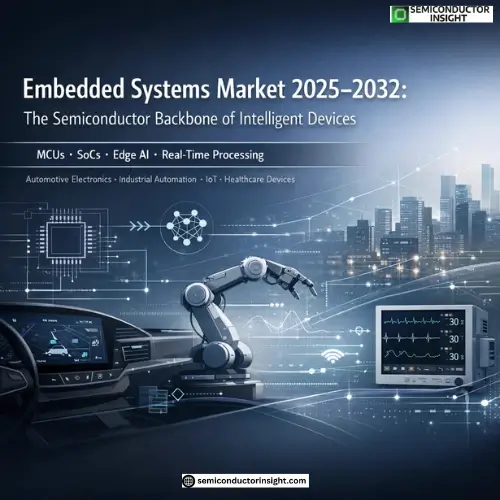
Embedded Systems Market Growth Strengthens Semiconductor Integration, Expands Intelligent Devices, and Drives Future Forecast
Embedded systems market represents the core of modern electronics, connecting hardware and software to perform dedicated functions within larger systems. What distinguishes this market today is its deep integration with semiconductor technology, enabling intelligent, real-time processing across diverse industries from automotive safety and industrial automation to telecommunications and healthcare devices. Embedded systems are no longer marginal components; they are the computational backbone of digital transformation and are essential to the deployment of smarter, more efficient systems in a globally connected world.
Embedded systems consist of dedicated microcontrollers, digital signal processors, sensors, and real-time operating software that work in concert to control specific functions. Their design emphasizes speed, reliability, and low power consumption, and adaptability, characteristics directly enabled by semiconductor innovation.
Semiconductor Components Powering Embedded Devices
At the heart of every embedded system lies semiconductor innovation. Embedded chips including microcontrollers (MCUs), system-on-chips (SoCs), field-programmable gate arrays (FPGAs), and application-specific integrated circuits (ASICs) deliver the processing capability that enables precise control and intelligent behaviour.
Trends in semiconductor design reflect a shift toward:
- Ultra-low-power MCUs to extend battery life in IoT devices
- High-performance embedded processors for real-time AI inference at the edge
- Integrated hardware accelerators for machine learning and computer vision tasks
Embedded processor shipments have seen year-on-year increases, particularly for designs featuring neural processing capabilities or advanced RISC-V architectures, driven by automotive, industrial automation, and smart device demand.
Application Diversification: Where Embedded Systems Matter Most
Embedded systems have grown far beyond traditional industrial controllers. Key application segments include:
- Automotive Electronics: Modern vehicles can contain more than 100 embedded systems supporting engine control units, driver-assistance architectures, infotainment systems, and safety monitors, with the automotive sector accounting for roughly 25% of global embedded demand.
- Industrial Automation and Industry 4.0: Embedded controllers facilitate real-time monitoring, robotics coordination, and machine synchronization, contributing to energy efficiency improvements approaching 40 % in monitored facilities.
- Consumer Electronics and IoT: Connected devices increasingly rely on custom embedded processors to deliver optimized user experiences, with uptake exceeding 80 % across smart devices worldwide.
- Healthcare and Medical Devices: Pacemakers, imaging systems, and wearable monitors depend on embedded modules to ensure precision and responsiveness in critical environments.
Embedded systems also play growing roles in telecommunication equipment, aerospace control modules, and smart infrastructure sensors illustrating the breadth of semiconductor-enabled deployments.
Edge Computing and Real-Time Intelligence Integration
One of the most significant market shifts is the intersection of embedded systems with edge computing and distributed intelligence. Rather than processing data centrally in cloud servers, many smart devices and applications now rely on local decision-making to reduce latency and bandwidth usage.
Semiconductor vendors are responding with embedded platforms that integrate AI accelerators, enabling tasks such as:
- Predictive maintenance in manufacturing
- Real-time video analytics in security systems
- Autonomous navigation in robotics and vehicles
Edge AI capabilities have grown rapidly, with over one-third of new embedded processors incorporating neural acceleration features, supporting advanced inference workloads without reliance on external compute resources.
To Stay Tuned with More meaningful and In-Depth Related Insights, Do Visit here:
https://semiconductorinsight.com/report/embedded-systems-market/
Regional Growth Patterns and Market Influence
The embedded systems market exhibits notable geographic dynamics. North America, backed by strong semiconductor design ecosystems and industrial adoption, holds a significant market share. Europe also commands substantial influence through automotive and industrial embedded innovation, while Asia-Pacific is emerging as the fastest-growing hub, driven by electronics manufacturing, IoT deployments, and automotive electrification.
Supply chain diversification and government investments such as initiatives to strengthen semiconductor manufacturing and embedded design talent are reshaping regional competitiveness and broadening market participation.
Security, Standards, and Resilience Challenges
As embedded systems become more connected, security emerges as a central concern. Many industrial embedded platforms still lack robust protection, with over two-thirds of surveyed systems showing insufficient security measures. As the number of connected endpoints multiplies, robust firmware integrity, cryptographic protections, and secure boot mechanisms are becoming prerequisites rather than options.
Standards compliance particularly in automotive safety (e.g., ISO 26262) and industrial control (IEC standards) also shapes design requirements and certification cycles, influencing time-to-market and development costs for semiconductor engineers.
Innovation Drivers and Emerging Technologies
The embedded systems market is rapidly incorporating next-generation semiconductor approaches:
- Open-standard architectures like RISC-V are gaining attention as flexible, cost-effective alternatives to proprietary instruction sets, with adoption momentum expected to grow significantly by 2027.
- AI and machine learning integration is enabling smarter decision engines within embedded frameworks, shifting the role of embedded systems from reactive controllers to proactive intelligent agents.
- Integration of heterogeneous computing elements, including GPUs and domain-specific accelerators, allows embedded platforms to tackle complex signal processing and real-time analytics in space-constrained environments.
This blend of hardware and software innovation reinforces embedded systems’ centrality in modern semiconductor strategy.
Amid global semiconductor expansion and shifting technology paradigms, embedded systems stand out as one of the most stable and strategically essential markets. By enabling real-time responsiveness, efficient power usage, and deep integration with cloud and edge architectures, embedded platforms are empowering industries to meet the performance, connectivity, and resilience demands of today and tomorrow.
As semiconductor manufacturers continue to innovate in both processing power and system integration, the embedded systems market will remain a critical fulcrum of intelligent device evolution and global technology advancement.

Comments (0)