
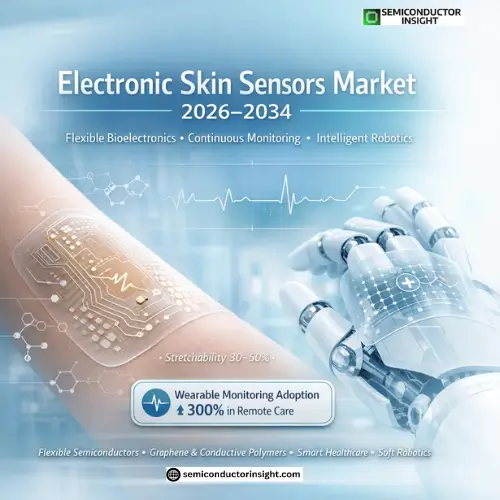
Electronic Skin Sensors Market Evolution Supports Next Generation Healthcare and Robotics Integration
Electronic Skin Sensors Market represents the development of ultra-thin, flexible sensing systems that replicate the sensing functions of human skin. These sensors detect pressure, temperature, strain, humidity, and biochemical signals and transmit data in real time. Built using flexible semiconductors, conductive polymers, and nanomaterial’s, electronic skin systems integrate seamlessly with wearable devices, medical monitoring platforms, and robotic systems.
Electronic skin technology functions as a bioelectronics interface, enabling continuous physiological monitoring and human-machine interaction. Healthcare adoption is increasing rapidly, with wearable monitoring solutions seeing usage increases of over 300% in remote patient monitoring applications in recent years, highlighting strong demand for skin-integrated sensing technologies.
Today, electronic skin sensors are emerging as a critical component of next-generation semiconductor devices, supporting flexible electronics, robotics, and smart healthcare ecosystems.
Why This Market Matters in the Semiconductor Ecosystem?
The importance of electronic skin sensors extends beyond wearable gadgets. The technology is reshaping how semiconductor devices interact with biological environments.
Modern semiconductor manufacturing is increasingly focusing on:
- Flexible integrated circuits for stretchable electronics
- Ultra-thin substrates below 50 microns thickness
- Low-power sensing chips for continuous monitoring
- Miniaturized sensor arrays with high signal precision
These developments are strengthening advanced packaging technologies and enabling new classes of smart sensing platforms.
Key industry impact areas include:
- Human-machine interfaces
- Medical diagnostics and rehabilitation devices
- Soft robotics and prosthetics
- Smart consumer electronics
- Defence and aerospace sensing platforms
To Know More about the Report, You Can Freely Browse Our Latest Updated Report:
https://semiconductorinsight.com/report/electronic-skin-sensors-market/
Material Science Revolution behind Electronic Skin
The electronic skin sensors market is deeply influenced by chemical and material innovation. Performance depends heavily on conductive materials capable of flexibility without signal loss.
Core Chemical and Material Components
Electronic skin systems typically use:
- Conductive polymers such as PEDOT:PSS for flexibility
- Graphene and carbon nanotubes for high electrical conductivity
- Silicone elastomers providing stretch ability
- Silver nanowires enabling stable signal transmission
- Hydrogel interfaces for skin compatibility
These materials allow sensors to stretch up to 30-50% without losing functionality, supporting long-term wearable applications.
The increasing use of biocompatible chemical coatings is also improving safety, durability, and signal accuracy in medical devices.
Healthcare Transformation through Continuous Monitoring
Healthcare represents the most influential application segment. Electronic skin sensors enable continuous tracking of physiological conditions without invasive procedures.
These devices monitor:
- Heart rate variability
- Hydration levels
- Muscle activity signals
- Body temperature fluctuations
- Sweat composition biomarkers
Wearable medical devices now represent a significant portion of digital healthcare adoption, with preventive healthcare driving nearly 60% of consumer wearable purchases.
The shift toward preventive healthcare is a major market driver, as electronic skin sensors provide real-time insights rather than periodic clinical measurements.
Hospitals are also integrating wearable monitoring with electronic health records, improving patient management efficiency and data accuracy.
Human-Machine Interaction and Robotics Integration
Electronic skin sensors extend far beyond healthcare, revolutionizing robotics and automation applications. Advanced robotic systems leverage this technology to detect pressure and texture, sense environmental changes, enhance object handling precision, and provide tactile feedback in prosthetics.
Modern designs replicate the layered structure of human skin with artificial sensory receptors that simultaneously measure pressure, friction, and strain. These advancements are reshaping industrial robotics, service robots, and rehabilitation technologies.
Emerging Semiconductor Architecture for Stretchable Electronics
Electronic skin sensors demand innovative semiconductor architectures that diverge from conventional rigid chip designs.
Key technology trends driving this innovation include stretchable transistor arrays, printed electronics manufacturing, self-healing materials for enhanced durability, ultra-low voltage sensing circuits, and wireless data transmission modules. These advancements enable next-generation devices that deliver continuous performance while prioritizing user comfort and reliability.
Electronic Skin Sensors Market represents a convergence of semiconductor innovation, chemical material science, and biomedical engineering. The technology enables seamless interaction between humans and digital systems while supporting predictive healthcare and advanced robotics.
With increasing demand for flexible electronics and real-time monitoring solutions, the industry is expected to play a central role in shaping next-generation semiconductor technologies and intelligent sensing platforms.

Comments (0)