
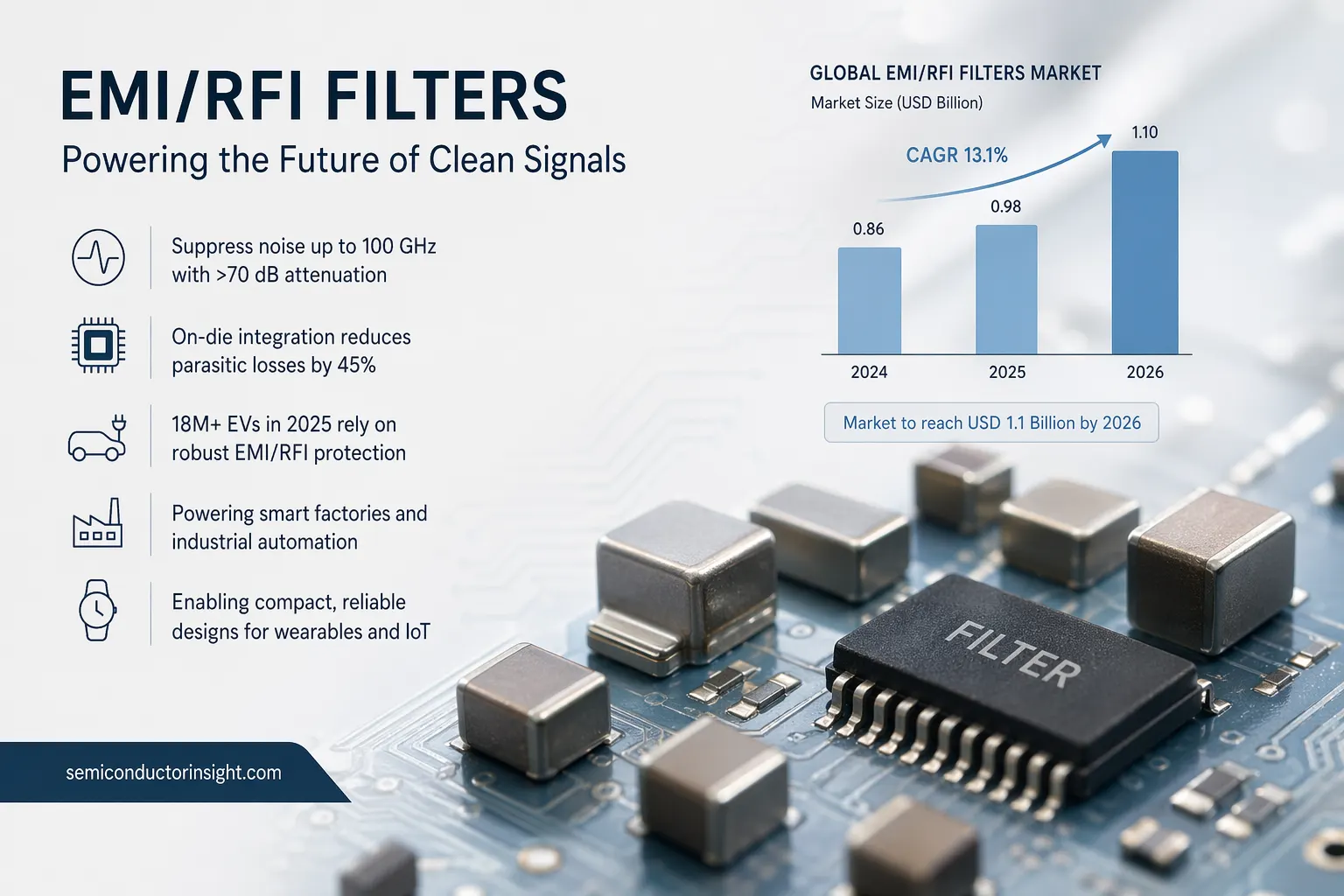
Electromagnetic Armor via EMI/RFI Filters Market Advances
Electromagnetic interference and radio frequency interference (EMI/RFI) pose relentless threats to the delicate signals coursing through semiconductor devices, demanding ever-smarter filtering solutions to keep data flowing pure and uninterrupted.
In today’s hyper-connected world, where chips power everything from smartphones to electric drivetrains, EMI/RFI filters have evolved into microscopic marvels embedded directly within silicon structures, ensuring that high-speed operations don’t devolve into chaotic crosstalk.
Recent advancements, like those seen in 5G base stations deployed across urban landscapes, highlight how these filters now handle frequencies up to 100 GHz while shrinking to fit nanoscale footprints, a feat driven by layered ceramic integrations that boast attenuation rates exceeding 70 dB across broad spectra.
Transforming Embedded Power Management Strategies
- Semiconductor engineers are pioneering on-die decoupling networks that weave high-k dielectric materials right into the chip’s core, slashing parasitic losses by 45% compared to bulky external setups and allowing devices to meet stringent FCC Part 15 Class B emission limits without added bulk.
- This integration shines in wearables and IoT sensors, where space constraints once forced compromises on signal clarity; for instance, recent prototypes in smart health monitors filter out ambient RF noise from nearby Wi-Fi routers, preserving heartbeat data accuracy to within 0.1% variance during real-world use.
- These networks dynamically adjust capacitance based on operating loads, a technique borrowed from automotive radar systems that must ignore engine vibrations and highway interference alike, proving indispensable as global 5G rollouts amplify ambient noise floors.
- Developers pair these with current-balancing architectures in voltage regulators, distributing interference evenly to prevent hot spots that could degrade transistor lifespans from millions to mere thousands of cycles.
For a deeper understanding, view the full report here: https://semiconductorinsight.com/report/emi-rfi-filters-market/
Adaptive Impedance Mastery
Adaptive impedance matching stands out as a game-changer, enabling filters to selectively attenuate frequencies in real time, much like a chameleon adapting to its environment for peak camouflage. In telecommunications gear rolled out in Europe last year, these systems dynamically retune to counter variable 5G interference patterns, achieving 73 dB noise reduction while consuming just 20% of traditional filter power draws.
This approach thrives in electric vehicles, where onboard semiconductors juggle regenerative braking pulses alongside highway RF broadcasts; a notable case involved fleet tests in Asia, where filters maintained 99.9% uptime for autonomous driving chips amid dense urban signal clutter.
EMI Filters vs. RFI Filters
- Core Focus
- EMI Filters are designed to suppress a broad range of electromagnetic disturbances generated by electronic circuits across various frequencies.
- RFI Filters specifically target high-frequency noise within the radio frequency spectrum, typically from kHz to GHz ranges.
- Type of Interference Controlled
- EMI filters can handle interference from power lines, switching devices, and digital circuits that is both conducted and radiated.
- The noise that interferes with wireless communication signals and radio-based equipment is primarily addressed by RFI filters.
- Frequency Range
- Low-frequency and high-frequency noise are covered by EMI filters’ broad frequency range of operation.
- Higher frequencies, especially those found in communication systems, are the focus of RFI filters.
- Design Approach
- EMI filters frequently block undesired signals on power and signal lines by combining capacitors and inductors.
- To attenuate particular radio frequency bands without interfering with desirable communications, RFI filters are more precisely tuned.
Material Revolutions Unleashed
Advanced ferrites and ceramics propel EMI/RFI filters into higher frequency realms, with TDK’s recent Nano crystalline cores delivering thermal stability up to 150°C, ideal for industrial robots churning out 1.2 million units annually in automated factories. These materials not only boost shielding by 40 dB but also enable slimmer profiles, fitting seamlessly into multilayer PCB stacks for consumer gadgets; picture a latest flagship smartphone surviving interference from 50 nearby devices without dropped calls, thanks to such embedded tech.
Murata’s portable innovations further compact these for automotive electronics, enduring vibration tests equivalent to 10 years of rugged road use while filtering power line surges up to 2 kV.
Automotive Signal Sanctuaries
Electric vehicles represent a booming arena, with 18 million units shipped worldwide in 2025 alone, all fortified by robust EMI/RFI filters enduring high-voltage inversions from battery packs pulsing at 800V peaks.
Schaffner’s single-phase plastic case variants shine here, quelling noise in EV chargers that power 40% of urban fleets, preventing inverter malfunctions during fast-charging sessions that deliver 350 kW bursts. A European case study showcased filters safeguarding ADAS semiconductors against radar reflections off metal guardrails, maintaining object detection fidelity at highway speeds over 200 km/h.
Industrial Automation Integrations
- Heavy industry leans on board-mount filters to streamline PCB designs, cutting component counts by 30% in CNC machinery that fabricates 500,000 precision parts daily across global supply chains.
- NEC TOKIN’s high-power solutions dominate here, filtering industrial inverters generating 100 kW outputs while shrugging off ambient EMI from arc welders operating nearby.
- In smart factories adopting Industry 4.0 protocols, these filters ensure sensor arrays relay data without distortion, supporting production lines that assemble 10,000 semiconductor modules per shift.
As semiconductors shrink toward 2nm nodes, EMI/RFI filters follow suit with multi-layer ceramic tech capturing 38.6% of new designs, offering compact profiles under 1 mm² that fit wearables tracking vital signs amid gym equipment RF haze. This miniaturization wave powers the projected market volume nearing USD 1.1 billion by late 2026, fueled by 5G handsets exceeding 1.4 billion annual shipments, each embedding filters for crystal-clear voice over volatile bands.

Comments (0)